 EN
EN
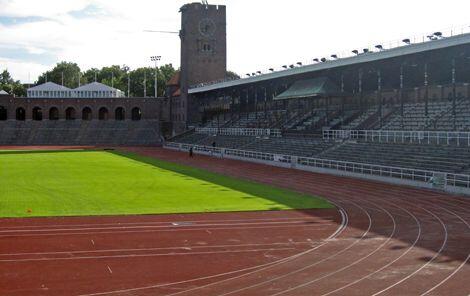
The start takes place in the Stadium that held the 1912 Olympics; a stadium that has maintained its stature over the last 100 years - Stockholm: 14 July: Jubilee Marathon 1912 – 2012 - Take a trip down the course ©ASICS Stockholm Marathon Organisation
Stockholm: 14 July: Jubilee Marathon 1912 – 2012 – Take a trip down the course
The Jubilee Marathon Stockholm 1912–2012 follows as closely as possible the course from the Olympic marathon of 1912. Along the course are a series of activities recreating the spirit of 1912. Read on and take a tour of the course from Stockholm’s Olympic Stadium, to the turning point in the suburb of Sollentuna and then back.
 The Musketeers of the Swedish Royal Lifeguards Regiment, in century-old uniforms shooting the starting gun with gunpowder and paper cartridges. |
The start takes place in the Stadium that held the 1912 Olympics; a stadium that has maintained its stature over the last 100 years. The creation was inspired by the medieval ring walls of Visby on the Swedish island of Gotland and officially opened just a couple of weeks before the Olympic marathon.
The Stockholm Olympic Stadium is one of the world’s most celebrated athletics arenas with no less than 83 world records being set here, more than any other arena on the planet.
Runners of the Jubilee Marathon will experience three-quarters of a lap of the track before making their way down Stockholm’s longest street Valhallavägen and running by the Sophiahemmet hospital; a building 20 years older than the stadium itself.
The Musketeers of the Swedish Royal Lifeguards Regiment, in century-old uniforms shooting the starting gun with gunpowder and paper cartridges.
It won’t take long before it’s time to take a right by Östra Station, and then past Sweden’s first polytechnic, the Royal Institute of Technology. From there the course winds its way down Drottning Kristinas Väg following one of the main commuter train lines into the city over to Stockholm’s oldest group of botanical allotments at Söderbrunn. At this point, the two kilometer point has been reached and the first of 21 water stations.
Just another kilometer down the road is Stockholm University. Get ready for some early 20th century music at the underground station a little further up the road.
Another water station awaits the runners here and supporters can stay hydrated at the nearby café.
 The course runs by Stockhlms oldest botanical allotments at Söderbrunn. |
The impressive National History Museum appears just before the four kilometre mark. Only the first part of this building was ready when the Olympic marathoners ran by in 1912. Today, it’s a hive of activity particularly for young families.
The marathon course now arrives in the city of Solna and turns off to the nearby area of "Bergshamra". Just a couple of generations ago, there were cows grazing here and people bought milk directly from the local farmer but in the 1980’s the barn was torn down as the area was developed for residential accommodation. But a replica building of the old farmyard has been re-constructed.
After the sixth kilometer the city of Solna is arranging a party for spectators with various stage acts, food and drinks and even a bouncy castle among other activities, right along the marathon course.
At this point the course cross the busy street "Bergshamraleden" and runs towards the old palace at "Ulriksdal", situated a couple of hundred metres north of the course.Here the Swedish queen Sofia lived in 1912. She passed away the year after.
On the left-hand side of the course is "Väntorp", It translates literally into English as ‘Friends Cottage’ which is somewhat appropriate as it was the place where the Swedish King Karl XV housed one of his mistresses, the actress Johanna Styrell, way back in 1866.
 "Nacka Hembygdsgille" is one of the groups that will provide entertainment along the course. |
After seven kilometers, the course runs for a short while alongside the E4 motorway bypassing "Järva Krog", an area with medieval roots. This was once a popular resting point for travellers on their way to Stockholm.
 On the vintage cars that will seen along the course. |
At the 10km mark, the runners arrive in "Sörentorp", once a home for the local day-hands that worked at Ulriksdal castle. The military took over here during the Second World War and in 1970 it became the home of Sweden’s police training college. Watch out for police dressed up in uniforms from 1912 as they keep order on the course.
At this point we arrive within the suburb of "Sollentuna" where at least half of the course will be run. At the end of the 19th Century, "Sollentuna" was a rural area and the majoritiy of its 1,150 residents made their living from forestry or farming. It’s fair to assume that today’s 66,000 residents occupy themselves with a broader range of professions.
We then run through "Silverdal" and its centuries-old oak trees; an area that apparently got its name when the 17th Century Swedish Queen Kristina’s horse lost a silver shoe whilst riding through the area. In recent years, "Silverdal" has witnessed a lot of new construction, residential and commercial in the last years.
After 10.5 kilometres is the picturesque and popular café "Lillstugan". Spectators dressed in 1912 attire are allowed to eat here at 1912 prices. Coffee and a bun will cost the princely sum of one Swedish crown (about 14 US cents).
Traces of the early 20th Century will be on show, vintage cars as well as music in the form of Lazy Farm Hand Texas swing.
 "Lillstugan" café, just after the 10km mark. |
Five hundred metres further down the road is the first refreshment station 1912 style. Water, iced-tea, coffee as well as orange and lemon wedges will be available to the runners, exactly as it was 100 years earlier. There will also be the option of a mug of Maxim sports drink.
Music, commentators and a number of race marshals dressed in 1912 attire will be cheering on the runners here.
We carry on northwards and follow the 1912 course exactly where a series of activities will take place along the course. Sollentuna’s town centre appears just after the 14km mark. While the town center is being completely re-built, it’s still exactly on the 1912 course that carries on following the train tracks to Sollentuna train station.
The local authorities in Sollentuna will be doing all they can to make this a great spectator spot. Fashion parades 1912 style, musical entertainment, 100-year-old cars and motorcycles as well as food and drink will be on offer here. There’ll even be a special Jubilee cake that spectators can get their teeth into.
At 15km, runners pass a roundabout celebrating the former Swedish high-jump world champion Kajsa Bergqvist. The roundabout is just a couple of hundred metres from Bergqvists home training grounds, "Sollentunavallen".
 The turning point is in front of the Sollentuna Church. |
Next up is the inn "Edsbacka Wärdshus", established in 1626 but shut down in 1872 due to excessive drinking. In 1912, these were official residences. Today’s, it’s a well-liked restaurant.
Here is the second refreshment station, 1912 style. The Harmony Bells choir will be singing this time round and this is also another opportunity to avail of coffee and snacks at 1912 prices but only if you’ve got the clothing to match.
After 18 kilometers runners make their way under the railway and reach the residential area of "Norrviken".
 The seven metres high memorial will be the turning point for the Jubilee Marathon. |
After 20km, runners finally reach the church at Sollentuna; a building dating back to the 12th Century.
After the 1912 Games there were discussions about erecting some form of memorial to the Olympic Games, and it was decided to install a memorial stone at the turning point on the marathon course.
The memorial stone memorial stone has been moved for the Jubilee Marathon to a spot just in front of the church and will be used as the official turning point on 14 July.
Sollentuna Church has prepared to greet the athletes with music, commentators, vintage cars and hopefully a large public audience. There will also be a café here for spectators.
After the turning point, the course takes the same route back reaching Stockholm’s Olympic Stadium after 40km of running.
For those who want to complete the exact same distance as 1912, 40,075m, a right turn will be required while those who want to complete the distance of the modern marathon, 42,195m, a left will be needed and the runners will run an extra loop on the street "Fiskartorpsvägen" and back again.
ASICS Stockholm Marathon Organisation
