 EN
EN
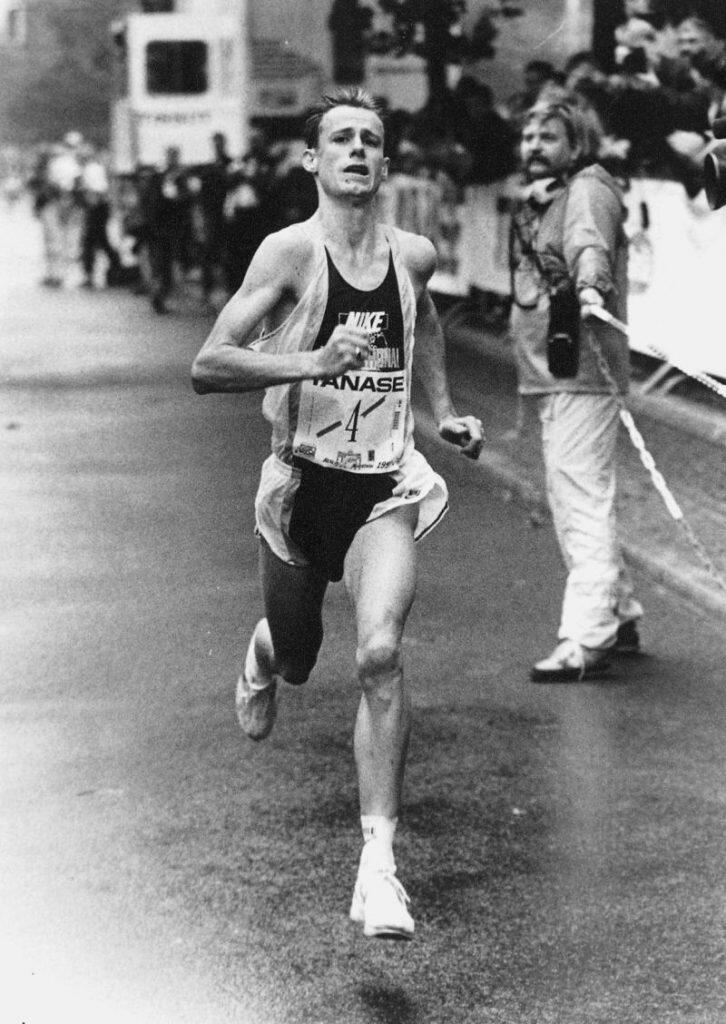
Steve Moneghetti 1990 in Berlin ©Sportmuseum Berlin - MARATHONEUM
Steve Moneghetti (AUS) and Uta Pippig (GER) – the winners of 1990 at the 44th BERLIN MARATHON 2017 – “Mona” Returns: 27 Years On
Steve Moneghetti (AUS) and Uta Pippig (GER)- the winners of the legendary and historic 17th BERLIN MARATHON on September 30, 1990 – three days before the reunion of West and East Germany – are honored guests of the BERLIN MARATHON on September 24th 2017th
Both have a "tight" program to complete in the days before. It starts on Wednesday. 20 September 2017:
Uta Pippig and Steve Moneghetti will open the BMW BERLIN MARATHON Hall of Fame at the Brandenburg Gate this year, which from now on will honour former champions every year. Both will be attending the grand opening on Wednesday. Both will visit the opening on Wednesday 20 September and open the premiere of the "Hall of Fame" at 12.00 pm.
Where: on the boulevard Strasse des 17. Juni / Ebertstrasse (in front of the Brandenburg Gate)
Opening hours:
| Wed | noon – 9 pm |
| Thursday/Friday | 10 am – 9 pm |
| Saturday | 10 am – 9 pm |
| Sunday | 8 am – 6 pm |
The program for MONA and UTA: MONA comes with the running tour organizer "RunFun Travel" by Fran Seton and Dave Cundy and about 40 Australian runners to Berlin.
On Thursday, the Australian runners will meet in a hotel for a nostalgic dinner with the organizers of the race 1990 with Horst Milde, Christoph Kopp, Rotraud Zylka, Renate Marin, and others at 6 pm. (which can be funny).
On Friday the Marathon get-together of the Berlin-Marathon in the evening belongs to the official program for both.
On Saturday MONA will start the breakfast run at Charlottenburg Palace.
On Sunday MONA will run the 44th BERLIN-MARATHON 2017.
Sunday: After the participation in the Berlin Marathon, the Australian team "hang" with Dave Cundy and Fran Seton in the Jazzlokal "Schlot" by marathon runner John Kunkeler "off"!
Little review of the 17th BERLIN-MARATHON on 30 September 1990 (Excerpt from the anniversary brochure "30 years BERLIN-MARATHON 1974 – 2003"
"The fall of the Wall was equal with the rise of the BERLIN-MARATHON into the elite class of international road running.
Just one day after the turn of the century, on November 10, 1989, Horst Milde was called by phone. Michael Coleman, sports editor at the Times of London spoke to him.
"The BERLIN-MARATHON will be the race of the year – but it must lead through the Brandenburg Gate."The organizer Sport Club Charlottenburg hosted only two days later
his traditional cross-country race at the Teufelsberg – and the first runners from the GDR were already taking part in the race. From then on the organizers worked hard
at the realization of her dream: The marathon through the Brandenburg Gate.
The first race through the gate, however, was almost nine months before the BERLIN-MARATHON – and it was a one-time event. On 1 January 1990, the SCC held a New Year's race. The route led to the side of the Brandenburger Tor through the cracked wall and with a dangling back then but through the gate, over 20,000 runners took part, and the GDR national soldiers clapped under the eyes of the the President of the International Athletics Federation (IAAF), Primo Nebiolo, applause.
On September 30, 1990, a dream came true for many runners in East and West.
The route of the BERLIN-MARATHON 1990 led 16 years after the premiere of the race through the Brandenburg Gate and thus through the both parts of the former divided city. Three days before German reunification (october 1, 1990), the sporting association of East and West took place on the streets of the future capital.
After all bureaucratic obstacles had been taken – the organizers also had to negotiate with the East Berlin magistrate – it quickly became clear that the BERLIN MARATHON was on its way to unlocking its models of New York and London.
“Mona” Returns: 27 Years On – BY DAVE CUNDY | RUNFUN TRAVEL
In the late 1980s, Steve Moneghetti was one of the leading marathon runners in the world, but he didn’t have a win on the board. His focus was international championships: bronze in his debut at the 1986 Commonwealth Games, fourth at the 1987 World Championships, fifth at the 1988 Olympic Games and silver at the 1990 Commonwealth Games.
In those four years, his only “big city” marathon was London in 1989, where he was outsprinted by his Kenyan nemesis, Douglas Wakiihuri. “Mona” came up just three seconds shy of the then world champion as they raced to the finish on Westminster Bridge.
Following the Auckland Commonwealth Games in 1990, where he was again second to
Wakiihuri, Mona and coach Chris Wardlaw sought a suitable big-city race to target both an international win and a fast time.
The pair opted for the Berlin Marathon, not then recognised as the world’s fastest marathon but historically significant as the first edition of the race to be run following
the fall of the Berlin Wall. Wardlaw recalls the process that led to this
decision. “[There were] a few reasons,” he explains.
“It was a big, important first race in unified Berlin; [there was] input from Mona’s sponsor, Nike; a fast course was pretty much guaranteed; plus there was a good field and pace. And there were twin races in the package, as Mona also ran the Great North Run two weeks prior to Berlin. Of course, this was all planned many months in advance.”
The rest is history. First, Mona finally beat Wakiihuri for his first international victory
at the Great North Run, recording a world best time of 1hr 0min 34sec – the fastest half
marathon run to that date. Then, in Berlin, he not only won but was also the first runner to break 2hr 10min in the city. His time of 2:08:16 was the fastest in the world in 1990 and helped pave the way for Berlin to become the perennial world record breaking race over the following 27 years.
Horst Milde, the race director, recalls the significance of the occasion. “The 17th Berlin Marathon was an athletic international sensation – three days prior to German unification,” he says. “East and West Berlin had been divided for 28 years, and that year’s race was the first time a marathon could lead through both parts of the city again …
Horst Milde
Please read more in the following pdf:
