 EN
EN
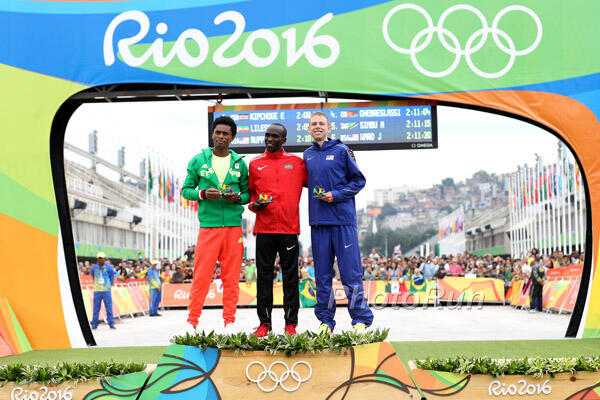
Kipchoge-Lilesa-Rupp ©Victah Sailer
Rio de Janeiro Olympics Athletics Day Ten Japanese Results – by Brett Larner – Japan Running News
No real surprises in the men's marathon to wrap up the Rio de Janeiro Olympics. Berlin and London Marathon winner Eliud Kipchoge (Kenya) for gold, Tokyo Marathon winner Feyisa Lilesa (Ethiopia) for silver, Galen Rupp (U.S.A.) stepping up for a medal in bronze, world champion Ghirmay Ghebreslassie (Eritrea) just missing the podium, DNFs for Kenyan and Ethiopian B-men Stanley Biwott and Tesfaye Abera, and irrelevant performances from the Japanese men.
The Japanese men finished in PB order, Satoru Sasaki and Suehiro Ishikawa hanging on to the pack for a while until fading to 16th and 36th, Hisanori Kitajima never in it and finishing 94th in 2:25:11.
Four men born outside Africa qualified for Rio with sub-2:10 times. The Japanese men were three of them. Sasaki was the only non-African-born athlete to have qualified sub-2:09. This was a good team, one of the best in the field. And yet, they were irrelevant, again. Hats off to the less accomplished athletes like Alphonce Felix Simbu (Tanzania), Jared Ward (U.S.A.), Callum Hawkins (Great Britain) and Eric Gillis (Canada) who made the top ten.
Sasaki's 2:13:57 for 16th, the 9th-fastest ever by a Japanese man at the Olympics, was exactly in line with most of the rest of Japanese long distance in Rio, a mid-to-high-teens placing and a time just inside the ten fastest-ever Japanese times at the Olympics:
- men's marathon: 16. Satoru Sasaki, 2:13:57 – JPN Olympic #9
- women's marathon: 14. Kayoko Fukushi, 2:29:53 – JPN Olympic #8
- women's 10000 m: 18. Yuka Takashima, 31:36.44 – JPN Olympic #8
- women's 5000 m: 15. Miyuki Uehara, 15:23.41 (h) – JPN Olympic #8
- men's 3000 mSC: 11(h). Kazuya Shiojiri, 8:40.98 – JPN Olympic #7
U.S.-based Suguru Osako, part of the Alberto Salazar-led Nike Oregon Project alongside Rupp and Rio gold medalists Matt Centrowitz (U.S.A.) and Mo Farah (Great Britain), deserves credit for beating that curve somewhat, his 13:31.45 the second-fastest 5000 m time ever by a Japanese athlete at the Olympics and his 27:51.94 the third-fastest 10000 m, but even those landed him only 16th in his 5000 m heat and 17th in the 10000 m. Except for his 10000 m and Uehara's surprising 5000 m performance, none of them made the Japanese Olympic top ten for placing,
So pretty well across the board in Rio, the Japanese spectrum ranged from Sasaki and the other top Japanese athletes running OK times nowhere near what they needed to be competitive and downwards from there. These are good athletes. Especially given the strength of the men's marathon team, how could this be? Brainstorming possible reasons of varying plausibility:
- The JAAF and coaches are setting the wrong goals.
- The JAAF and coaches are instilling the wrong mentality.
- The JAAF and coaches are stuck in the past.
- The JAAF and coaches don't know how to cultivate their best talent.
- Their coaches don't know how to peak them for an international championships.
- They are overtraining for the Olympics (subset of the above).
- They don't know how to compete internationally.
- They don't have competitive psychology or can't handle stress.
- They don't care about medalling or running seriously.
- They have other reasons for being at the Olympics.
- Their PBs from domestic races are not what they seem.
- There are problems with the selection system.
- Add your theory here.
Exploring those would be another article or two, or three. Maybe later this week. But whatever the reasons, the consistent level of Japanese distance performances shows exactly where its bar is being set. Overall Rio was Japan's best-ever Olympics, 6th overall in the medal count with 12 gold, 8 silver and 21 bronze, medals and podium near-misses coming in a range of sports and events including many outside Japan's traditional strengths. That's great news with the Tokyo Olympics on the horizon, but the men's 4×100 m silver medal aside, the contrast between most of the rest of the Japanese Olympic team and its athletics squad couldn't have been starker. It's clearly not the case that the Japanese athletes aren't good enough, but it's equally clear that they're not getting what they need to be their best when it counts most. Other sports have cleaned house and represented Japan in a way that made the country proud. It's time for athletics to do the same.
Rio de Janeiro Olympics
Aug. 21, 2016
click here for complete results
Men's Marathon
1. Eliud Kipchoge (Kenya) – 2:08:44
2. Feyisa Lilesa (Ethiopia) – 2:09:54
3. Galen Rupp (U.S.A.) – 2:10:05
4. Ghirmay Ghebreslassie (Eritrea) – 2:11:04
5. Alphonce Felix Simbu (Tanzania) – 2:11:15
6. Jared Ward (U.S.A.) – 2:11:30
7. Tadesse Abraham (Switzerland) – 2:11:42
8. Munyo Solomon Mutai (Uganda) – 2:11:49
9. Callum Hawkins (Great Britain) – 2:11:52
10. Eric Gillis (Canada) – 2:12:29
—–
16. Satoru Sasaki (Japan) – 2:13:57
36. Suehiro Ishikawa (Japan) – 2:17:08
94. Hisanori Kitajima (Japan) – 2:25:11
Rio de Janeiro Olympics Athletics Day Nine Japanese Results
by Brett Larner
Men's javelin throw national champion Ryohei Arai (Suzuki Hamamatsu AC) was the lone Japanese athlete in action on the last evening of Olympic athletics action. Despite a throw of 84.16 m in the qualification round that put him at 4th going into the final, Arai choked under the pressure. Opening with a throw of only 77.98 m, he followed with two more throws under 80 m before being cut and ultimately finished 11th of 12. In a TV interview afterward he could do little more than sob and apologize to everyone who supported him. His underperformance means that two Japanese men must make the top eight in the marathon for the Japanese athletics squad to meet the JAAF's total targeted number of medal and top eight placings, a tall order.
Rio de Janeiro Olympics
Aug. 20, 2016
click here for complete results
Men's Javelin Throw Final
1. Thomas Rohler (Germany) – 90.30
2. Julius Yego (Kenya) – 88.24
3. Keshorn Walcott (Trinidad and Tobago) – 85.38
—–
11. Ryohei Arai (Japan) – 79.47
Rio de Janeiro Olympics Athletics Day Eight Japanese Performances
by Brett Larner
Empty-handed so far despite strong showings by the rest of the Japanese Olympic team, the eighth day of athletics at the Rio de Janeiro Olympics finally brought Japan two medals, one controversial, one beautiful.
In the men's 50 km race walk, Koichiro Morioka was out of the front-end action early, while Takayuki Tanii and Hirooki Arai were part of a nine-man chase group behind breakaway leader Yohann Diniz of France. Tanii fell off the pace, but Arai stayed up front as the pack dwindled, then overtook Diniz. In 3rd behind Beijing World Championships gold medalist Matej Toth (Slovakia) and London Olympics gold medalist Jared Tallent (Australia) in the final stages of the race, Arai was caught by Canada's Evan Dunfee. With 1 km to go, Arai made a move to retake Dunfee. As he passed he bumped Dunfee hard; Dunfee seemed to lose his balance, then a few seconds later appeared to cramp up. Arai pulled away for bronze by 14 seconds, Dunfree coming through in a national record 3:41:38 for 4th. But it wasn't over yet.
Canada was quick to file a protest over Arai's contact. Arai was disqualified and Dunfee elevated to bronze. Japan appealed the decision, and it was duly overturned to put Arai back onto the podium. Dunfee had the option to appeal to the CAS, but instead he issued a very respectable statement in which he said he felt that the decision was correct, that contact happens, and that he could never be proud of getting a medal that way. "I will never allow myself to be defined by the accolades I receive, rather the integrity I carry through life," he wrote in a statement that is recommend reading for anyone who hasn't yet.
In an Olympics in which appeals and protests have played a major role in overturning the outcome of races it was refreshing to see someone put their personal honor and integrity before a medal-at-all-costs attitude. And a Canadian to boot. The JAAF has targeted one medal in Rio, but a bronze in what is probably athletics' most fringe event won under a small cloud wasn't really something that could have satisfied expectations. A few hours later came redemption.
After a brilliant heat that saw then come to the final ranked 2nd just 0.03 behind the U.S.A., Japan's men's 4×100 m ran to almost near perfection in the final, leading at the final exchange and outrunning both the U.S.A. and Canada to take silver behind Jamaica in an Asian record 37.60. Ryota Yamagata started them off strong, slightly sloppy on the exchange to Shota Iizuka but nothing fatal. Iizuka and Yoshihide Kiryu doing their work, the team's well-practiced underhand exchanges a technical advantage that gave them the edge they needed.
Anchor Asuka Cambridge getting a glance from Jamaican great Usain Bolt as they ran side-by-side in Bolt's final Olympic race. Cambridge holding off next-generation stars Andre de Grasse (Canada) and Trayvon Bromell (U.S.A.) to cross the line 2nd, straight up legit silver unaffected by the U.S.' subsequent disqualification. Silver, behind the greatest of all time, in one of the Olympics' marquee events. The third-fastest country ever. No sub-10 runners, no sub-20 runners, no runners with doping suspensions on their record. A true team, youth on their side, staring into a Boltless future with a home-soil Olympics on the horizon. Cambridge post-race: "In four years we'll try to bring home a better medal!"
Missing multi-year national champion Yuzo Kanemaru, the men's 4×400 m relay team, already lucky to have made the Olympics, didn't have the same luck, finishing 7th in its qualifying heat. Women's 20 km race walker Kumiko Okada likewise couldn't match Arai's medal, finishing 16th in 1:32:42.
The day's other Japanese athlete in action, Miyuki Uehara, finished 15th in the women's 5000 m in 15:34.97. Having turned heads by frontrunning her heat to become only the second Japanese woman to ever make an Olympic 5000 m final, Uehara tried the same approach but found the bar set several meters higher. Dropping back as soon as 10000 m gold medalist Almaz Ayana (Ethiopia) made a move, Uehara struggled to maintain pace. Her final time was 11 seconds slower than in her qualifying heat, but ranked last among the 17 starters on PB her 15th-place finish was a small triumph for someone totally unexpected to make the final. With only the men's marathon yet to come for Japan she remains its top long distance performer of the Rio de Janeiro Olympics.
Rio de Janeiro Olympics
Aug. 19, 2016
click here for complete results
Women's 5000 m Final
1. Vivian Jepkemoi Cheruiyot (Kenya) – 14:26.17 – OR
2. Hellen Onsando Obiri (Kenya) – 14:29.77
3. Almaz Ayana (Ethiopia) – 14:33.59
4. Mercy Cherono (Kenya) – 14:42.89
5. Senbere Teferi (Ethiopia) – 14:43.75
—–
15. Miyuki Uehara (Japan) – 15:34.97
Men's 4×100 m Final
1. Jamaica – 37.27
2. Japan – 37.60 – AR
3. Canada – 37.64 – NR
Women's 20 km Race Walk Final
1. Hong Liu (China) – 1:28:35
2. Maria Guadalupe Gonzalez (Mexico) – 1:28:37
3. Xiuzhi Lu (China) – 1:28:42
—–
16. Kumiko Okada (Japan) – 1:32:42
Men's 50 km Race Walk Final
1. Matej Toth (Slovakia) – 3:40:58
2. Jared Tallent (Australia) – 3:41:16
3. Hirooki Arai (Japan) – 3:41:24
—–
4. Evan Dunfee (Canada) – 3:41:38 – NR
14. Takayuki Tanii (Japan) – 3:51:00
27. Koichiro Morioka (Japan) – 3:58:59
Men's 4×400 m Relay Heat 1
1. Jamaica – 2:58.29 – Q
2. U.S.A. – 2:58.38 – Q
3. Botswana – 2:59.35 – Q, NR
—–
7. Japan – 3:02.95
© 2016 Brett Larner
all rights reserved
by Brett Larner – Japan Running News
