 EN

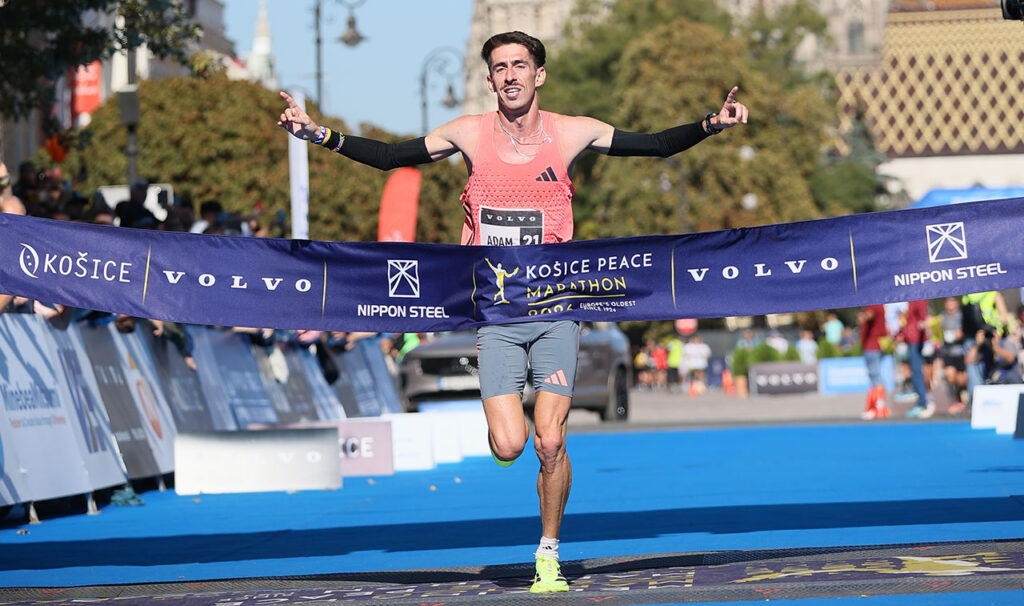
Sieger in Kosice 2026 - Adam Nathan Lipschitz (South Africa) - Foto: Veranstalter
A Marathon That Connects Generations and Cities – The Košice Peace Marathon entered its 103rd edition 2026
The Košice Peace Marathon entered its 103rd edition with record interest from runners.
Ahead of the event, the organisers recorded 19,283 registered participants from 74 countries across the various disciplines. Women accounted for 37.4 per cent of all entries. Europe’s oldest marathon once again demonstrated that its appeal rests on a combination of sporting excellence, historical continuity and a welcome extended to runners of all abilities.
Marathon weekend transformed Košice into a place of encounters, movement and shared experiences. The racing programme was complemented by a vibrant Expo, social runs, the Family Run and musical performances along the course.
Men:
1. Adam Nathan Lipschitz / RSA / 2:07:21
2. Abednego Cheruiyot / KEN / 2:07:53
3. Moses Kipngetich Kemei / KEN / 2:08:04
Women:
1. Aberash Fayesa Robi / ETH / 2:21:54
2. Nurit Ahmed Samiro / ETH / 2:25:03
3. Tecla Jelimo Kibet / KEN / 2:29:56
For thousands of participants, the highlight was the start on Sunday, 4 October. For the organisers and the entire city, the day marked the culmination of a year’s work involving approximately 1,500 specialists and volunteers.
The men’s race brought victory for South Africa’s Adam Nathan Lipschitz. He already knew the Košice course from previous appearances as a pacemaker, but this time he came to compete for the title. The seven-man lead group stayed together until the 35-kilometre mark, when Lipschitz, defending champion Moses Kemei and Abednego Cheruiyot emerged as the leading trio. The decisive move came at around 37 kilometres. Lipschitz broke away from his rivals and maintained his advantage to the finish.
He won in 2:07:22, substantially improving his personal best. Cheruiyot finished second in 2:07:53, followed by Kemei in 2:08:04. Lipschitz’s performance was just 35 seconds short of the course record set here by Kemei the previous year.
In the women’s race, Ethiopia’s Aberash Robi confirmed her quality. The early pace suggested a challenge to the course record, but rising temperatures gradually began to affect the race. From 34 kilometres onwards, the eventual winner ran clear of her female rivals, accompanied by pacemakers. Her time of 2:21:55 was the third-fastest women’s performance in the event’s history. Her compatriot Nurit Samiro took second place in 2:25:04, while Kenya’s Tecla Jelimo finished third in 2:29:57.
Today, the Košice Marathon also offers places where its stories continue long after the final participant has crossed the finish line. MarathonPoint at Hlavná 57, opened in May 2025, combines a permanent historical exhibition with a community and cultural space. Visitors can explore the marathon through original documents, photographs and objects, as well as the digital MarathonPedia. A café, discussions and other events bring the space to life every day.
It is particularly interesting that Berlin and Košice are home to two of the few dedicated marathon museums.
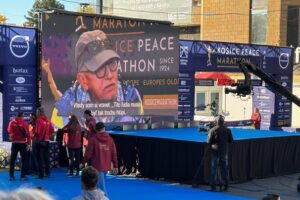
Horst Milde (BERLIN-MARATHON) on the screen during the start procedere in Kosice – Photo: Sabine Milde
The year 2026 also marks a significant anniversary in the relationship between Košice and German running. On 28 October, exactly one hundred years will have passed since Paul Hempel’s victory in what is now Europe’s oldest marathon. The German runner won here in 1926 in 2:57:02 and claimed a second victory in 1929. He represented the Berlin club SC Charlottenburg, which still exists today and holds a special place in the history of road running. Hempel’s victory in Košice thus represents a remarkable historical connection between two cities that today rank among the major centres of world marathon running.
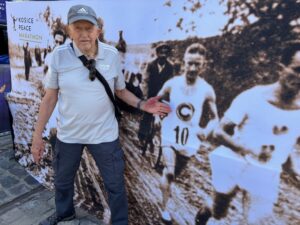
Paul Hempel with the big black “C” on his chest (m) and Horst Milde (l.) – founder of the BERLIN-MARATHON – Photo: Sabine Milde
A century of history also takes tangible shape in the stories of runners who return to the same course for decades. The most powerful such moment in Košice this year was the finish of Peter Polák, the first person to complete fifty Košice Peace Marathons. The 77-year-old runner crossed the finish line in 6:12:52, greeted by applause and a group of his supporters.
Polák ran his first Košice Marathon in 1974. On the same course, he achieved his personal best of 2:25:20 in 1980. His journey from that first appearance to his milestone finish in 2026 spans more than half a century of training, returning and persevering. His fifty finishes therefore speak of a relationship with running far deeper than any finishing time alone can express.
Just one week before Polák, Wilfried Köhnke reached a similar milestone in Berlin. The 78-year-old German completed his fiftieth Berlin Marathon on 27 September in 4:39:39. For Köhnke, his home marathon has a special significance: it is part of his life in the city and has given him a reason to keep running regularly for decades.
Peter Polák and Wilfried Köhnke reached their milestones on different courses, but they share the same enduring loyalty. For them, Košice and Berlin are places of repeated returns, encounters and personal challenges.
One hundred years after Hempel’s victory, the connection between the two marathons continues through new human stories. Alongside the achievements of the winners, their names show just how deeply a marathon can leave its mark on the life of a person and a city.
Brano Koniar
Race Director
Košice Peace Marathon
