 EN
EN
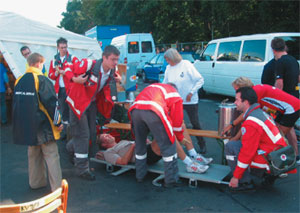
Questionnaire for race organisers worldwide are being called - Best practice advices for medical teams ©Ulf Ringer - Laufzeit
Questionnaire for race organisers worldwide are being called – Best practice advices for medical teams
Race organisers worldwide are being called upon to complete a questionnaire geared towards developing best practice advice for medical teams providing care at endurance events.
Researchers at Loughborough University’s School of Sport, Exercise and Health Sciences (SSEHS) are working with the International Institute for Race Medicine (IIRM) and the Matthew Good Foundation to set up a resource for race directors, medical directors, emergency medical providers and participants that aims to provide educational resources and advice on best medical practice at long distance races.
The Loughborough research team has developed a set of questionnaires designed to help them understand how medical care is currently managed at events ranging from tens of thousands of entrants to just a few dozen.
The questionnaires are being distributed to race and medical directors throughout the world and can also be completed online at https://www.survey.lboro.ac.uk/racemedicine
Findings will be used to gain a picture of current medical programs, to identify best practice and to develop guidelines for races of varying sizes. They will also be used to assess runners’ knowledge on drinking behaviour during races and help provide practical advice for runners and race organizers.
Loughborough Research Associate Steve Mears said: “We want to identify the optimum level of medical support needed at events so that each race can deliver the best possible care based on resources and runner numbers. Our initial focus is on sudden cardiac arrest, exertional heat illness and water intoxication (hyponatremia) as these can occur in endurance races. We hope to provide an educational resource to help to understand the best practices for medical logistics and provide guidelines for the most effective treatment."
Chris Troyanos, IIRM Executive Director and Boston Marathon Medical Coordinator added: “The running industry has witnessed tremendous growth over the past 10 years. Advances in runner tracking, data entry, and timing have allowed for larger field sizes. The safety of event participants and the general public should be the first priority.
As a group of medical professionals, we must keep up with the demand for appropriate medical care and the education that comes with that care. This first of a kind study will show us what is currently being offered and will also pave the way when providing scalable medical coverage at all events”.
For more information visit: www.racemedicine.org
Source: AIMSworldrunning.org
