 EN
EN
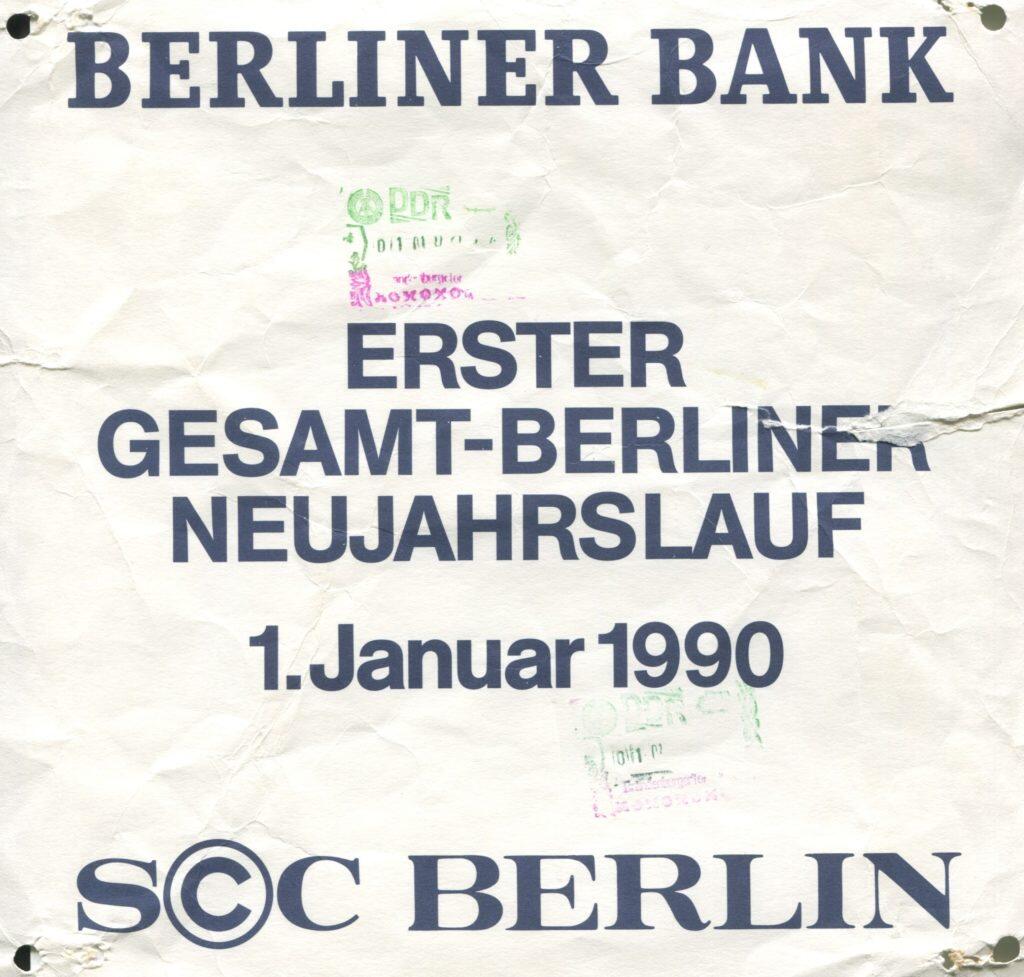
Bib of the First Berlin New Year's Run in 1990 with stamps from the border troops – Photo: Horst Milde
Two classic Berlin running events at the turn of the year – the capital celebrates the 50th New Year’s Eve Run and the 54th Berlin New Year’s Run, events with special historical significance.
At the turn of the year, the Berlin running scene is focused on two classics 2025/2026: The 50th Berlin New Year’s Eve Run (since 1977) and the 54th Berlin New Year’s Run, a unique event in sporting and world history (since 1990).
Both events have been part of the Berlin residents‘ end-of-year tradition for decades, especially as both runs reflect the turbulent history of (East and West) Berlin.
Of course, the people responsible for these two exceptional events are forward-thinking organisers and generations of employees who established these races and developed them into something unique.
The 50th Berlin New Year’s Eve Run began its long history in 1977 as a mountain run (over the Teufelsberg) and was immediately cancelled because the roads and paths were impassable for participants due to ice and snow.
The race was postponed to 12 March 1977 (!), which was won by Inge Simonsen (SCC), a Norwegian student in Berlin. Incidentally, in 1981, Simonsen and American Dick Beardsley went down in the annals of the world’s most famous marathons as the first winners of the London Marathon.
Encouraged by this great success, the 2nd Berlin Mountain Run was moved to 31 December 1977 and given the name ‘Sylvesterlauf’ (New Year’s Eve Run). Later, it was given the obvious subtitle ‘Pfannkuchenlauf’ (Pancake Run).
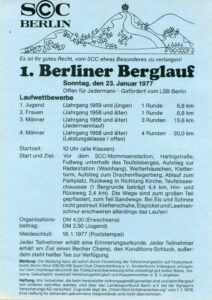
The announcement for the 1st Berlin Mountain Run on 23 January 1977 – Photo: Horst Milde
Curiosities and photos can be found in the article ‘How the Berlin Mountain Run became the Berlin New Year’s Eve Run – Cancelled at its premiere on 23 January 1977, now a traditional Berlin run and classic!’ on the GRR website.
The 54th Berlin New Year’s Run on 1 January 2026 shows like no other Berlin event the history of Berlin (West and East), as it symbolises the political and sporting significance of this run at the time.
Just a few days after the fall of the Berlin Wall on 9 November 1989, the race took on ‘historic dimensions’ after 30 years of separation between East and West Berlin. For the first time, participants were able to run through both parts of Berlin and through the Brandenburg Gate.
The idea for this Berlin New Year’s run came from British Times journalist Michael Coleman, who called Berlin Marathon boss Horst Milde from London in the early hours of 10 November 1989 and explained that a New Year’s run had to be organised in Berlin on 1 January 1990 from the Olympic Stadium to the Red Town Hall.
In West Berlin, the only New Year’s Eve run to date was the SC Charlottenburg’s ‘Rund um den Teufelsberg’ (Around the Devil’s Mountain), and a New Year’s run was not yet on the calendar. ‘This was a new type of event in West Berlin, which was already very popular with runners,’ recalls Horst Milde.
For runners from East Berlin, however, a New Year’s run was nothing new. Berlin Radio, headed by the well-known GDR journalist Heinz-Florian Oertel, had been organising the Berlin New Year’s Run in Berlin’s Volkspark Friedrichshain since 1972, together with the DTSB (note: the German Gymnastics and Sports Federation was the central mass organisation responsible for sport in the GDR), modelled on the famous New Year’s Eve run in Sao Paulo.
The first start of GDR and East Berlin runners in West Berlin, after 28 years of separation bythe Wall and barbed wire, at the Berlin Cross-Country Run on 12 November 1989 was ultimately the starting point for the further development of running in Berlin and Germany.
During the subsequent coffee break at Horst Milde’s with the East Berlin runners Roland Winkler and Detlef Dalk, as well as Gerd Engel from Stendal, plans were made for the future that would have a significant impact on the running scene in Germany.
GRR editorial team
Note: The unique and incredible story of the two running events and their historical significance for later generations, as different as they were, can be read in detailed articles on the German Road Races website.
