 EN
EN
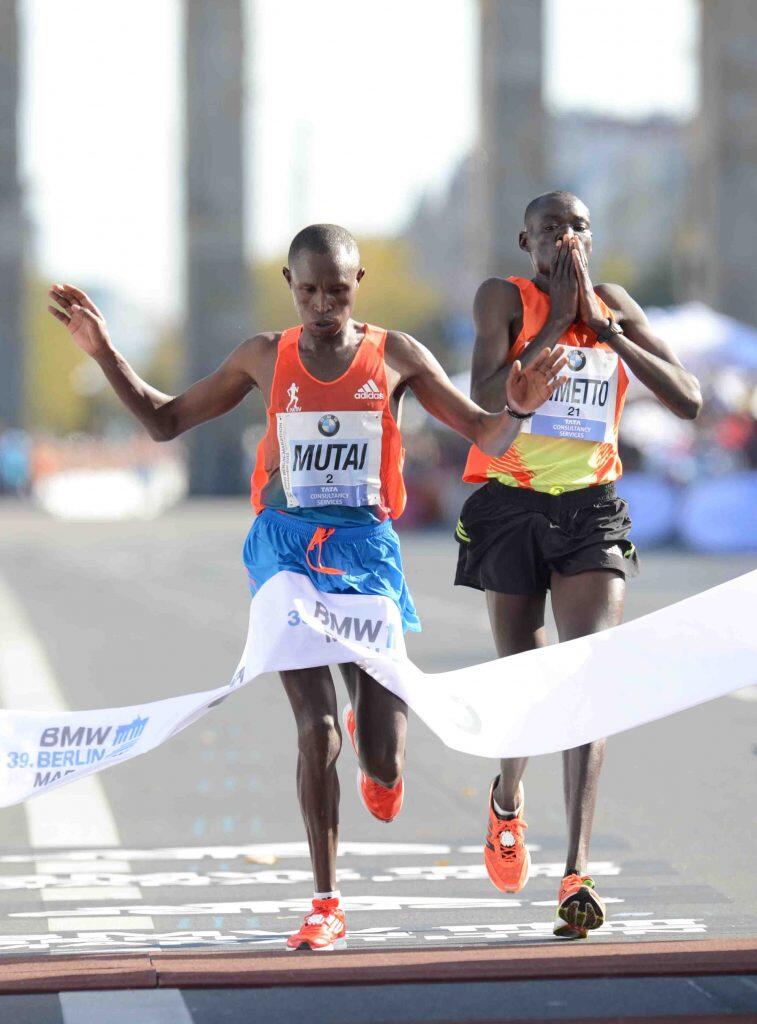
Even after running more than 42 kilometers, minimum distances can be decicive for the runner's success. By means of exact time measurement with a transponder attached to the shoe, Geoffrey Mutai became winner with a margin of one second at the Berlin Marathon in 2012. ©Victah Sailer
Without RFID Technology Time Measurement at Running Events Would Be Impossible – Berlin-Marathon: For 40,000 runners every second counts
„At the beginning 50 to 60 people participated the first races which I have organized as of 1964. Back then the time was read from a running stopwatch by a judge and then noted, together with the competition number of each runner“, Horst Milde remembers the beginnings of the sports event in Berlin. „After the race the numbers were assigned to the runners. The order of the runners passing the finish line was correct, still only one in ten runners' time was recorded appropriately.“
The first marathon was timed manually
In 1974 the public marathon event was born in Germany. At that time still on a course in the Grunewald Horst Milde organized the first marathon with 286 participants. The time was still manually measured due to the lack of an alternative.
After the Berlin-Marathon moved to the streets of Berlin in 1981, the timekeeping for Germany's biggest street running could be technically improved for 3,486 registered participants. „A barcode was printed on the competition numbers which was detected at the goal“, Horst Milde reports.
Time measurement with transponder
„The Berlin-Marathon was also the first running event realizing time measurement using a transponder which was attached to the shoe. Only a few weeks before the marathon took place in 1994 we had tested the tag during a halfmarathon“, Horst Milde reports on the first time measurement based on using an RFID tag.
At the actual marathon 12,263 runners then finished the line with transponders on their shoes. The run in the mid 1990s was thus the launch of chip based time measurement, which is part of almost every bigger running event worldwide today.
40,000 runners are detected accurately to the second
The 40,000 starting positions for the 40th Berlin Marathon were sold within three and a half hours. The jubilee is already casting a shadow. „Measuring the course officially before the race and measuring the time during the race are the two crucial conditions for the success of large running events which can only be fulfilled by means of technical assistance“, Horst Milde says.
At today's marathons with several tens of thousands participants the time of each runner is often measured every five kilometers. Therefore at the 42.195 kilometers of the Berlin-Marathon more than 200 Tartan pads with integrated antenna detect split and finish times in real-time to create a special experience for the spectators.
Very rare system failures
The systems from different suppliers applied today are very reliable. Still there are sporadic failures as observable at the Dreiländereck Marathon (border trianlge Marathon) in 2012, when many participants were too late or could not be found on the results lists at all, as Horst Milde explains: „Such failures occur very rarely today. It's very unlikely that the time measurement system will collapse completely.“
However according to Horst Milde, RFID technology was not necessarily the last step in the development of time measurement. „There are decisions which depend on a few tenths of a second in the marathon when the runners finish the line head-to-head. International associations are supposed to develop solutions to guarantee the most accurate time measurement. Thus particularly today when the participants' expectations increase, the development will not stand still.“
Source: The article is part of the report „Culture | Leisure | Sports“, published in the June issue 2013 of the magazine „RFID im Blick“.
