 EN
EN
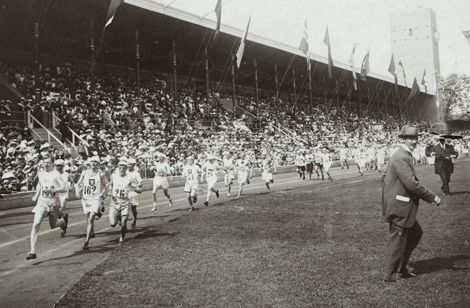
At 13:48 on 14 July was the start of the 1912 Olympic marathon race. Alexis Ahlgren from Sweden is the first runner leaving the Olympic Stadium. ©ASICS Stockholm Marathon Organisation
Welcome to a historic race, 14 July 2012 – Sunday 14 July 1912 was the date of the marathon, the highlight of the 5th Olympic Games in Stockholm.
Saturday 14 July 2012 at 13:48 is the first start of the Jubilee Marathon Stockholm 1912-2012. 10,510 runners from 66 countries are entered in this historic race.
Welcome to a weekend in Stockholm which we hope will be memorable!
All entered runners will receive their registration card and a detailed map of the course by post in mid June. Your start number is printed on this registration card. You can also find your start number on the startlist for the race.
Here you will find information about the Jubilee Marathon and everything connected with the race. Please read carefully.
1912: Since it was the Olympic Games, obviously it was a very important competition. Runners staked their all to achieve a prominent result. Only 35 of the 69 starters reached the finish.
2012: The Jubilee Marathon is run on a demanding course with some tough inclines. It could be warm on 14 July. We hope that you run the marathon in a sensible way and take the opportunity to appreciate the context of this historic race.
 |
1912: The Marathon was the biggest event at the Stockholm Olympics. It was the only competition day when Stockholm’s newly built Stadium was full to capacity with 22,000 spectators, despite the fact that ticket prices were higher than for any other day.
Tens of thousands of spectators lined the course. More trains were provided for spectators travelling to Stockholm than ever before in the city’s history.
2012: We have worked hard to create a 1912 atmosphere around the Jubilee Marathon; officials in apparel of the time, refreshment stations according to the 1912 model, etc. There will be bands and choirs along the course providing music from 1912. We have grandstands for spectators dressed in 1912 fashion. Along the course there will be 100 year old cars, motorcycles and bicycles.
Check out what will be happening along the course!
1912: Runners received their number bibs in the Olympic Stadium hours before the start.
2012: You can collect your number bib at the Marathon Expo which is on the large grass area directly behind the Olympic Stadium. See map – Marathon Expo. It is, of course, forbidden for runners to give their race number to another runner.
The Expo is open 09:00-20:00 Friday 13 July and 09:00-12:30 Saturday 14 July.
On sale at the Marathon Expo are Jubilee Marathon souvenirs and the newly published ”Maratonlopp i Stockholm under 100 år” (100 years of Marathons in Stockholm). In addition there will be a 1912 style market with the sale of home cooked candy, handmade marmalade canes, jam, mustard, smoked sausages, flat bread, chestnut lollipops and other products. The running company ”Löplabbet” will be selling Asics goods. You can see a magnificent 1912 veteran car, listen to music from 1912 and enjoy our refreshments.
On Friday there will be guided tours of the Olympic Stadium which also celebrates 100 years in 2012. You will be able to listen to lectures on the 1912 Olympics and on running, and you can watch the unique film of the 1912 Olympic Games. Read more. about these activities.
Sponge: When you collect your number bib, you also receive a sponge which you can use during the race. At each water station there will be sponge stations with running water where you can soak your sponge to cool yourself down. After the race leave your sponge in one of the bins located in the finish area.
2012: The underground and buses are the best way to get to the Marathon Expo, the start and to the Stadion party. Take the underground ("T-bana") to "Stadion" station. You can also take bus number 4 which goes to the Stadium. See map – Marathon Expo.
It is difficult to find a parking place near the area.
 Changing room in the Olympic Stadium 1912. |
1912: Every nation had its own changing room at the Olympic Stadium.
2012: Female runners can change at the School of Sport ("Idrottshögskola") directly behind the Stadium. Male runners can use the changing rooms at the sports grount Östermalms IP. See map – Before the start.. Changing rooms are open 11:00-22:00 on 14 July.
There is a shortage of changing rooms so we encourage those who can to change at home or at their hotels.
1912: Participants left their tracksuits in the changing rooms at the Olympic Stadium.
2012: Tracksuits can be left in a specially marked area at "Östermalms IP" before you go to the start.
You will get a plastic bag when you leave your tracksuits. Please mark the plastic bag with the adhesive label with your name and number that you get in the envelope containing your start number. Show your number bib when you collect the bag after the race.
1912: There was no such service 100 years ago.
2012: Don’t leave your valuables or keys with your tracksuit or in the changing rooms! The organisers are not responsible for anything which is left there. Instead leave them at the Safety Deposit at Östermalms IP, situated in front of the tribune, before you go to the start.
There are envelopes for your valuables at the Safety Deposit. Use the smaller sticker which you will get with your start number to label the envelope. Show your bib number, which is your receipt, when you collect your valuables after the race.
1912: Runners assembled outside the arena and walked together to the start.
2012: All runners should assemble at "Östermalms IP" which is open from 09:00 on 14 July.
From "Östermalms IP" you will then walk approximately 800m to the start pens which are located just outside the Olympic Stadium. You should go from "Östermalms IP" about 30 minutes before your start time.
You must be in the start pen at least 20 minutes before the start.
Approximately 8 minutes before the start, the groups will walk into the Stadium and then 250m up to the start line. See map – Before the start.
Toilets: There is a limited number of toilets at the assembly area.
The start was meant to have been at 13:45, but it took longer than expected to assemble the participants so the race did not start until 13:48.
2012: The race will start inside the Olympic Stadium in front of the royal box. The first group will start at 13:48 on Saturday 14 July. The participants run threequarters of a lap before leaving the arena through the south gate towards “Valhallavägen”.
See map – After the start.
 In 1912 the start was in front of the royal box. Hundred years later the start will be at the same place. |
1912: 69 runners came to the start. Of course they all started at the same time.
2012: With over 10,000 registered runners, it is not possible for the whole field to start at the same time. Participants are split into five groups which will start at 10 minute intervals.
Bib numbers for runners in group 1 and 2 have been allocated according to results given by the runners at the registration.
Bib numbers for all other runners have been given by random.
Check your bib number in the start list.
1912: The course ran from the Olympic Stadium on the main road north to Sollentuna Church and then back on the same road to the Stadium.
2012: The course runs from the Olympic Stadium on the roads north to Sollentuna Church and then back the same way to the Stadium.
The course will follow the 1912 Olympic course as closely as possible. 21.6 of the 2012 course’s 40.2 kilometres is on the same route as 1912. Read more.
The course is just as hilly as 100 years ago. The difference between the course’s highest and lowest point is 41 metres. See the course profile.
Every km is indicated with a clear sign. Runners must follow directions from the police and officials.
For security reasons no bicycles are permitted to follow the runners on the course and no rollerskating/inline skating is allowed. Walking poles and children’s buggies are also not permitted.
Dropping out of the race: If you have to drop out, please contact the nearest refreshment station. Runners who drop out will be provided with transport from the refreshment stations back to “Östermalms IP”.
1912: A wooden stick in the middle of the road outside Sollentuna Church marked the turning point. See the film from the 1912 Olympic race.
 |
The memorial stone was dedicated in November 1913. It is an approximately six metre tall pillar in the form of a fluted doric column, made out of black granite, a reference to the ancient Olympic Games in Greece. At the top is a square stone block. On the side which faces Stockholm are the words ”turning point”, on the back ”1912” and on the sides ”Marathon”.
The memorial stone was placed over 40 m north of the turning point for the 1912 Olympic race. Before the Jubilee Marathon it will be moved and placed in front of Sollentuna Church, approximately 100 metres south of the Olympic turning point.
The memorial stone will be the turning point for the Jubilee Marathon Stockholm 1912-2012.
2012: Runners will turn to the right after they have entered the Stadium, through the gate on Valhallavägen. Then they will run 100m in the normal direction of running towards the finish in front of the royal box. This change makes it easier for runners to leave the arena and go towards Östermalms IP after they have crossed the finish line.
See map – Finish 40,075m.
1912: The distance was 40,200 metres.
2012: The course is 40,075 metres. It has been official measured by Bosse Hellström and Micke Hill, two of the Swedish Athletic Federation’s accredited course measurers.
Runners who wish to run 42,195 metres – the official distance for a marathon race today – can choose to run an extra loop before the finish.
When these runners enter the Stadium, through the gate on Valhallavägen, they should turn left and run 150m – against the normal direction of running – on the track before leaving the arena through the gate on Drottning Sofias väg. They should run 910m to a turning point on the street “Fiskartorpsvägen” and then back the same way.
When they enter the gate on Drottning Sofias väg, they should run 250m on the track up to the finish line. See map – Finish 42,195m.
There is one refreshment station at this extra loop.
There is no need to register in advance whether you plan to run 40,075m or 42,195m, you can decide when you enter the Stadium after 40 km.
There will be a water station on this extra loop. Runners who choose to run 42,195m will also have their time recorded at 40,075m.
 |
1912: Officials at the finish line used stop watches.
2012: Timing, which is the responsibility of Racetimer, will be taken with the aid of a datachip attached to a tab on the edge of the number bib which is made of cloth like the 1912 version. Don’t tear off this tab ! For the timing to work best, the tab should be folded away from the body at an angle of between 45 and 90 degrees.
The number bib should be worn visibly on the chest.
Results: You can find your preliminary result on our website approximately 15 minutes after crossing the finish line. The official results will follow a few days later.
There will be two result lists. One for the distance 40,075 m. This list will include also those who run 42,195. The other result list will be for 42,195m.
1912: Split times for the leading runners were recorded at 5 km, 15 km, 20 km, 25 km and 35 km.
2012: Split times for all runners will be recorded at 5 km, 10 km, 15 km, 20 km, 25 km, 30 km and 35 km.
These times will be in the results which you will find on the race website.
|
This was the only day during the 1912 Olympics with a packed Stadium. Here you se spectators lining up outside the Stadium to buy tickets.
|

1912: There were four refreshment stations along the course which were passed both on the way out and back; Söderbrunn (2km and 38km), Stocksund (5km and 35km), Silverdal (11km and 29km) and Tureberg (15km and 25km). At these points, water, tea and coffee and orange and lemon quarters were provided. Water was also provided at the turning point after 20km and at other points along the route.
2012: The course has 21 various types of refreshment stations
Environmentally friendly recyling: Cups used at the refreshment stations are biodegradable and will be collected in compostable refuse sacks and taken away after the race to a compost outside Stockholm.
Refuse sacks are situated after each refreshment station. Please throw cups into these sacks !
Extra energy: At some refreshment stations, additional energy boosters will be provided, eg bananas, grape sugar and Power Bars.
Toilets: there will be toilets at every refreshment station.
1912: There were no showers along the course.
2012: Between the water stations there will be showers to help runners cool down.
 |
1912: The first three were awarded a medal. In addition, 25 runners received a diploma.
2012: All finishers will receive a medal for the Jubilee Marathon Stockholm 1912-2012. On one side of the medal is the Stockholm Olympic Stadium as it is today and as it looked 100 years ago. On the other side is a portrait of the South African, Kennedy Kane McArthur, who won the Olympic race in 1912.
The medal is 60mm in diameter and attached to a blue and yellow ribbon.
All runners can download their own diploma from the race website.
1912: The winner of the marathon was awarded s small statue given by the King of Greece.
2012: Prizes will be awarded to 50 runners who complete the race in apparel (not shoes) which is most similar to the apparel worn by the athletes at the 1912 marathon. These prizes will be awarded at Sunday’s Stadium party.
1912: There was no maximum running time at the Olympic Games.
2012: The maximum time is 6 hours for 40,075 metres.
On the course there are two control locations which runners must pass within a certain time in order to continue the race:
Turning point after 20km must be passed within 3 hours of the start of the race.
Refreshment station at Silverdal after 29.3km must be passed within 4 hours, 25 minutes of the start of the race.
1912: The minimum age for participants in the Olympic Games was 17.
2012: The minimum age is 18 (born in 1994 or before).
1912: There were doctors and nurses at the start and finish and also at the refreshment stations.
2012: Doctors and nurses will be at every refreshment station and also at the start and finish. Doctors have the right to any injured or exhausted runners take off the course.
1912: Almost all participants wore a knotted hankerchief on the head as protection from the sun.
2012: At the Marathon Expo on 13 July and 14 July, all registered runners will receive a large hankerchief which can be used as headgear during the race.
1912: After the finish the runners were offered champagne on the Stadium infield.
2012: After the finish, those who wish can drink a small glass of sparkling wine. There will of course also be an alcohol-free alternative.
1912: The organisers didn’t make any special arrangements for the runners after the race. It was the team leaders who did this.
2012: After the finish, you should proceed to the sports ground "Östermalms IP" (300 metres) where drinks and something light to eat will be provided for all runners.
Then there is time for entertainment, relaxing and chatting with other runners.
Collect your t-shirt: At "Östermalms IP" you will be given a Jubilee Marathon Stockholm 1912-2012 t-shirt.
 A range of celebrations and parties took place during the 1912 Olympic Games. |
1912: A range of celebrations took place during the Olympic weeks, mostly for Swedish and overseas dignatories.
2012: Sunday 15 July – the day after the race – all participants are invited to the post race party at yhe Olympic Stadium. Food and drink will be provided. There will be entertainment, awards ceremonies, etc. The party is free for all runners.
A limited number of additional tickets to the Stadion party will be sold at the Marathon Expo. The cost is 400 SEK.
More information.
1912: The concept of sponsorship didn’t exist in 1912. However, a number of companies supported the Olympic Games, mainly with goods and services.
2012: Asics, Löplabbet, Mitt I and Marathon.se are the sponsors for the Jubilee Marathon. Partners: Stockholm City, Solna City, Sollentuna Municipality och Sollentuna Church.
1912: Svenska Gymnastik- och Idrottsföreningarnas Riksförbund and Centralföreningen för Idrottens Främjande – the country’s leading sports organisations at that time – stood behind the organising committee of 17 persons who were responsible for the Olympic Games.
Colonel V.G. Balck was Chairman of the committee and HRH Crown Prince Gustaf Adolf (later King Gustaf VI Adolf) Honorary Chairman.
Officials from Fredrikshofs IF were responsible for the marathon course.
2012: Jubilee Marathon Stockholm 1912–2012 is organised by the athletics clubs Hässelby SK and Spårvägens FK. The same clubs are responsible for ASICS Stockholm Marathon and many other major distance races.
Officials from Fredrikshofs FIF are responsible for the course.
If you have any questions, contact our competition office:
E-mail: info@jubileumsmarathon.se
Telephone: +44 8 – 545 66 440 (Monday-Friday 09:00-12:00 and 13:00–16:00).
Take it easy and run sensibly! Jubilee Marathon Stockholm 1912-2012 is a test of strength. Start off cautiously. 40km is a demanding distance and you will need strength left for the final kilometres.
Take the chance to enjoy the scenes along the course !
Don’t start unless you are 100 per cent fit. Remember that there is no shame in stopping if you are tired.
The rules of the Swedish Athletics Federation apply. All participants run at their own risk.
Welcome to the Jubilee Marathon Stockholm 1912–2012!
Hässelby SK and Spårvägens FK
