 EN
EN
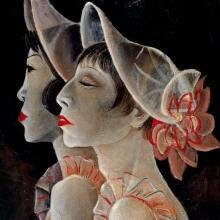
Jeanne Mammen: Revuegirls, 1928/29, BG, VG Bild-Kunst, Bonn, 2013, Revuegirls, 1928/29 - Berlinische Galerie © VG Bild-Kunst, Bonn, 2013, Reproduktion: Kai-Annett Becker ©Reproduktion: Kai-Annett Becker Jeanne Mammen
VISITING GERMANY/CULTURE: BERLIN – Vienna Berlin – The Art of Two Cities – From Schiele to Grosz – Berlinische Galerie – Museum of Modern Art, Photography and Architecture
In their first major themed exhibition together, the Berlinische Galerie and the Österreichische Galerie Belvedere will show key works of modern art from Vienna and Berlin ranging from the Secessions via Expressionism to New Objectivity.
Masterpieces from both collections will combine with lesser-known specimens to create a panoramic insight into the vibrant exchange between these two metropolitan hubs in the early 20th century.
Much is already known about the links between these two cities in the fields of literature, theatre and music, but the dialogue between Vienna and Berlin around classical modernism in art has rarely been explored. This themed exhibition of some 200 works seeks to redress the oversight. It opens with the formation of the Secessions, whose champions turned their backs on academic style to negotiate new positions between art nouveau and late impressionism.
The dawn of modernism is reflected on both sides in a quest for new tools of expression, but while the Berlin Secessionists around Max Liebermann took a growing interest in everyday reality and made a theme of the urban experience, Viennese artists around Gustav Klimt and Koloman Moser sought their style in ornamental forms, often associated with the language of symbolism. Nevertheless, it is evident from the many exhibitions of the day that there was a constant flow of exchange and that they were well aware of each other's work.
In the 1910s, as a new generation of Expressionists emerged in the form of artists like Ernst Ludwig Kirchner, the Danubian capital was gradually ousted from its leadership role in the fine arts by its recent but aspiring German counterpart. Young Austrian artists such as Oskar Kokoschka and Egon Schiele stepped out of Klimt's shadow, presenting their avant-garde work to a more open-minded yet critical audience in Berlin. Art dealers and essayists such as Paul Cassirer, Herwarth Walden and Karl Kraus were equally at home in the art communities of both cities and built a close network of contacts, enabling many artists to settle in Berlin, especially after the Great War.
With the post-war decline of the Danubian monarchy and the death of important artists like Egon Schiele and Gustav Klimt, the Viennese art world faded from international view during the 1920s and 1930s. While Dada, Verism and New Objectivity rigorously confronted new political and social realities in Berlin, such engagements were now rare in the Austrian capital.
At the same time, Vienna witnessed quite independent phenomena, such as kineticism with its utopian visions and avant-garde idiom. There were also some specifically Austrian interpretations of New Objectivity, largely but unjustly ignored in the past. While they reflect links with Berlin and the work of an Otto Dix or George Grosz, they are influenced just as much by the Viennese tradition of psychological art.
When Friedrich Kiesler organised his "International Exhibition of New Theatre Technology" in 1924, the Austrian capital once again became a magnet for the avant-garde. Finally, tribute is paid to exhibition organiser and art historian Hans Tietze, a historic figure almost unknown in Germany, whose call for "lively art history" inspired the exhibition "Vienna Berlin: The Art of Two Cities".
Artists (selected)
Hans Baluschek, Max Beckmann, Otto Dix, George Grosz, Carry Hauser, Raoul Hausmann, Hannah Höch, Ernst-Ludwig Kirchner, Erika Giovanna Klien, Gustav Klimt, Oskar Kokoschka, Broncia Koller-Pinell, Max Liebermann, Jeanne Mammen, Ludwig Meidner, Koloman Moser, Max Oppenheimer, Emil Orlik, Christian Schad, Egon Schiele, Max Slevogt.

Berlinische Galerie
Museum of Modern Art, Photography and Architecture
The Berlinische Galerie is one of the newest museums in the German capital and collects art from Berlin dating from 1870 to the present day – with both a local and international focus.
Founded in 1975, the State Museum reopened in its own building close to the Jewish Museum in 2004, moving into a spacious industrial hall that has been rebuilt to provide 4,600 square metres of exhibition space. Fine art – painting, graphics, sculpture, multimedia – photography, architecture and artists’ archives provide a rich source, whose interdisciplinary relationships create exciting dialogues.
Its outstanding collections include Dada Berlin, the Neue Sachlichkeit (New Objectivity) and the Eastern European avant-garde. The art of the divided and reunified city of Berlin provides another focus.
Berlinische Galerie
Landesmuseum für Moderne
Kunst, Fotografie und Architektur
Stiftung Öffentlichen Rechts
Alte Jakobstraße 124-128
10969 Berlin Germany
www.berlinischegalerie.de
bg(at)berlinischegalerie.de
Tel +49 (0)30-789 02-600
Fax +49 (0)30-789 02-700
Opening hours
Wednesday-Monday 10am-6pm
closed on Tuesday
closed on 24.12. and 31.12.
Admission Vienna Berlin
Day ticket 10 Euro
Concessions and groups of 10 or more: 7 Euro
Every 1st Monday of the month: 6 Euro
Admission free for visitors under 18
Reduced admission with a ticket from the Jewish Museum Berlin (see above)
