 EN
EN
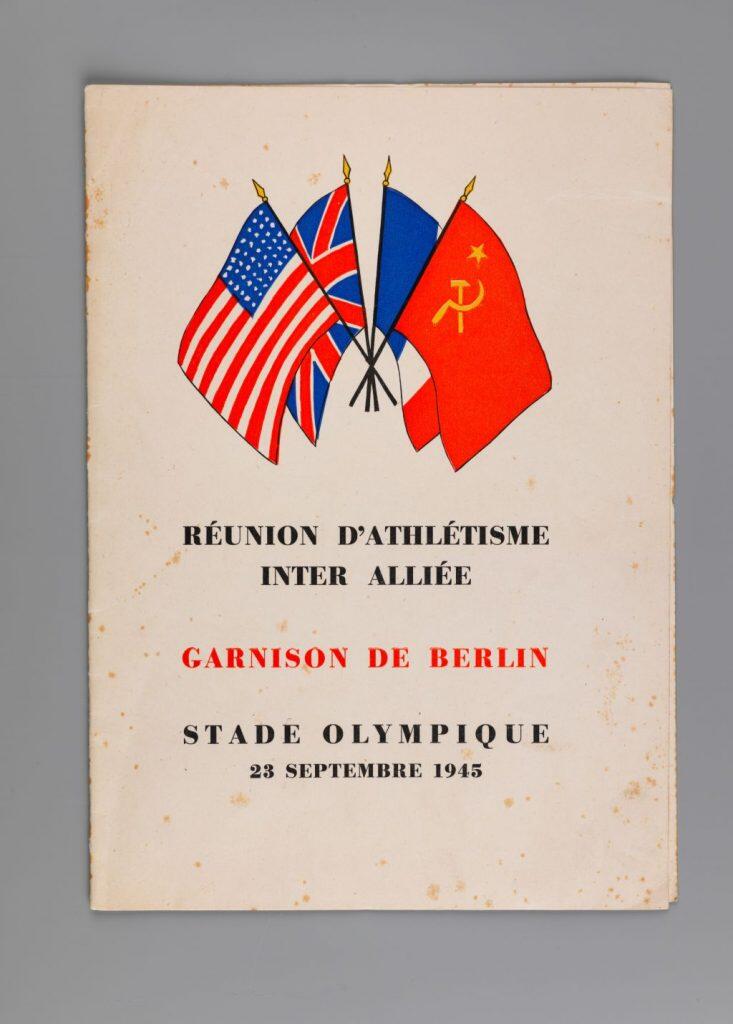
Program of the first sporting event on september 23, 1945 in the Olympic stadium. The Russian cancelled in last minute! ©Alliierten Museum- Chodan
VISITING GERMANY – BERLIN – Fair Play. The Allies and Sports – till april 18, 2013
In the Olympic Year of 2012 sports will as well prevail in the Allied Museum. A special exhibition under the heading of “Fair Play – The Allies and Sports” will be staged on our premises in cooperation with the Berlin Museum of Sports and will be opened till april 18, 2013.
It will be, for the first time ever, that a hardly explored topic will be presented with all its exciting aspects, ranging from the ban on all German sports associations by the war-winning powers back in 1945 to the most popular sportive events of the Berliners together with the same partners who in time had become protective powers.
Joint sport activity, as early as in 1945, had been an approach taken by the Allies to strengthen their alliance. Contests were held in regular intervals within each of the services. Sports in a military environment were to enhance comradeship, physical fitness and morale.
The Allied soldiers in Germany, last but not least, appreciated sports as a change from everyday routine, a little bit of home on the pitch.
 Sports of the Allies at the Olympic Stadium in Berlin – in the 1950!
After all, sportive competition helped in a significant way to foster ties with the Berliners. Once the ban on fraternisation had been lifted, it was practised in American youth clubs with the view to implanting into children’s minds values, such as democracy, fair play and team spirit.
Also covered in the special exhibition will be the early days of post-war sports which were characterised by bans. Growing links between the Allies and Berliners were accompanied by sportive encounters. Friendly contests, tournaments and other events opened up spaces for closer relationships, with some of them lively unto the present day. The show will also follow those traces in the sports landscape of Berlin.
No charge for admission.
The lavishly illustrated accompanying publication in German, English, and French is available for purchase on site at the Museum.
Look, experience, discuss
Our guided tours for adults
Why did the Western powers decide on an Airlift to Berlin? How did the Allied intelligence services operate during the Cold War? What does the inside of the last guardhouse from Checkpoint Charlie look like?
We answer these questions and more on the history of the Western powers in Berlin from 1945 to 1994 in our guided overview and thematic tours, which focus on selected objects from our permanent exhibition or the current temporary exhibition.
In conversation we elucidate the exhibition contents, discuss your questions, and make history come alive through direct encounters with objects.
We offer guided tours in German, English, and French. If you would like to book a group tour, please use the reservation form. For the dates of free public tours in German, check the events calendar.
How Enemies Became Friends
Overview tour of the permanent exhibition
Get to know the most interesting exhibits from 50 years of Allied presence in Berlin.
The first part of the exhibition in the former Outpost Theater is dedicated to the period from 1945 to 1950. Numerous documents, photos and objects tell the checkered history of the Allied victory over Nazi Germany up to the early occupation period in Berlin.
Fair Play. The Allies and Sports
Overview tour of the temporary exhibition
On the occasion of the Summer Olympics in London, the Allied Museum opened the temporary exhibition “Fair Play. The Allies and Sports on July 24, 2012 in cooperation with the Sportmuseum Berlin. The exhibition will be on view in Berlin’s Zehlendorf district until April 8, 2013.
Interior Views of the Cold War
Thematic tour of the large-scale objects
Haven’t you always wanted to see the inside of a genuine Airlift plane, inspect the desks of military policemen at Checkpoint Charlie, or know what the dining car of a French military train looked like?
This thematic tour offers you the unique opportunity to do just that and view the large-scale objects on the Museum grounds from the inside. The Hastings TG 503 “Candy Bomber,” the dining car of the French military train, and the last guardhouse from Checkpoint Charlie bear powerful witness to West Berlin’s island status and the threat to access routes to the western part of the city.
The American Outpost Theater
Architectural tour
The American Outpost movie theater on Clayallee was built in the early 1950s, when it was considered one of the most modern cinemas in Europe. The Allied Museum presents the first part of its permanent exhibition in the building, which was designated a historic landmark in 1995.
Join us in touring the Outpost Theater inside and out. You will gain insights into the now virtually forgotten history of this American movie theater in West Berlin. The tour will also take you to places not generally accessible to Museum visitors. With the help of architectural plans and historic photos, the tour traces the changes the building has undergone over the years.
Little America in Berlin
Architectural tour and neighborhood walk through the former U.S. housing area on Hüttenweg
The Allied Museum invites you to take a guided walking tour of the neighboring housing area on Hüttenweg, the Parkviertel Dahlem.
The tour begins at the historic Outpost Theater, which now houses the first part of the Allied Museum’s permanent exhibition. The tour will then take us past the former American headquarters on Clayallee through the present-day Parkviertel Dahlem to the United States Army Chapel.
How Enemies Became Friends
The Allied Museum’s permanent exhibition
The history of the Western powers in Berlin is full of suspense and drama. It begins with the American, British, and French occupying troops marching into Berlin in 1945 and ends with the Allies’ ceremonial withdrawal in 1994.
From the end of the war to the Berlin Airlift
The first part of the permanent exhibition in the former American Outpost movie theater explores the years 1945 to 1950. The themes are the Allied victory at the end of World War II, the first years of the occupation, and the process of democratic renewal. The Berlin Airlift during the Soviet blockade of 1948/49 is a central focus.
Threats to access to West Berlin
The open-air exhibition on the Museum grounds includes the British Hastings TG 503 Airlift plane, the dining car of a French military train, the last guardhouse from Checkpoint Charlie and segments of the Berlin Wall. These large-scale objects are impressive reminders of West Berlin’s status as an island in the middle of the Soviet zone of occupation, and stand for the threats to access routes to the western part of the city.
From Checkpoint Charlie to the Two-plus-Four Treaty
The second part of the permanent exhibition in the Nicholson Memorial Library examines the period 1951 to 1994. The focus is on the military confrontation between East and West during the Cold War. Berlin war an especially important scene of rivalries between opposing intelligence services. Apart from everyday life in the garrisons, the exhibition also highlights the events from German unity in 1990 to the withdrawal of the Western forces in 1994.
Nearly all of the texts in our permanent exhibition are trilingual in German, English, and French.
Admission is free.
Source:
Allied Museum
Clayallee 135
14195 Berlin-Zehlendorf
Tel. +49-(0)30/818199-0
Fax +49-(0)30/818199-91
info@AlliiertenMuseum.de
