 EN
EN
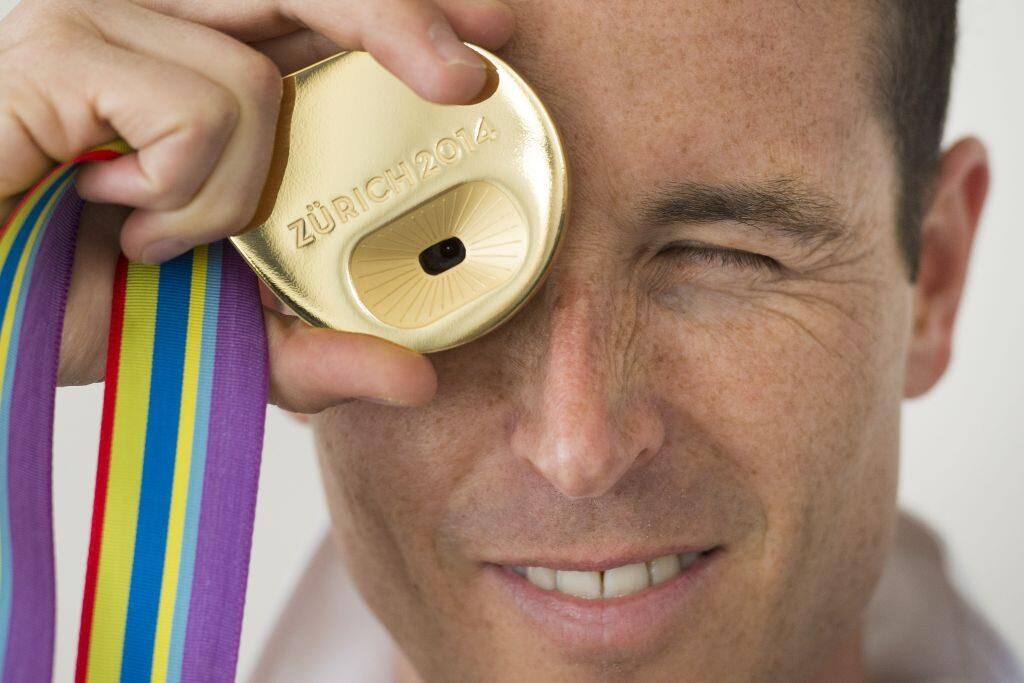
L'athlete suisse Viktor Roethlin, pose avec la medaille d'or lors d'une conference de presse de presentation des medailles du prochain Championnats d'Europe d'Athletisme de Zuerich ce lundi 24 mars 2014, chez le medailleur Huguenin au Locle dans le canton de Neuchatel. (KEYSTONE/Jean-Christophe Bott)
Viktor Röthlin: A First Glance at Zürich 2014 Medals – European Athletics Championships Zürich
Gold, silver, and bronze – medals are every athlete's dream. Reigning European marathon champion Viktor Röthlin was the first to lay his eyes on the medals up for grabs at the upcoming European Athletics Championships Zürich 2014. Together with the Zürich 2014 promoters, he stopped by the manufactory Faude & Huguenin, where the precious objects are being produced.
Viktor Röthlin already has a full set of medals in his cabinet, all of them tokens of his impressive athletics career: He won gold at the 2010 European championships, silver at the 2006 European championships, and bronze at the world championships in 2007. "My running took me to three championship podiums. I feel no pressure whatsoever when thinking about potential medals," explained the Swiss marathoner when speaking about his goals for the last marathon race in his career. "I will definitely try my best to win one more in Zurich on 17 August 2014. But whatever the outcome of the race; whether or not I will take home another medal, the championships will mark the end of a wonderful and very successful time."
Viktor Röthlin was the very first athlete to get a glimpse of a set of medals designed for Zürich 2014 today.
He visited Faude & Huguenin SA in Le Locle to have a look at the precious objects. The manufactory's CEO Christian Fontana, production manager (and former Swiss National League ice hockey player) Daniel Dubois, and internationally renowned designer Alfredo Häberli explained a medal's road to the championship podium. "I feel honoured to have seen the first Zürich 2014 medals. They look like superb pieces of jewellery, befitting the occasion. And it was fascinating to see how much work is behind making each medal."
Letzigrund Stadium, legendary and inspiring
The Zürich 2014 medals have been created by Alfredo Häberli. The Zurich-based industrial designer has won many awards and is widely known for his simple, minimalistic designs for everyday objects. His work is often inspired by observations he makes in everyday life. "When I was asked to create medals for Zürich 2014, I immediately decided to go for an unusual design," Alfredo Häberli explained when speaking about finding ideas for his work. "I started looking for a subject which incorporates both the host city and the championships. Letzigrund Stadium with its simple architecture and its characteristic light posts was a perfect source of inspiration."
Alfredo Häberli's approach led to a brilliantly simple, modern result. The asymmetric shape of the medals depicts the contours of the legendary athletics arena. Another detail leaping to the eye – and a first: The ribbons will come in three colours, depending on the colour of the medal.
Making medals requires outstanding craftsmanship
After discussing his ideas with the Zürich 2014 promoters, Alfred Häberli made a prototype. At Faude & Huguenin SA, 79 gold, silver, and bronze medals are now being manufactured on the basis of his draft. The company is specialised in minting select medals and coins for customers from all over the world. The manufactory has been operating since 1868, and to this date, all products are handcrafted in Le Locle. "The medals for the championships will all be made here. The process involves many working steps. Each medal will pass through many hands before it's finished," said CEO Christian Fontana.
The designer's sketches will be used to shape models, so that the hand-made embossing devices for the front and the back side of the medal can be developed. Each blank will be pressed repeatedly using several hundred tons of weight, and will be heated over and over again. A large number of working steps will follow before galvanic gold or silver plating will give the medals their splendour. Experienced polishers will carefully bring out the lustre of each medal, highlighting the structure of each piece.
Crafting all 237 medals will take weeks. However, each medal will be given its final touch only minutes before they are put on the best competitors. Only after the final results of an event are known can the names of the future medal owners, their position, performance, and name of venue be engraved on the medal.
Janine Geigele
Downloads:
