 EN
EN
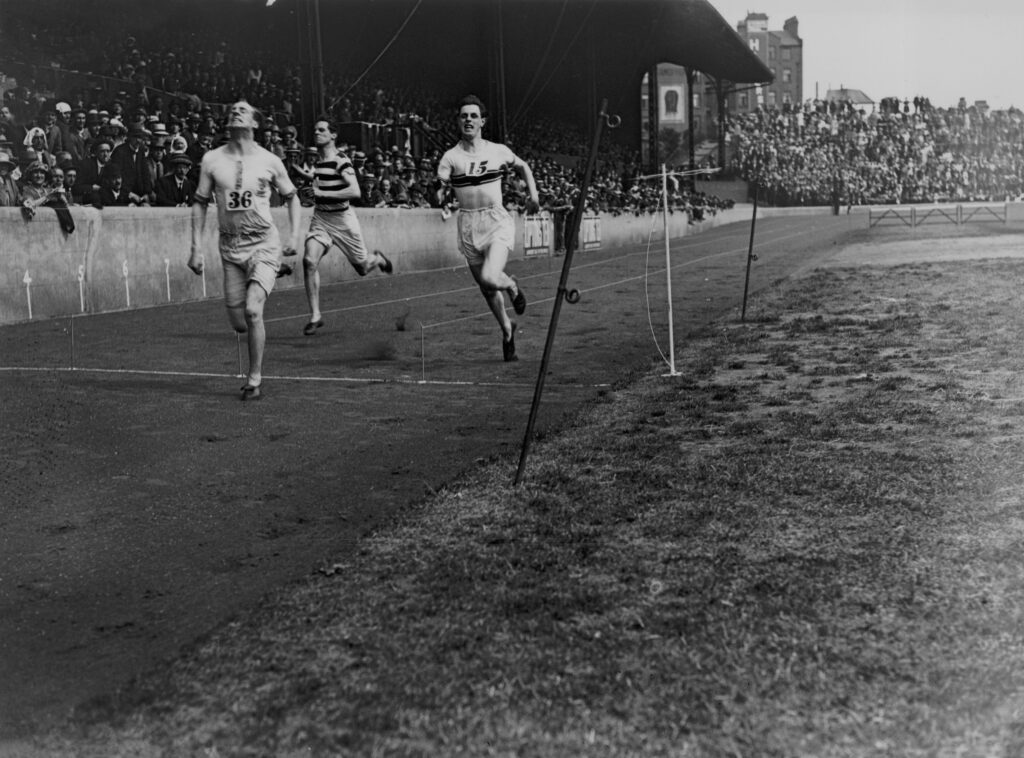
Eric Liddell gewinnt die 220 Yards bei den AAA-Meisterschaften - Foto: World Athletics
‘The Flying Scotsman’ Eric Liddell honoured with the World Athletics Heritage Plaque – World Athletics – Chris Turner
Dear friends of the MOWA, yesterday, at a ceremony held at the MOWA World Indoor Athletics Exhibition in the St. Enoch Centre, Glasgow, World Athletics President Sebastian Coe announced the award of the World Athletics Heritage Plaque in the posthumous category of ‚Legend‘ to ‚The Flying Scotsman‘ Eric Liddell.
Coe presented the plaque to Liddell’s niece Susan Liddell Caton. Her father Ernest was Eric’s younger brother. Caton is one of the Patrons of The Eric Liddell Community which is an Edinburgh based care charity and community hub. Their work which reflects Liddell’s code of ethics includes supporting people living with dementia, providing a Day Care service and a well-being programme for unpaid volunteers.
The presentation of the plaque took place in front of an invited audience of 150 guests who included Allan Wells, Moscow 1980 Olympic 100m champion and Denise Lewis, Sydney 2000 Olympic heptathlon champion, who earlier in the ceremony had made donations of historic clothing and shoes from their competition careers to the Museum of World Athletics.
World Athletics President Sebastian Coe commented:
„I am honoured on behalf of World Athletics to announce this award which celebrates one of Britain’s greatest and most inspirational Olympic champions.“
„As immortalised by the 1981 Oscar winning film ‚Chariots of Fire‘, the religiously devout Liddell made the principled decision not to compete in his preferred event the 100m in the 1924 Paris Games because the timetabling of the heats would have meant competing on a Sunday, a day he held sacred.”
“Liddell instead switched his Olympic ambitions to the 200m and 400m. He finished with the bronze in the former and won gold in the one lap in an Olympic record, all the more remarkable as he ran blind of his more experienced competitors, having been drawn in the outside lane.“
“Liddell poured his heart and soul into his running, a commitment which he matched in every strand of his life, ultimately laying down his life for his faith and missionary work.”
Sue Liddell Caton commented:
„I am so pleased that World Athletics have chosen to recognise my uncle Eric Liddell with this award one hundred years on from his Olympic success in Paris 1924.”
“I’m thrilled to be able to accept this on behalf of the Liddell family and hope his legacy continues to inspire younger and future generations.”
The plaque will be placed on permanent public display at The Eric Liddell Community which is based in a converted church in Edinburgh. The charity is leading The Eric Liddel 100, an exciting programme of events and activities to recognise and celebrate the legacy of the Scottish and international icon.
The World Athletics Heritage Plaque is a location-based recognition, awarded for ‚an outstanding contribution to the worldwide history and development of the sport of track and field athletics and of out-of-stadia athletics disciplines such as cross country, mountain, road, trail and ultra-running, and race walking‘.

Seb Coe presents Sue Liddell Caton with the World Athletics Heritage Plaque. – The distinguished others (all global champions and/or world record breakers) in the photo from left to right: Allan Wells, John Regis, Tom McKean, Graham Richards (on behalf of the family of Ron Hill), Yvonne Murray-Mooney, Steve Cram, Denise Lewis, and Fiona May. – Photo: World Athletics
Eric Henry Liddell (16 January 1902 – 21 February 1945)
Born in 1902 in the city of Tientsin in north-eastern China, Liddell was the son of missionary parents working for the Church of Scotland.
Liddell, who studied in Edinburgh University for a BSc in Pure Science, was a talented rugby player capped seven times for Scotland as a wing three quarter but who ultimately decided to concentrate his leg speed on athletics success.
Liddell won five successive Scottish titles in the 100 yards and the 220 yards (1921 to 1925) and took the 440 yards gold twice (1924 and 1925). He demonstrated his Olympic credentials by winning the Amateur Athletics Association Championships in the 100 yards and 220 yards in 1923 and the 440 yards in 1924, the latter his personal trial for Paris.
The manner of his Olympic victory in the 400 metres, a few days after he had taken bronze in the 200m, was remarkable. He set out at a devasting pace and, with grit and determination, held on to his lead to win by six metres in an Olympic record of 47.6 seconds.
To put the magnitude of his Olympic performance into perspective, Liddell had travelled to Paris with a personal best of 49.6 seconds, and his winning time a European record remained unbroken until 1936.
Liddell continued running in 1925 taking three individual Scottish titles and a relay victory. Later the same year, after graduating from Edinburgh University, he travelled to China to join his father as a missionary where he devoted his life to work for the poor of China.
He married Florence Mackenzie, from a Canadian missionary family, in Tianjin in 1934, and the couple had three daughters.
In 1943, with the world war intensifying, Liddell’s wife and children followed British government advise to their nationals to leave China, and they settled in Canada with Florence’s family. Liddell stayed on to continue his mission and ultimately gave his life for his faith, dying in a war time internment camp aged 43.
“Eric is remembered in many ways to different people – as a sportsman, a husband and father, a devout soul who lived his life according to his beliefs, a graduate of Edinburgh University and a missionary in China who refused to leave those he looked after during the Second World War. If he had lived longer than his forty-three years, who knows what more he could have done.” – The Eric Liddell Community.
Chris Turner
Director of Heritage & curator of MOWA
Click here to read this press release on the World Athletics website
Click here to enter MOWA and Take a virtual journey through Athletics history
For more information about MOWA and the World Athletics Heritage Collection – https://worldathletics.org/heritage
#MOWA
#WhereChampionsLive
