 EN
EN
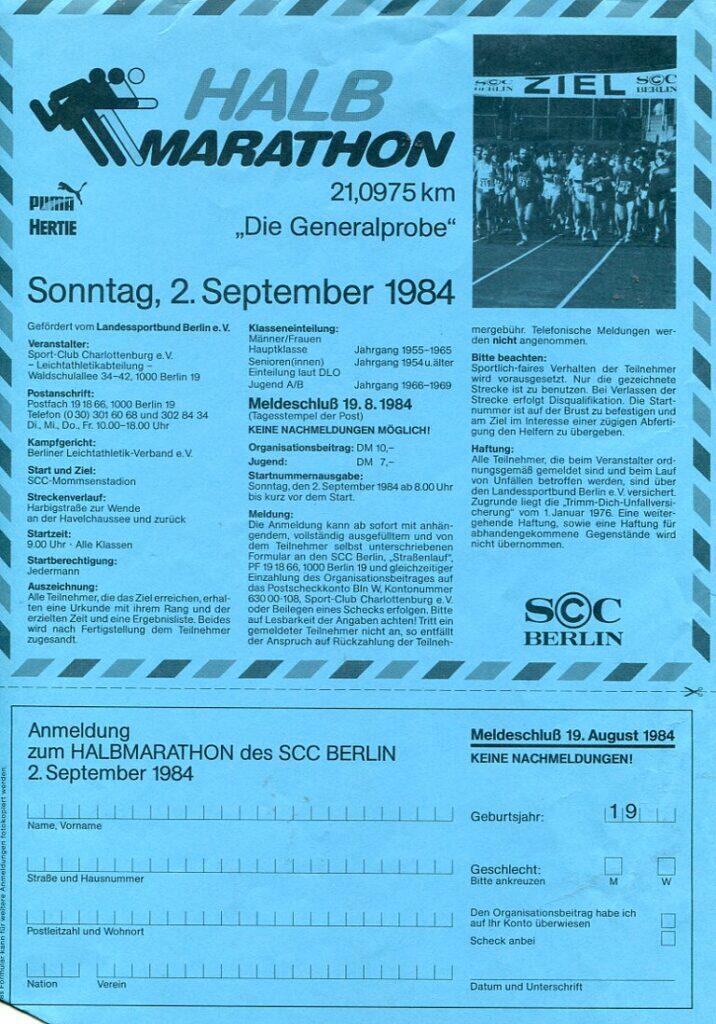
First Berlin Half Marathon, Berlin 1984 – Photo: Horst Milde
The Berlin Half Marathon (29.3.2026) – a success story marked by many obstacles – Now a highlight of the national and international running scene.
What began as the ‘little brother’ of the BERLIN MARATHON has grown into a fully-fledged highlight of the national and international running scene – two European records set by Carsten Eich and Fabian Roncero top the list of distinguished winners
Originally conceived as a dress rehearsal for the BERLIN MARATHON, the half marathon has long since stepped out of the marathon’s shadow and, with over 40,000 participants from 135 countries, it has become a spectacle of a special kind.
The race over exactly 21.0975 km has become a race for everyone … for runners, inline skaters, wheelchair users, hand cyclists and, on the day before, also for children over shorter distances.
Just as the Abbott World Marathon Majors are to the marathon, the GENERALI BERLIN HALF MARATHON has been a member of the European SuperHalfs series since 2024, which certainly further
enhances the appeal of the race. The course records set by Eric Kiptanui (Kenya/ 58:42) and Fotyen Tesfay (Ethiopia/ 1:03:35) underline the high standing of the event, which was originally launched in 1984 alongside the 10 km run in the Tiergarten and the AVON Women’s Run, essentially as a complement to the marathon
.
It seems that the marathon organisers of SCC Berlin, led by race director Horst Milde, were particularly creative in 1984, as the three races have developed into attractive “flagship events” for Berlin and remain extremely popular to this day. Thus, the 10 km run in the Tiergarten has become the Adidas Runners City-Night, and the AVON Women’s Run has become the Vitamin Well Women’s Run, both now integral parts of Berlin’s running scene.
The races established in 1984 are milestones in Berlin’s running history, which were certainly necessary to further develop running in Berlin within its long tradition as a running stronghold at the highest level.
Let us look back at the eventful history of the Berlin Half Marathon, which took place for the first time on 2
September 1984, initially with a slow, but later with a rapid increase in participant numbers, and is today by far the largest running event over the 21.0975 km distance in Germany.
Originally conceived as ‘The Final Rehearsal’ four weeks before the Berlin Marathon, it was initially held – as, incidentally, was the Berlin Marathon – with the start and finish at Mommsen Stadium, the home ground of SCC Berlin. Later, the start was moved to Messedamm (at the now demolished) Deutschlandhalle.
After the fall of the Berlin Wall, from 1990 onwards there were changing start and finish locations and route layouts through the city. The Berlin Half Marathon, too, not least after its relocation to the city centre, constantly had to contend with the rather reluctant approvals of the regulatory authorities, who prioritised the primacy of cars on the roads.
Much like the marathon, the Berlin Half Marathon also had to reinvent itself several times in its historical
development: the start and finish locations within Berlin changed, as did the date within the calendar year, as the half marathon was held once in spring and once in autumn. The number of participants was initially just under 1,000, later rising steadily year on year to over 2,000.
Bernie Dowson, a British soldier stationed in Berlin, won the inaugural race in 1984 in 1:06:51
hours; in the women’s race, Berlin’s Angelika Brandt won in 1:22:45, who, incidentally, had also been the winner of the BERLIN MARATHON in 1977.
Much like the BERLIN MARATHON, the half-marathon was, until 1989, primarily a local affair at the top level. Ingo Sensburg, competing for the Neuköllner Sportfreunde (NSF), won the race from 1985 to 1988; his winning time of 1:06:33 in 1986 remained. Incidentally, Kerstin Preßler, a runner for NSF Berlin, also claimed victory. Her winning time of 1:15:44 hours, set in 1985, was also the course record until 1990.
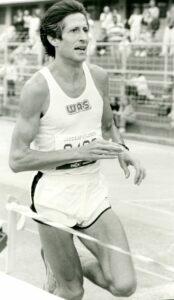
Ingo Sensburg (NSF) won the race four times – Photo: private
In 1990, the “Berlin Regional Athletics Committee of the DTSB of the GDR”, led by Stefan Senkel,
converted its existing “Peace Run” in East Berlin into a half-marathon and launched it on 1 September 1990 on Karl-Marx-Allee, with sections of the route also passing through West Berlin.
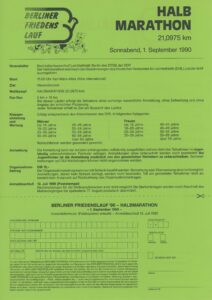
From „peace run“ (see logo -top left) to Half marathon in former East-Berlin – Photo: Horst Milde
As a result, the SCC cancelled its autumn date for the half marathon. Since the “Peace Run” organisers were unable, for financial reasons, to continue organising the race, the SCC stepped back into the role of organiser as early as 1991, incidentally with Stefan Senkel.
Under the “Friedenslauf” banner, the SCC’s half marathon continued on 1 September 1991, starting from Karl-Marx-Allee.
From 1992 onwards, the event was moved from autumn to spring, as it seemed more sensible to organise this ever-growing running event in spring and to keep the BERLIN MARATHON in autumn.
Admittedly, there were a few side notes illustrating that not everything went smoothly with the half marathon either. In 1993, for instance, the changing and organisation tents in the large car park on Alexanderstraße were blown through the air by a strong gust of wind, so that the nearby fire station stepped in at short notice to help with the organisation thanks to the dedicated assistance of Albrecht Broemme – Head of the Berlin Fire Brigade – or in 1994, when a delivery error left organisers with ten times the required amount of bananas, which were quickly distributed to nearby care homes and the Berlin Zoo.
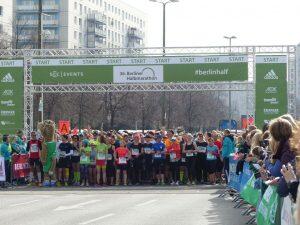
Start on Karl-Marx-Allee – Photo: Horst Milde
In the following years, the congress hall on the corner of Alexanderstraße was used for organisation. However, the start and finish locations had to be changed several times due to construction work.
Whilst the 1992 BERLIN MARATHON already recorded over 13,000 finishers, the response to the half-distance race, with 2,000 finishers, fell far short of expectations. The running community’s focus was solely on the BERLIN MARATHON. It was not until 2003 that the Berlin Half Marathon reached 10,998 participants.
The route was absolutely attractive, taking runners along the ‘Unter den Linden’ boulevard through the Brandenburg Gate, past the Victory Column, Charlottenburg Palace, Kurfürstendamm, the Kaiser Wilhelm Memorial Church and ‘Checkpoint Charlie’, finishing on Alexanderstraße. Later, the race finally moved to Karl-Marx-Allee, with the start and finish there.
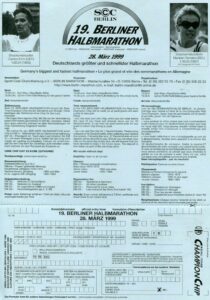
Carsten Eich, top left on the flyer, in the left-hand corner, in 1993 with the European record time – Photo: Horst Milde
After reunification, the winning times improved significantly: Stephan Freigang (LC Cottbus) won in 1990 in 1:01:14, Carsten Eich (Leipzig) in 1993 with the European record time of 1:00:34. Had the Berlin Half Marathon started a day earlier, Eich would even have set a world record, as the Kenyan Moses Tanui had set the bar at a finishing time of under an hour the previous day with 59:47 minutes. Times were also falling in the women’s race: Kathrin Weßel (SCC Berlin) initially ran 1:10:47 in 1994, before the course records were improved by the Belgian Marleen Renders to 1:10:04 (1998) and the Kenyan Joyce Chepchumba to 1:08:22 (2000).
Following Carsten Eich, the Spaniard Fabian Roncero set the second European record in 2001 with a time of 59:52 minutes, thereby also securing the Berlin Half Marathon’s breakthrough in the international spotlight.
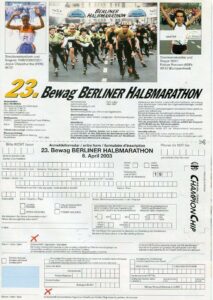
In the promotion flyer (2003) Fabian Roncero – with a new European record – is pictured in the top corner – Photo: Horst Milde
With the Berlin Half Marathon, SCC Berlin had another international ace up its sleeve alongside the BERLIN MARATHON. As early as 1997, the club had broken new ground with the introduction of an inline skating competition, which was also introduced with great success at the BERLIN MARATHON that same year. This once again made Berlin a trendsetter on the international running scene.
Due to various construction works, the start and finish were moved to the Schloßbrücke (2004) and to Karl-Marx-Allee (2011 to 2018); there is now a similar start and finish area to that of the Marathon, with the course passing through the Brandenburg Gate.
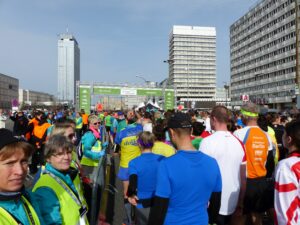
Start at Alexanderplatz – Photo: Horst Milde
From 2002 onwards, the men’s race was won exclusively by runners from Kenya (20) and Ethiopia (3); the last German winners were Carsten Eich (1993) and, in the women’s race, Sabrina Mockenhaupt (2009)In 2025.
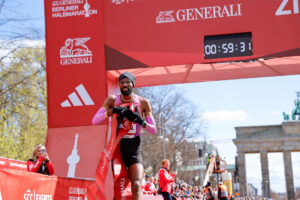
Amanal Petros – Photo: SCC EVENTS / Jean-Marc Wiesner
Amanal Petros also made a significant mark by setting a new German half-marathon record of 59 minutes 31 seconds.
Horst Milde
