 EN
EN
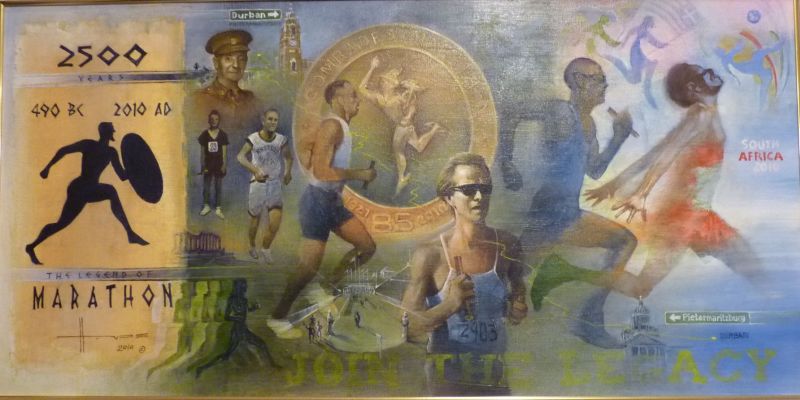
Henk Vos - a man of passion - and his painting from the Comrades Maathon for the AIMS Marathon Museum of Running. ©Horst Milde
“The artifact of the month” XVI. – Henk Vos – a man of passion – and his painting from the COMRADES Marathon for the AIMS Marathon Museum of Running in Berlin
In Athens, Greece, on the occasion of 30 year AIMS jubilee and the staging of the 30th Athens Marathon, Peter Proctor, Comrades Marathon Representative presented Horst Milde a painting as a donation for the AIMS Marathon Museum of Running.
This work of art, created by the South African artist Henk Vos, is based on the theme 2500 years of marathon running and includes key elements that reflect the history of the Comrades Marathon itself.
Horst Milde
Henk Vos – A man of passion
Botha’s Hill resident Henk Vos is a man of passion – and foremost among his passions are art, marathons and the Beatles. Adrian Rorvik gets up close and personal.
Spend time with Henk and you may be blown away by his grasshopper energy and dismiss him as an eccentric, but here is a man who sees links, signs and connections and grasps such strands with conviction as if they were the rigging of sails that propel him on his journey. One can only imagine that his uncommon, unwavering commitment to his path, coupled with his faith that solutions and directions will present themselves, strikes a chord and is admired in today’s materialistic world. Many years back, Vos was inspired by Oprah when she told her viewers “If you do what you love, you’ll never have to work again”! Since then he has enjoyed honing and developing his prodigious painting prowess.
Having studied art and then worked for display companies, commercial agencies, The Star newspaper and publishing houses painting and drawing, among other things, cartoons and “chocolate box” calendars, Vos went to work for himself in1975 and gained an immense reputation as a painter of wildlife. His huge oil, Survival of the Giants, became the symbol in the African campaign to save the disappearing herds of elephants. He later became renowned for his depictions of racehorses and particularly for his monumental five metre long painting commemorating one hundred years of the Durban July horserace, titled The Painting of the Century.
A decade has passed since Vos first started on what has evolved into The Circles of Life which contains 360 mainly circular themes or “degrees” as well as an additional five “Decrees” to make up one revelation for every day of the year, revolving round war and peace, life and death, love and hate, illuminating humanity’s influence upon our planet and beyond. It also revolves around the history of The Beatles and the VW Beetle car! Vos has been a Beatles fanatic since they first burst on the scene (they appear in The Painting of the Century) and in September he embarked on a “When I’m Sixty-four”/”Magical Mystery Tour”, boarding a plane for London wearing a Sgt. Pepper’s outfit.
His quest is to take The Circles of Life painting and follow the footsteps of the Fab Four, visiting as many Beatle landmarks as he can and, on the 25 September (when he’s 64), walk across the most famous zebra crossing on earth with his painting en route to the Abbey Road Studio where George Martin first produced their music. As he points out, this is 50 years since the Beatles first appeared in Liverpool, 40 years since they walked across Abbey Road. and broke up, and 30 years after John Lennon was gunned down by a deranged fan.
If that’s not enough, Vos will take part in five marathons on both sides of the Atlantic in just six weeks, including the Athens Marathon which commemorates the birth of the marathon 2500 years ago.
In 2009 Vos was browsing through a magazine in an optician’s waiting room when his eyes sparkled upon seeing The Beatles featured in an article on Abbey Road as a popular tourist destination. This planted the seed for his journey and he has been rehearsing by taking and displaying Circles of Life at every opportunity. Vos has devised a special collapsible easel, part of which he carries on his back in a weatherproof bag, while the painting is protected in a clever slimline, baize-lined wooden box inside a canvas bag- painted on one side with Magical Mystery Tour / When I’m 64, and on the other with Sgt. Pepper’s Lonely Hearts Club Band.
Part of Vos’s preparation for his trip involved running, which included the Comrades Marathon. Not only did he run the race but, two weeks before deadline, discovered there was an art competition which he duly entered and won. Such was his haste that he painted over an already completed painting. He also somehow found the time to conjure up a second which was purchased by the Comrades Marathon Association to be taken to Greece as a present. Vos is also embracing digital technology. “I have developed a technique I affectionately call “painting in celluloid”. Using clips of “paint” mixed upon the DVD “pallet” with a software “brush” applied to the “canvas” monitor, I am now able, like never before, to explain fully in an entertaining way the meaning contained in the “Circles” oil painting, incorporating the additional dimensions of action and sound in the process. I can only imagine how artists like da Vinci and Rembrandt would have blown their minds if they could only have shared in these unbelievable advances in technology with me!”
“If you do what you love, you’ll never have to work again!”
Two weeks before the closing deadline, I discovered that the Comrades Marathon Association where having a “Join the Legacy” art competition which I duly entered and fortunately won.
DESCRIPTION OF PAINTING
The seed for my “When I’m Sixty-Four Magical Mystery Tour” adventure was first planted In 2009 while I was browsing through a magazine in an optician’s waiting room. My eyes sparkled upon seeing The Beatles featured in an article on Abbey Road as a popular tourist destination. Then preparing to run a Cape Town race I saw an advertisement on the back page of an International running magazine inviting me to “RUN THE ORIGINAL…2,500 YEARS AFTER” celebrated the “birth” of the Marathon as an Olympic event.
One of the highlights of my life was to retracing Phidippides’s footsteps on that auspicious occasion and run into the Olympic stadium and receive a bronze medal on the 29th October 2010.
The Artwork “reads” from right to left, and appropriately starts with the poster commemorating and celebrating 2500 year since Phidippides ran from the bay of Marathon to Athens to carry the news of the victory and the warning about the approaching Persian ships. Despite his fatigue after his recent run to Sparta and back and having fought all morning in heavy armour, Phidippides rose to the challenge, delivering his message before dying from exhaustion shortly thereafter.
Huge field for 85th anniversary
A massive entry of 23.565 was received for the 85th edition of the race, which took place a little earlier than usual, to make allowance for the Fifa World Cup, on 30 May 2010. The race was once again a "down" run so that the big entry could be accommodated at the finish in Durban. is shown as starting point of the “Down” run (as shown by the. From “Pietermaritzburg” traffic direction sign the route the course takes is visible as it winds its way from the Pietermaritzburg City Hall through the special commemorative 85th COMRADES MARATHON medal (depicting the Olympian god in Greek mythology HERMES), past the Durban City Hall to “DURBAN’s” destination sign.
The inscription along the bottom of the canvas reads: “Join The Legacy”, theme of the Comrades Marathon race and Art Competition of the historic 2010 85th running of the world's greatest ultra-marathon.
Paying homage to the historical South African hosting of the prestigious World Cup Soccer Tournament, the classical iconic Greek athletics transform into African rock art figures culminating in the Logo of the World Cup.
VIC CLAPHAM
Beside the Greek poster, in the top left hand corner of the painting is featured the portrait of World War I veteran Vic Clapham. The Comrades Marathon as an event owes its beginnings in 1921 to the vision of this man.
Vic Clapham was born in London on 16 November 1886 and emigrated as a youth to the Cape Colony in South Africa, with his parents. At the outbreak of the South African War (Anglo-Boer War 1899-1902) he enrolled as an ambulance man into the Cradock Town Guard at the age of 13. He later moved to Natal and worked as an engine driver with the South African Railways.
With the outbreak of the Great War 1914-1918, Vic Clapham signed up with the 8th South African Infantry, and fought and marched 1700 miles of the eastern savannahs of Africa in pursuit of Glen Paul Von Lettow-Vorbecks askari battalions.
The pain, agonies, death and hardships of his comrades which he witnessed during those awful days left a lasting impression on the battle-hardened soldier, especially the camaraderie engendered among the men in overcoming these privations. Thus when peace was declared in 1918, Clapham felt that all those who had fallen in this catastrophic war should be remembered and honoured in a unique way, where an individuals physical frailties could be put to the test and overcome.
Remembering the searing heat and thirst of the parched veld through which he had campaigned, he settled on the idea of a marathon and he approached the athletic authorities of the day to sound their views. His enquiry led him to the doors of the League of Comrades of the Great War a corpus of ex-soldiers who had formed an association to foster the interests of their living companions who had survived the War.
Clapham asked for permission to stage a 56 mile race between Pietermaritzburg and Durban under the name of the Comrades Marathon and for it to become a living memorial to the spirit of the soldiers of the Great War This was strenuously resisted by the League, but Clapham persisted maintaining that if a sedentary living person could be taken off the street given a rifle and 60lb pack and marched all over Africa then surely a fit and able athlete could complete the distance.
Applications in 1919 and 1920 were refused but in 1921 the League relented and gave permission and 1 for expenses, which was refundable.
The first Comrades Marathon took place on 24th May 1921, Empire Day, starting outside the City Hall in Pietermaritzburg with 34 runners. It has continued since then every year with the exception of the war years 1941-1945, with the direction alternating each year between Pietermaritzburg and Durban, the so called up & down runs.
Bill Rowan
Forty-eight runners entered the first race in 1921, but only thirty-four elected to start. The course at the time was tarred only for the final few kilometres into Durban. A time limit of 12 hours was set and Bill Rowan became the inaugural winner, clocking 08:59 to win by 41 minutes ahead of Harry Phillips. Of the 34 starters, only 16 completed the race.
AURTHER NEWTON
Arthur Newton entered and won the race for the first time in 1922. He went on to win the race five times and emerge as the dominant Comrades runner of the 1920s. When he completed the down run in 06:56 in 1923, there were only a handful of spectators on hand to witness the finish because so few thought it possible that the race could be run so quickly.
The first woman to run the race was Frances Hayward in 1923,[4] but her entry was refused, so she was an unofficial entrant.[3] She completed the event in 11:35[3] and although she was not awarded a Comrades medal, the other runners and spectators presented her with a silver tea service and a rose bowl. In 1924 the Comrades had its fewest starters ever, just 24. Four years later, in 1928, the time limit for the race was reduced by an hour to 11 hours.
WALLY HAYWARD
The winner of the 1930 race, Wally Hayward, was to become one of the greatest of the legends of the Comrades Marathon.
In the 1950s, a full twenty years after he won the race for the first time, Wally Hayward recorded his second victory and followed that up with wins in 1951, 1953 and 1954. He represented South Africa at the 1952 Olympic Games in Helsinki, where he finished tenth in the marathon. Hayward retired from the Comrades after establishing new records for both the up and down runs and equaling the five wins of Newton and Ballington.
In 1989 Wally Hayward entered the race at the age of 79 and finished in 9:44:15. He repeated the feat in the 1989 Comrades, where he completed the race with only two minutes to spare and at the age of 80 became the oldest man to complete the Comrades.
BRUCE FORDYCE
Bruce Fordyce completely dominated the Comrades Marathon in the 1980s, winning the ultra-marathon nine times between 1981 and 1990. His 'down run' record of 05:24:07, set in 1986, stood for 21 years before finally being broken in 2007
In 1981, University of the Witwatersrand student Bruce Fordyce won the first of his eventual nine Comrades titles. An outspoken critic of apartheid, Fordyce and a number of other athletes initially decided to boycott the 1981 event when organisers announced that they would associate it with the 20th anniversary of the Republic of South Africa. Fordyce ultimately competed wearing a black armband to signal his protest. He repeated his victories in 1982, 1983, 1984, 1985, 1986 (a record 5:24:07 down run), 1987, 1988 (a record 5:27:42 for the up run), and 1990.
LEONID SHVETSOV
In 2007, Bruce Fordyce's 21-year-old record for the down run finally fell – and it did so in spectacular fashion. Russia's Leonid Shvetsov shattered the mark by more than three minutes with a stunning time of five hours, 20 minutes and 49 seconds.
Leonid Shvetsov was at it again in 2008, destroying his opposition as he won by almost 14 minutes over second-placed Jaroslaw Janicki and set a new up run record of 5:24.48 to better the record set by Vladimir Kotov in 2000.
STEPHEN MUZHINGI
Stephen Muzhingi became the first Zimbabwean winner of the Comrades in 2009 in the second fastest time ever recorded: five hours, 23 minutes and 27 seconds. Shvetsov, going for his third win in succession, was struck by cramps nine kilometres from the finish and had to settle for second.
In 2010 Zimbabwe's Stephen Muzhingi repeated as the men's champion, winning in 5:29:01. South Africans Ludwick Mamabolo and Sergio Motsoeneng finished in second and third as local athletes finished in eight of the top 10 places.
Muzhingi proved to be a formidable competitor on the "up" run too in 2011. He paced himself well and pulled clear 14 kilometres from the end before going on to victory in 5:32.45.
His win marked the first time since Bruce Fordyce in the 1980s that a male runner had won the Comrades three years in succession.
Source: COMRADES Marathon
Here is the essential information about the museum:
General Information on the Berlin Sports Museum- AIMS Marathon Museum of Running
The Berlin Sports Museum – The AIMS Marathon Museum of Running – The most fit museum in the German capital:
The Berlin Sports Museum – The AIMS Marathon Museum of Running – The most fit museum in the German capital
The AIMS Marathon-Museum of Running Presentation
News Sports Museum
2500 Years of the Marathon – The current Newsletter:
Download
More information about "The Artifact of the Month":
