 EN
EN
Berlin 10 km race for prisoners at Plötzensee Prison - Logo
Saved: The 9th Berlin 10 km race for prisoners on Friday, September 26, 2025, at Plötzensee Prison – Horst Milde reports
Another “highlight” of the Berlin running scene
Just under a week after the 51st BMW Berlin Marathon on September 21, 2025, another classic event in the Berlin running scene will take place: the 9th Berlin 10 km Run for Prisoners.
While over 50,000 participants complete the 42.195 km course in front of an audience of millions, the 9th Berlin 10 km Run for Prisoners, with an integrated 5 km run for Beginners, will take place behind closed doors at the Plötzensee Prison on September 26.
The traditional Berlin Justice Run was on the verge of being canceled for 2025, as the Senate’s austerity measures called into question the financing of the event.
Finally, the organization became a cost factor due to the involvement of a professional timekeeper, who, in addition to timekeeping and extensive evaluation, also ensures the printing of start numbers and certificates.
The services, which had been provided “manually” by volunteers until 2023, were too complicated and no longer appropriate.
The organizers are expecting further help from hoped-for “external participants” and spectators.
Against the backdrop of public sector spending cuts, this means that, in order to finance the costs incurred this year, a fee of 20 euros will be charged for the first time for registration to participate as an “external runner” or spectator.
Therefore, two steps are necessary for registration in 2025:
1. Register as a participant or spectator (with first and last name, date of birth, and ID card or passport number at the Plötzensee Prison by email to: sozialearbeit@jvapls.berlin.de
2. After confirmation of registration (by email from the Plötzensee Prison), the
registration fee of €20 (per registration) must be transferred to the account of German Road Races e.V.: IBAN: DE 36 47650130 1800080291 – Sparkasse Paderborn-Detmold-Höxter – WELADE3LXXX –
Reference: “Gefängnislauf 2025”.
If payment is to be made for additional participants, all names must be specified in the
reference field of the bank transfer. This complicated registration formality is due to the regulation that JVA institutions are not permitted to accept cash payments.
There is great hope that the “external participants” will help finance the event with their contributions. In return, participants receive exclusive access to an extraordinary and unusual running event.
The premiere of the Berlin 10 km race for prisoners took place in 2014 at the Plötzensee prison with 25 prisoners and 12 “external” participants.
In 2024, 35 prisoners (including 3 women) and 30 external runners took part. Due to the low turnout, it was decided to postpone the event until the fall to give the inmates more training time to prepare for the race.
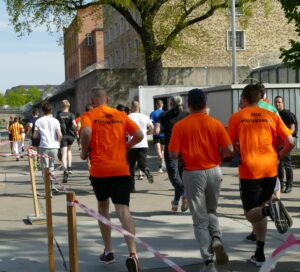
The participants shortly after the start – Photo: Horst Milde
The men’s course record is 37:20 minutes (Felix H./ 2022), and the women’s is 47:33 minutes (Mohamad K./2016).
The course record for men is 37:20 minutes (Felix H./ 2022), and for women 47:33 minutes (Mohamad K./2016).
The running course is a 1,000 m loop on the grounds of the Plötzensee Prison and thePlötzensee Youth Prison. It must therefore be completed ten times for the 10 km race and five times for the 5 km race.
The course was measured by World Athletics/AIMS A-grade course measurer John Kunkeler, who also measures the running courses for the BERLIN MARATHON and the Berlin Half Marathon, among others. John Kunkeler is also the traditional spokesperson for the event.
Since the course has been measured in accordance with competition standards, “records” could also be officially recognized, especially since the supervision is carried out by official referees of the Berlin Athletics Association (BLV).
The runners will be led during the race by Reinhard Roecher, marathon runner and former employee of the Plötzensee prison, on a bicycle. He has to pedal hard to keep up with the fast pace of the runners and clear the way for the leading group with shrill whistles when overtaking.
In addition to the general organization by the social education department of the Plötzensee Prison, German Road Races (GRR) is responsible for the sporting organization and provides external helpers and honorary prizes for this event.
As with every running event, there are also honorary prizes at the “Knästelauf,” as the race was originally called. The first six (of the prisoners) receive victory prizes from German Road Races, as well as the highly coveted jackets and T-shirts from the BERLIN MARATHON and T-shirts and sports equipment from ISTAF Berlin.
As in previous years, the sports officers of the seven Berlin prisons will receive a number of T-shirts from the BERLIN MARATHON and ISTAF BERLIN as an incentive and reward for the prisoners for their training. This will reward inmates in the individual prisons who are willing to train and motivate them to participate in training and the next races.
For the entertainment of visitors, the “in-house band” of the Plötzensee Prison, “Notorius booknumbers,” consisting of inmates and music teacher Jürgen Bailey, will perform.
The positive effects of sporting activities for prisoners with limited mobility that go beyond push-ups and strength exercises are undisputed and offer special motivation. Running and running therapy in prison are a stress buffer and are intended to reduce the stress experienced by inmates.
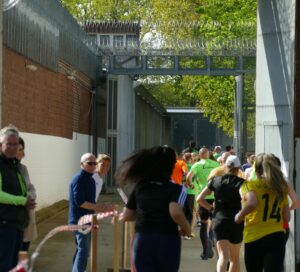
The narrow “passarelle” to the sports field of the youth prison – Photo: Horst Milde
The antidepressant and stress-reducing effects of running have been scientifically proven, which is why running in prisons is an important part of rehabilitation.
Strengthening a positive self-image and improving the chances of reintegration through meaningful leisure activities in running while in prison are important factors that are now recognized by the judiciary as a therapeutic measure and antidepressant in rehabilitation.
This running event is not only a special event for the Berlin judiciary – and thus a special “flagship” for the judiciary – but also a model event for German Road Races to bring running closer to all members of our society as a form of therapy for the soul.
The organizers‘ joint goal for 2025 is to have 70 inmates and an equal number of external runners.
Horst Milde
