 EN
EN
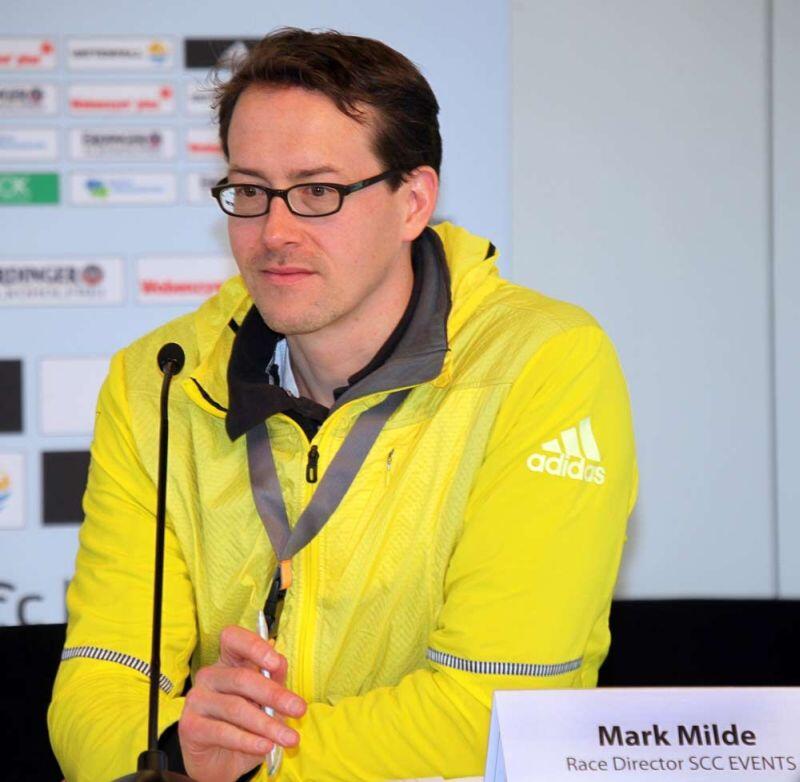
RUNNING GERMANY: BERLIN - Marathon Movers – Mark Milde - The rekordman - By Helmut Winter in Distance Running ©Helmut Winter
RUNNING GERMANY: BERLIN – Marathon Movers – Mark Milde – The rekordman – By Helmut Winter in Distance Running
With one glance at the list of elite athletes competing in the 40th BMW Berlin Marathon on 29 September last year, anyone would have expected results ranking among the best times ever run. For over a decade the race has been the non-plus-ultra marathon event.
On the morning of 29 September the then current men’s marathon world record had been set in Berlin two years previously; and on those courses ranked for the top-10 times ever achieved on them, Berlin credentials are even more impressive.
The Berlin Marathon is able to recruit the best athletes in the world year after year to come and compete for the next world record. And by the afternoon of 29 September Wilson Kipsang had delivered the present world record of 2:03:23.
A significant factor in Berlin’s dominance of the top marathon times is due to the work of one man, who for over 10 years has been responsible for the elite athletes at the Berlin Marathon: Race Director Mark Milde.
The general public and the media normally pay little attention to distance running, but when the marathon world record is mentioned many will ask: “Wasn’t that in Berlin?” It is in large part Mark Milde’s ability and hard work that has won Berlin such status in today’s fast-paced global world of distance running.
New world records are only possible with detailed planning and organization. The availability of top athletes, a ‘fast’ course profile, and optimal weather conditions are prerequisites without which “nothing runs”. New records no longer happen spontaneously.
Berlin’s success is even more remarkable because – in comparison to other big marathons – it operates on very limited resources. To account for the success one inevitably comes up with the significant factor of its race director. On race day he remains on the edge of the limelight: accompanying the lead runners on his bike, as an interviewee on the competitive aspects of the race, or congratulating the winners in the finish area.
His hard work takes place mostly outside the race arena. His ability in procuring top athletes, establishing race tactics together with the runners and their managers, and supporting their realization with creative ideas, is unrivalled.
Since Mark took on responsibility for the elite athletes, Berlin has monopolized the men’s world Marathon record. Paul Tergat’s 2:04:55 in 2003 has been improved four times to Kipsang’s current record of 2:03:23. During this period Berlin has had the year’s fastest time seven times; (compared to Rotterdam’s three). Berlin is also among the top women’s races internationally.
Mark’s first coup was to assist in getting Berlin’s first male record-setter, Ronaldo da Costa of Brazil to run in 1998. One year later he began his own career managing Berlin’s elite athletes and brought Tegla Loroupe (KEN) to Berlin to set her second “world best time” of 2:20:43. When Naoko Takahashi of Japan became the first woman to break the 2:20 barrier in the 2001 Berlin Marathon, with a time of 2:19:46, it was Mark Milde who ensured her participation by securing funding through a contract with Japanese TV. The world record and the unbelievable TV ratings in the Far East were a fabulous payoff.
At that time the race was still under the direction of Mark’s father, Horst, who had launched the Berlin Marathon in the Grunewald Forest back in 1974 when Mark was only one year old. At age eight, together with his brother Karsten, he helped distribute the race bibs, then later assisted at refreshment points along the course and increasingly became involved in the organizing team.
From early on he brought in innovative ideas which played an important role in his later success as elite athlete coordinator. In 1995 he initiated a personal drinks service that placed into the hands of the top athletes by appointing assistants dedicated to each athlete to hand over the drinks at each refreshment point (travelling between them on bikes). This avoided elite athletes struggling to find their drinks.
Mark Milde’s older brother Karsten personally handed drinks to Da Costa (1998), Loroupe (1999), Takahashi (2001), Tergat (2003), and Haile Gebrselassie (2007, 2008), as each of them continued on to set a world record.
Another innovation was “saturation” pacing. To help top runners achieve times under 2:05 Milde used pacemakers in a formation that provides a protective wedge at a fast and controlled pace. This involves agreeing which pacemakers are to lead at what point, and who should take over when one weakens. Haile’s world records in 2007 and 2008, Makau’s in 2011 and Kipsang’s recent world record were all achieved in such a manner. Milde’s talents are recognized by both athletes and managers around the world, yet despite his great success he has kept both feet solidly on the ground.
He has a proven ability to recognize potential young athletes and provide early support. He recruited young athletes who had good times over shorter distances as in order to whet their appetites for the marathon and their affinity to Berlin. Geoffrey Kipsang was one such. He won the Berlin Half Marathon at age 18 in 1:00:38 and then paced Haile and Makau. In 2012 he came third in the Berlin Marathon in 2:06:12. He then ran a 58:54 half marathon in February 2013 in Ras Al Khaimah, and again finished third in Berlin in Wilson Kipsang’s world record run.
Mark Milde was athletically active himself: his best marathon time is 2:50:36; he has completed an Ironman Triathlon and his love of inline skating led him to integrate this sport into the Berlin event to huge success, with the Berlin Skating Marathon now the largest of its kind in the world.
Horst Milde handed over to Mark as race director in 2004 with the advice: “lead by example and stay cool”.
He has done so, fulfilling all expectations and bringing Berlin to centre stage in the Marathon world.
Helmut Winter in Distance Running – 1/2014
