 EN
EN
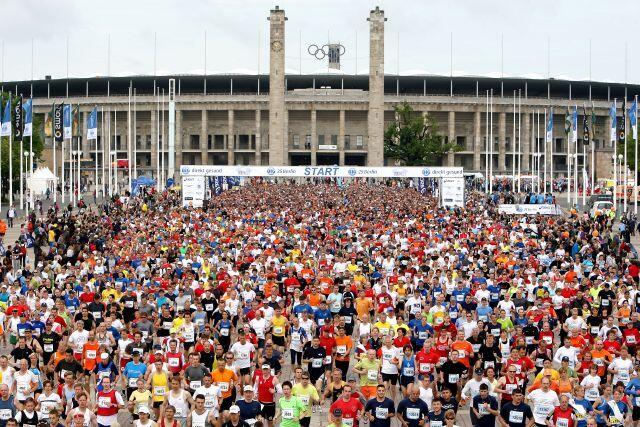
Start of the "25 km de Berlin" in front of the famous Olympic Stadium ©Victah Sailer
RUNNING GERMANY – BERLIN: History of the „25 km de Berlin“ – In 1981 the event “25 km de Berlin“ was the first German city road race
The first edition of the “25 km de Berlin“ on May 3rd 1981 was the start for a greater running movement. In America, Great Britain and several other countries running was already popular. City races were common in those countries. In Germany running was still in its beginnings.
Streets were not supposed to be for runners until that 3rd of May 1981. Yet there have been ambitions from the organisers of the marathons in Berlin and Frankfurt to follow the American example. But the French allies in Berlin were the ones who could finally install a city race. They organised the “25 km de Berlin”, which became a precursor of German city races. Today the race is called BERLIN RUNS … 25 km.
During the last few years the event has developed. In the first years only the distance of 25 k had to be run. In the recent years a couple of additional competitions were introduced. First of all a children’s run with a distance of about 2.5 k was added, later the organisers put up a 10 k run and again some years later a relay of 5 x 5 k was included.
It was the idea of the French Major Bride to organise a city run of 25 k through Berlin. The 20 k race from Paris to Versailles served as a role model for the Berlin event. The prerogative was the right of the allies in Berlin, therefore the police did have no means to stop the race through the city. The organisation was a large scale operation not only for Major Bride and the co-organising institutions Landessportbund Berlin (LSB) and the athletics association of Berlin (BLV), but also for the police. After all the “25 km de Berlin” became a widely acknowledged success and cleared the way for city races in Berlin. In the same year the course of the Berlin Marathon led through the city for the first time.
3,250 participants started at the first edition in 1981. Turkish runners Mehmet Yurdadön and Mehmet Terzi passed the finish line jointly for victory in 1:16:59 hours holding their hands. The French Yonille Audibert was the first woman to win the event in 1:36:35 hours. The fact, that there were two winners entering the finish line together in the first year, fit to the concept of the French organisers. It was their goal by organising this race to show their friendly connection to the population of Berlin. During the first 10 years the soldiers of the western allies formed a large group in the growing field of participants.
In 1984 there were already 7,583 runners, two years later even 10,063. The largest number of participants was registered in 1990. Half a year after the wall had come down 14,300 runners from all over the world ran through the city. In the following years there was a considerable decline of the number of participants in this temporarily biggest running event of Germany. In the last years a positive development of the race was recorded.
In the first five years the male victories came from France and Turkey. During this period German Christa Vahlensieck could win the women’s race twice. The other three times a French runner won. In 1984 the so far best victory times were achieved. The internationally known French 10,000m record holder Pierre Levisse won in 1:15:11 hours.
His compatriot Joelle de Brouwer improved the course record by nearly four minutes to 1:24:06 hours. She defeated the favourite, then European Marathon Champion Rosa Mota. Even though the Portuguese ran a top time of 1:24:59, she was clearly beaten. The series of French-Turkish successes had come because of the lack of contacts of the French organisers to international top athletes. This changed later on.
Olympic Champion Rosa Mota wins with a course record
Rosa Mota came back to the „25km de Berlin“ being an Olympic Champion – and she won her second attempt. 1989 she set up a new course record with 1:25:46 hours. The course had been re-measured after the sensational 1:14:33 victory of the German long distance stars Ralf Salzmann and Herbert Steffny in 1986. The new measuring procedure of the Association of International Marathons and Road Races (AIMS), in which the race is a member, really showed a slightly too short course.
On the correct 25 k course Berlin’s Kerstin Preßler repeated her victory in 1987. In 1:26:18 h she was even four seconds faster than the year before. In the men’s competition Swiss Markus Ryffel set a mark in 1987 with 1:15:04 hours that could not be beaten during the following five years. Despite respective first-class races neither Dave Clarke (England), who won in 1989 with 1:15:07, nor Alfredo Shahanga (Tanzania), who reached the first African victory a year later in 1:15:09, succeeded against Ryffel’s course record.
In 1992 there was a unique Berlin double success reached by Kathrin Ullrich-Weßel, who improved the course record to 1:24:41, and Rainer Wachenbrunner, who ran 1:15:21 hours. Tendai Chimusasa surprised in 1993 with a world best time of 1:14:25 hours. In 1994 he repeated his success with only a slightly slower performance of 1:14:45 hours. Kenya’s Kenneth Cheruiyot became the first runner ever to run a 25 k race under 1:14 hours in 1997. The 23 year-old won in 1:13:58.
The fastest woman that year was Lornah Kiplagat (Kenya) with a course record of 1:24:39 hours. It was a year later that Kenya demonstrated ist domincance. Eight men and threee women started – and came in first to eighth and first to third, respectively. Isaac Chemobo clocked 1:14:16 hours, the second best time ever run in Berlin so far, Lornah Kiplagat repeated her success in 1:26:15. In 1999 the women’s race was in the centre of interest. Susan Chepkemei (Kenya) ran 1:24:29 hours. That was a course record and she had missed the world best time by just two seconds.
The first European double victory since 1992 happened in 2000, when Robert Stefko (Slovakia/1:15:31) and Madina Biktagirova (Russia/1:26:01) won.
Kenyans run world records
Another high class race took place in 2001, where the spectators watched the third world record in the history of the event. Winner Rodgers Rop (Kenya) ran 1:13:44 and even the runner-up John Yuda (Tanzania) stayed under 1:14 with his 1:13:56 result. In 2004 the runners were even faster. The finish line was located in the Olympic Stadium again, after several years of reconstruction of the arena (an alternative finish had to be put up during this time).
Kenyan Paul Kosgei won the race in 1:12:45 hours, followed by ten fellow-Kenyans. He smashed the world record by nearly one minute. Besides the 26 year-old winner also the succeeding four runners ran times faster than Rodgers Rop’s former world record. Second was Luke Kibet in 1:12:52, third place was taken by Benson Cherono in 1:13:01.
During the 25th edition of the race in 2005 once again the Kenyans were dominating. The first 12 places were occupied by the athletes from East Africa. In a thrilling sprint finish Luke Kibet reached victory with the high-class time of 1:13:51. Only one second later Simon Kiprop crossed the finish line. In the women’s race the spectators watched a thrilling sprint duel as well. Finally Rose Cheruiyot (Kenya) won in a quick 1:24:46 hours. She was as well only one second ahead. Dire Tune Arusei (Ethiopia) took second.
For the first time since 1990 a five-figure number of participants registered in 2006. A total of 10,495 athletes took part in different races. The 25 k was of course still the main competition of the whole event. 6,186 joined this race. Once again the race produced first-class results. The winner Patrick Makau Musyoki ran a fine 1:14:08. The women’s race was won by a Kenyan as well: Peninah Arusei clocked 1:26:25. Kenyan runners continued their series of victories also in 2007. For the 7th time both winners came from the African country. 22 year-old Patrick Makau Musyoki won again despite high temperatures (1:14:22). His compatriot Flomena Chepchirchir was surprisingly the fastest woman, who reached the finish on the blue track of the Berlin Olympic Stadium in 1:25:38 hours.
From 2008 onwards BERLIN RUNS took over as organiser of the traditional race:
4th May 2008 – BERLIN RUNS, the new organiser of the traditional Berlin 25 k race, had a perfect start this Sunday. The 28th edition of what is Germany’s oldest big city road race produced high-class winning times: While Samuel Karuku (Kenya) surprisingly took the men’s race with 1:13:49 his fellow countrywoman Peninah Arusei established a new course record of 1:24:10.
Adding all running events 8,142 athletes from 23 nations had entered the event, which finished inside the Berlin Olympic Stadium. The figure was up by more than 1,000 runners compared to last year, showing that BERLIN RUNS is on its way to bring back the race to former glory. More than 50,000 spectators lined the course through Berlin’s city centre. Among the total figure of 8,142 entries there were 6,012 runners for the 25 k distance. 1,628 had entered the 10 k event while 502 children ran a 2 k race. “This is a superb start for us. Entry figures are up by a big margin compared to a year ago. Additionally we got superb winning times. Combining the two winning times the race never ever had such high quality results,” said Race Director Gerhard Janetzky.
10th May 2009 – Taking the two winners’ times the 29th edition of the BIG 25 Berlin produced the best ever 25 k race. Kenyans Matthew Koech and Peninah Arusei took advantage of the perfect weather conditions and clocked world leads on the fast course through Germany’s capital. 25 year-old Matthew Koech ran 1:13:24, which is the seventh fastest ever run at the distance. Peninah Arusei became the first runner to achieve a third victory in this race. The 30 year-old, who had taken the race in 2006 and 2008, clocked a course record of 1:22:31, which was the fourth fastest ever.
The BIG 25 Berlin also made big progress regarding the fun runners: 9,871 entries from 45 nations were registered for Germany’s oldest city road race. Fred Kosgei (Kenya) finished second in 1:14:35 while Luke Kibet (1:15:31) took third. Behind Peninah Arusei, who smashed her course record from last year by more than 90 seconds (1:24:10), Furtuna Zegergish (Eritrea/1:22:57) and Caroline Cheptonui (Kenya/1:23:43) took second and third, beating the former course record as well.
9th May 2010 – Kenyans Samuel Kosgei and Mary Keitany crowned the jubilee edition of the BIG 25 Berlin with unique double world record performances. Never before have both world records been broken in one road race. While Sammy Kosgei stormed into the finish inside the Berlin Olympic Stadium with a time of 1:11:50, Mary Keitany clocked a sensational 1:19:53. She became the first female runner to dip under 1:20 in a 25 k race. Both records were smashed in the BIG 25 Berlin race.
Organisers of BERLIN RUNS registered 10,114 runners from 47 nations at the 30th edition of the race. Elite runners took advantage of perfect conditions for running on Sunday morning. While temperatures were between 12 and 14° Celsius there was practically no wind at all and the sky was overcast.
A duel between Samuel Kosgei and Gilbert Kirwa (Kenya), the winner of the Frankfurt Marathon in 2009, developed.
At first the defending champion Matthew Koech (Kenya) ran together with the two, but he soon dropped back. The pace kept high although the section between 18 and 21 k is slightly uphill. Samuel Kosgei – he was Haile Gebrselassie’s pacemaker in last year’s Berlin Marathon and was next to the Ethiopian when the 30 k world record of 1:27:49 was established in that race – and Gilbert Kirwa had reached the 20 k mark in 57:22 and then they achieved a remarkable half marathon split time of 60:42. In the final two kilometres 24 year-old Samuel Kosgei opened a decisive gap. He finally improved the world record set by Paul Kosgei (Kenya) in this race in 2004 (1:12:45) by almost one minute. Gilbert Kirwa took second and he also achieved a sub 1:12 time with 1:11:58. Terefe Maregu (Ethiopia) was third in 1:13:16. Altogether seven runners finished inside 1:14.
Among them was the former world record holder Paul Kosgei. He had been in the leading group until close to the 15 k mark and finally finished in sixth position with 1:13:48. „It was my aim to run 1:12 here today. But I did not think that I could win this and I also did not expect to run sub 1:12,” said Samuel Kosgei. Right from the start Mary Keitany ran her own race at the front, supported by two pacemakers. With an even pace the 28 year-old World Half Marathon Champion was on course for a time of around 1:20 throughout the race. She reached the 10 k mark in 31:58 minutes – a time which would be good enough to win almost all of Germany’s 10 k races – and then clocked 47:58 at the 15 k point.
Even when the course was going up on the way back to the Olympic Stadium Mary Keitany kept her rhythm and speed perfectly. Finally clocking 1:19:53 she smashed the world record set by Japan’s Mizuki Noguchi during the Berlin Marathon 2005 (1:22:13). Mary Keitany was almost five minutes ahead of Alice Timbilili (1:24:38), who was second. Pasalia Kipkoech (both Kenya/1:26:47), who had recently won the Berlin Half Marathon, took third. „I have prepared long and intensively for this race and I had expected to break the world record. But I did not expect to break it by such a margin and to run sub 1:20,” said Mary Keitany.
8th May 2011 – The BIG 25 Berlin have confirmed its position as the world’s leading 25 k race. Despite the warm weather world leads for the men and women were established at the Berlin Olympic Stadium. While a year ago both world records were broken at the BIG 25 Berlin this time Mathew Kisorio (Kenya) clocked 1:12:13, which is the third fastest time ever run at the distance. The 21 year-old missed the world record of his fellow countryman Samuel Kosgei, who had finished with 1:11:50 in 2010, by just 23 seconds.
Women’s winner Filomena Chepchirchir clocked 1:23:22, the fastest time so far in 2011.
Adding other running events organisers of BERLIN RUNS registered 10,423 entries for the 31st edition of the BIG 25 Berlin. In the men’s race a group of Kenyan favourites was on course for a world record until the half marathon mark. It was only on the final three kilometres, when Mathew Kisorio was running alone, that he could not quite keep the pace. “It is a fantastic event. Sadly it was too warm to break the world record,” said the 21 year-old. With his time of 1:12:13 he was well ahead of fellow Kenyans Levi Matebo (1:12:46), Eliud Kiptanui (1:12:59), Nathaniel Kipkosgei (1:14:00) and Onesmus Serem (1:14:05). Tujuba Beyu (Ethiopia/1:14:50) and Japhet Kipkorir (Kenya/1:14:59) also finished inside 1:15, taking sixth and seventh places.
In the women’s race Filomena Chepchirchir had been regarded as the favourite. And the 29 year-old Kenyan confirmed this, when she appeared to dominate the race. Chepchirchir, who had won the BIG 25 Berlin in 2007 and had placed second the year after, clocked 1:23:22, which is the fourth fastest time ever in the history of the event and a personal best. She was well ahead of fellow Kenyans Diana Chepkemoi (1:26:14) and Christine Chepkemei (1:28:24).
6th May 2012 – Dennis Kimetto stormed to a world record at the BIG 25 Berlin: Kenya’s 28 year-old newcomer crossed the finish line of the traditional 25 k race in 1:11:18. Caroline Chepkwony (Kenya) was the women’s winner, clocking a world-class time as well with 1:22:56. Adding all running events of the day there were a total of 10,478 athletes competing in Germany’s oldest city road race. In the history of the event, which started back in 1981 and always had the finish inside the Berlin Olympic Stadium, this was already the seventh world record.
A very fast men’s race developed right from the start. It was between 23 and 24 k when Dennis Kimetto broke away from Wilfred Kigen and then stormed into the Olympic Stadium to become a world record holder. Kigen clocked 1:11:29 for second and was also faster than the former world record holder. Jacob Kendagor (all Kenya) took third with 1:11:59. In contrast to the men’s race the women’s leading group broke up soon after the 5 k mark.
From then on Caroline Chepkwony built a big lead. Guided by a pacemaker she achieved a time of 1:22:56 which is the third fastest winning time in the history of the event. Caroline Chepkwony was well ahead of Taemo Shumye Woldegebriel (Ethiopia/1:25:21) and France’s Christelle Daunay (1:25:27).
Jörg Wenig / race-news-service.com
Online registration
 Register now for BIG 25 Berlin on May 5th 2013:

