 EN
EN
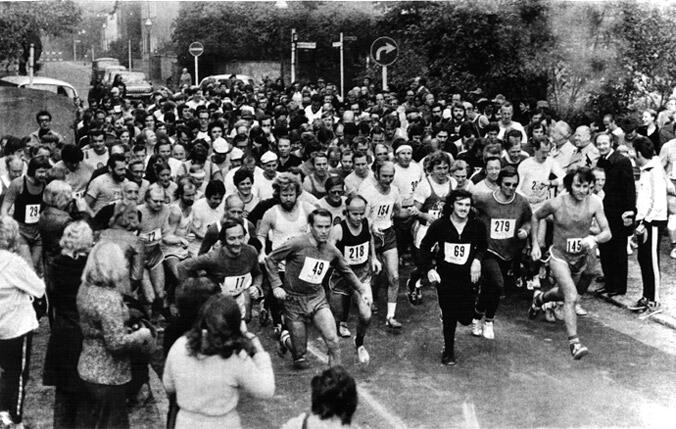
The "1. BERLINER VOLKSMARATHON" on 13. october 1974 - 9.00 h - start in Waldschulallee 80 in Berlin-Charlottenburg ©Sportmuseum Berlin – AIMS Marathon-Museum of Running
RUNNING GERMANY: BERLIN – 40th BERLIN MARATHON 2013 – Running into History – The first 30 years of the BERLIN MARATHON
The story of the BERLIN MARATHON is a story of the development of road running in Germany. When the first BERLIN MARATHON was started on 13th October 1974 on a minor road next to the stadium of the organizers‘ club SC Charlottenburg Berlin 286 athletes had entered. 244 runners finished.
The first winners were two runners from Berlin: Günter Hallas (2:44:53), who still runs the BERLIN MARATHON today, and Jutta von Haase (3:22:01), who actually was a middle distance runner in the 70’s. But to find out about the roots of the BERLIN MARATHON one has to look back another ten years. It was in November 1964, when a group of students
from the "Free University Berlin" – (FU Berlin) organised the first cross country race in Berlin’s Grunewald, a large forest area.
Already then Horst Milde was the main organiser of the race – nearly 40 years later he still is in charge as race director of the real,-BERLIN-MARATHON and of all the other races of SCC-RUNNING, including the cross country.
Actually the race in 1964 was a starting point for the development of mass races in Germany. Before only club runners were allowed to start in running events. For the first time people who were not associated with a club could enter the race. And it was an immediate success. More than 700 runners entered the race, which additionally was the first cross country event in Germany.
Before there used to be only races on flat walking routes in the forests. It was indeed Horst Milde and the SCC Berlin which then successfully applied for the introduction of national cross country championships.
During the next few years the SCC Berlin started to organise more running events in West Berlin. It was a coincidence that led to the idea of staging the first BERLIN MARATHON. The organizers from SC Charlottenburg read about a marathon that was staged by Berlin’s local athletic federation. It was described as a great success, although it had less than 100 participants. ”We should be able to do better“, Horst Milde thought. And they did, although not knowing what would develop from their first BERLIN MARATHON.
Until 1980 the marathon route led the runners along the Grunewald. The largest participation in those days was 397 in 1976. But already during the early stages there was a world record.
In 1977 the national marathon championships were held at the event for the first time. Although this race was not started at the same time of the day. The women’s championship winner was Christa Vahlensieck from Wuppertal who covered the distance in 2:34:47,5.
About one year later her time was bettered by the famous Norwegian distance runner Gre-
te Waitz. The official winner of the BERLIN MARATHON in 1977 was Angelika Brandt (3:10:26,8). 1977 also saw quite a good men’s winning time: British runner Norman Wilson won in 2:16:20,7. It was the fastest time on the old course along the Grunewald. But three years later Ingo Sensburg came close. In 1980 the runner from Berlin finished in 2:16:48.
Until today he is the only male runner to have won the BERLIN MARATHON three times: 1976, 1979 and 1980.
The 27th September 1981 was a big day for the organizers of the SC Charlottenburg. For the first time the BERLIN MARATHON was run through the main streets of West Berlin. The race was started in front of the Reichstag and finished on Kurfürstendamm.
But it was a hard piece of work for Horst Milde and his colleagues to convince the city’s government and especially the police to give the needed authorisation. When Milde was introduced to the chief of Berlin’s police, he was described by officers as a mad person.
And even when the decision was final that BERLIN MARATHON would be run right through the city for the first time the opinion of the police was clear: „Roads are for cars only – not for runners“, they argued, when SCC planned that the finish would be on Kurfürstendamm.
In the eyes of the police running through Kochstraße was impossible, because the famous Checkpoint Charlie would have been cut off. But once again the organizers found a way to success. They contacted the American forces directly and got the permission to run through Kochstraße from John Kornblum, who later be- came ambassador of the United States in Germany.
The American forces as well as the British and French allies were among the most important supporters of the BERLIN MARATHON in the 80’s.
It was also no coincidence that the first winner on Kurfürstendamm in 1981 was British. Ian Ray ran 2:15:41,8, finishing ahead of two fellow countrymen. Angelika Stephan from Kassel (Germany) won the women’s race in 2:47:23,5.
A total of 3,486 runners from 30 nations participated in the race. And in the end even for the police the event was a success – they had kept the roads free of traffic. It was already in 1981 that a couple of wheelchair athletes took part in the race. BERLIN MARATHON has always supported this discipline.
Later Heinz Frei (Suisse) would go on to record enormous success on Berlin roads. Out of 17 starts he took 15 wins and set four world records.
The quality of the BERLIN MARATHON then im- proved from year to year. Right through the 80’s the women’s course record was improved every year. In 1984 Agnes Sipka (Hungary) was the first woman to run sub 2:40 (2:39:32). And another four years later Renata Kokowska (Poland) beat 2:30 (2:29:16). While Domingo Tibaduiza (Columbia) was the first winner to run sub 2:15 (2:14:46) already in 1982, it took a while to get a sub 2:11 result.
Finally Alfredo Shahanga managed to get this much wanted time. In 1989 he ran 2:10:11. It was the third time in a row that a runner from Tanzania had won the BERLIN MARATHON. Suleiman Nyambui was a prominent winner in 1987 and 1988. He was the first African winner of Germany’s biggest and fastest marathon.
The numbers of participants increased strongly from 1981 onwards with 6,270 athletes from 45 nations starting in 1983. It was only two years later that more than 10,000 entries were registered for the first time (11,814). Running became more and more popular in Germany, and hundreds of thousands of spectators lined the streets on marathon day in West Berlin.
Already in 1978, the organizers decided to honour Olympic marathon champions. From then on their faces appeared on the medal, which every finisher gets. The certificates, which were sent to the runners later on, also showed the Olympic champions. Some time after the BERLIN MARATHON in 1983 a certificate was sent back to organizers. The Italian runner Roberto Baradi had not understood the idea. He had written on the certificate: „That’s not me!“ He even had attached a photo showing himself and put a mark on it, saying: „That’s me!“
Nothing in 1989 indicated that just one year later the BERLIN MARATHON would reach another dimension.
Bernd Hübner, a runner from Berlin who is the only athlete to have finished all 29 editions of the BERLIN MARATHON, remembers: „In the 80’s we used to say, when we went to the start right at the wall at Brandenburg Gate: It would be nice if we would be able to run through the gate. But we never expected it to happen in our lives.“
This year Hübner will run the real,- BERLIN MARATHON with bib number 30.
Some runners from East Germany managed to run the BERLIN MARATHON even in the 80’s. They were lucky to get permission for a visit of a family member in West Germany and used this opportunity. The organizers knew about it, and they of course gave them numbers without receiving any money for it. Names were kept secret for security reasons. If the "Stasi" would have found out about it, the runners would have faced problems once they were back in the GDR.
The BERLIN MARATHON was popular in East Germany right from the beginning. „It was a dream for us to be able to start in West Berlin“, Roland Winkler remembers. He was one of the few runners from the GDR to be able to run the BERLIN MARATHON. „It was simply an unbelievable experience“, he says. For security reasons one runner from East Germany was registered under the name of his dog first and then he chose the name of his village next time. Some runners listened to West Berlin radio stations when they were living near the wall to get news about the race. That was of course forbidden.
Others went up the TV tower at Alexanderplatz to get a view. Once there were so many runners who tried to get up that the tower had to be closed.
The 30th September 1990 was a very special date in the history of the marathon. Three days before the official German unification the limited number of 25,000 runners ran through Brandenburg Gate – many of them with tears in their eyes. It was also the day when the BERLIN MARATHON established itself among the fastest marathons in the world.
Steve Moneghetti (Australia) ran a world year’s best of 2:08:16 – the first world class time
in Berlin. It was Uta Pippig, who had left the GDR right after the wall collapsed and moved to Stuttgart, who managed a home win. She was already back in Berlin and a few months later she was going to start for the SC Charlottenburg, when she won in 2:28:37. „I got goose-pimples when I ran through the Brandenburg Gate. It was a very emotional experience“, Uta Pippig said.
Two years later BERLIN MARATHON again saw an historical race. It was the first time that South African athletes were allowed to compete in a big city marathon after the apartheid ban. And what a comeback they made: David Tsebe won the race in a course record of 2:08:07. One year later Renata Kokowska (Poland) ran a personal best of 2:26:20 and achieved her third win in Berlin after 1988 and 1991.
There were two German winners in 1994 and 1995, which proved the strength of German women at the event at this time. In 1994 Katrin Dörre-Heinig set a course record of 2:25:15 and a year later Uta Pippig ran 2:25:37. It was her third win after 1990 and 1992.
1995 saw a great men’s race and the first Kenyan triumph. In a race against 1994’s win-
ner António Pinto (Portugal) and Vincent Rousseau (Belgium), the strongest European runner at that time, Sammy Lelei achieved a remarkable breakthrough in marathon running. His 2:07:02 was the second fastest time of all times and the fastest for more than seven years. He missed the world record by just twelve seconds. It was a total triumph for Uta Pippig’s coach Dieter Hogen, who took care of Lelei and some other Kenyans at that time.
After Abel Antón (Spain) started his marathon career with a win in Berlin in 1996 (2:09:15) the race in 1997 produced a large number of top times. It was Elijah Lagat (Kenya) who won in 2:07:41, just two seconds ahead of Eric Kimaiyo (Kenya). Nine runners finished sub 2:10 and 21 sub 2:15.
Catherina McKiernan (Ireland) won the women’s race in an unofficial debut world debut record of 2:23:44, which was a course record as well.
The 25th BERLIN MARATHON had a record number of 27,621 athletes who had entered the race. And the jubilee edition was unexpectedly crowned by a world record. Ronaldo da Costa (BRA) ran the race of his life. Despite not having been in the leading group in the first part of the race, he then left the rest of the field behind by the beginning of the second half. Becoming faster instead of slower he finally clocked 2:06:05 hours.
Ronaldo da Costa became the first athlete to have run the marathon in an average speed of more than 20 k per hour. That meant he was also the first runner to have run every kilometre in an average of sub 3:00 minutes.
A year later another world record was broken. This time Tegla Loroupe (KEN) became the heroine of the BERLIN MARATHON. The outstanding Kenyan distance runner wanted to be the first woman runner to achieve a sub 2:20 time in the marathon. She had the potential, but unfortunately got some muscle problems during the race. Because of that Tegla Loroupe had to slow down and would miss her big goal. In the final stages she was getting faster again and finally just managed to break her own world record by four seconds.
Loroupe, who is a shining example for Africa’s women athletes, ran 2:20:43.
The men’s winner Josephat Kiprono (Kenya) ran a world class time of 2:06:44 as well. And there was an Asian record as well: Takayuki Inubushi became the first Japanese athlete to run sub 2:07. He finished second in 2:06:57. Maybe it was because of Inubushi’s race that the interest of Japanese elite runners in the BERLIN MARATHON rose.
In 2000 Kazumi Matsuo became the first Japanese athlete to win Germany’s biggest
marathon. While Matsuo ran 2.26:15 Josephat Kiprono (Kenya) was the fastest man (2:07:42). That year’s race also marked the first time more than 30,000 entries
were received.
In 2001 the Japanese superstar Naoko Takahashi had decided to run the real,- BERLIN MARATHON. The aim of the Olympic champion was obvious. She wanted to be the first woman to run sub 2:20. And finally she was the one to do so. For twenty years the best women distance runners had unsuccessfully tried to break this barrier.
Naoko Takahashi won the real,-BERLIN MARATHON in 2:19:46.
Nearly half of the nation back home watched her breaking the record as the race was broadcasted live in Japan.
After the 11th September the race had a political dimension as well. The runners held up a banner before the start. It read „United we Run“ and showed the symbols of both the real,- BERLIN MARATHON and the New York City Marathon. A couple of weeks later it was placed on Verrazano Bridge for the start of the New York Marathon.
A year later Naoko Takahashi was back in Berlin. After injury problems it was her first marathon since her triumph the previous year. Her form was not quite as good, but she achieved a world class time of 2:21:49.
Raymond Kipkoech (Kenya) won the men’s race in 2:06:47. Meanwhile the real,- BERLIN MARATHON continued to grow.
A year before the 30th edition of the race the milestone of 35,000 entries was surpassed for the first time.
Paul Tergat smashes the world record 2003-09-28
Paul Tergat of Kenya made a quantum leap in marathon running when he clocked the first sub-2.05 in history, winning in Berlin this morning in 2.04.55. That takes all of 43 seconds off American Khalid Khannouchi's previous record of 2.05.38, set in London 2002, when Tergat was second in 2.05.48.
Paced by half a dozen compatriots, on a perfect day with temperatures ranging between 9 and 12 degrees centigrade, the 34 year old Kenyan was always on course for a new record. But, in the end it was a tight victory for the man who had not won in five previous starts.
Tergat got away from his last pacemaker with a kilometre to go, but Sammy Korir closed fast in the final strides, and was only a second behind Tergat at the line, to take three and a half minutes off his previous best, and become the second member of a very elite club This is the third world record of Tergat's illustrious career. The elegant and personable Kenyan, who won five successive world cross country titles between 1995-9, set a 10,000 metres record of 26.27.85 in 1997, since broken by his great rival Haile Gebrselassie, and ran the current half-marathon record of 59.17 in Milan 1998.
Tergat's run was extraordinary enough, but 40 year olds across to the world will rub their eyes at the feat of their peer, Andres Espinosa. The Mexican finished fourth, and took over two minutes off the veterans' or masters' record, with 2.08.46. The previous record was 2.11.04, by John Campbell of New Zealand.
Tergat, who won 120,000 euros, said he expected to break the record, but not by so much. "I knew deep in my head that one day I would get this world record, and today everything fell into place. It was a relief after training for so long. But I couldn't believe the time, I thought I could maybe do low 2.05, but 2.04 was fantastic".
This was another triumph for the Berlin organisers with race director Horst Milde, whose superfast course has now yielded four world records in the last five years, since Ronaldo da Costa of Brazil cart-wheeled over the finish line in 2.06.05 in 1998. Tegla Loroupe of Kenya broke her own world record the following year, with 2.20.43, and that was improved to 2.19.46 in 2001, when Olympic champion Naoko Takahashi of Japan became the first sub-2.20 woman.
Yasuko Hashimoto made it four in a row for Japanese runners in the Berlin Marathon women's race this morning (Sunday), when she won in two hours, 26minutes, 32seconds (2.26.32).
Hashimoto took over from long-time leader Alina Ivanova of Russia at 35 kilometres, and was never challenged again. In only her third marathon, Hashimoto improved her best from 2.29.37, set in Nagoya earlier this year.
There was a tight finish in the men's wheelchair race between the two giants of the sport – Joel Jeannot of France prevailing in the last 100 metres over Heinz Frei of Switzerland.
MEN 1 Paul TERGAT KENYA 2.04.55 WORLD RECORD (Previous record, 2.05.38 Khalid Kannouchi USA, London 2002) 2 Sammy KORIR KENYA 2.04.56 3 Titus MUNJI KENYA 2.06.15 4 Andres ESPINOSA MEXICO 2.08.46 WORLD MASTERS REC 5 Raymond KIPKOECH KENYA 2.09.22 6 Kazuhira MATSUDA JAPAN 2.09.50 7 Kurao UMEKI JAPAN 2.09.52 8 Andre RAMOS BRAZIL 2.09.59 9 Makhosonke FIKA S AFRICA 2.10.16 10 Javier CABALLERO SPAIN 2.10.44
Yasuko Hashimoto wins the women's race – She won in two hours, 26minutes, 32seconds (2.26.32)
Yasuko Hashimoto made it four in a row for Japanese runners in the Berlin Marathon women's race this morning (Sunday), when she won in two hours, 26minutes, 32seconds (2.26.32).
Hashimoto took over from long-time leader Alina Ivanova of Russia at 35 kilometres, and was never challenged again. In only her third marathon, Hashimoto improved her best from 2.29.37, set in Nagoya earlier this year, and follows the victories of compatriots, Kazumi Matsuo in 2000, and Naoko Takahashi in 2001, when she ran a world record of 2.19.46. Takahashi won again in 2002.
WOMEN 1 Yasuko HASHIMOTO JAPAN 2.26.32 2 Emily KIMURIA KENYA 2.28.18 3 Ornella FERRARA ITALY 2.28.28 4 Ana DIAS PORTUGAL 2.29.49 5 Alina IVANOVA RUSSIA 2.29.00 6 Monika DRYBULSKA POLAND 2.29.58 7 Fumi MURATA JAPAN 2.30.15 8 Liz YELLING GB 2.30.58 9 Adelia ELIAS PORTUGAL 2.34.07 10 Dagmar RABENSTEINER AUSTRIA 2.34.35
Jörg Wenig in "30 YEARS BERLIN – MARATHON 1974 – 2003"
Related article:
