 EN
EN
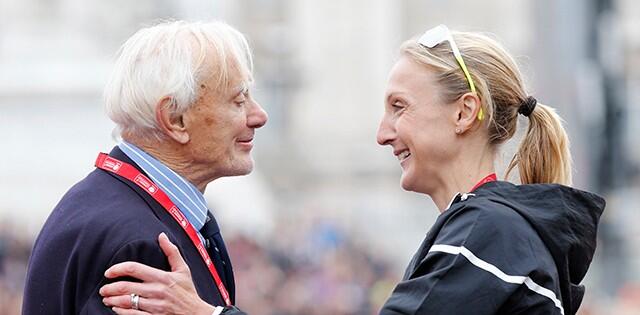
His friend Patrick Collins, the eminent sports writer who spent nearly 50 years covering the world’s greatest sports events, pays tribute to the man who did so much to develop the sport of running in this country, and looks at how the London Marathon shaped Disley’s legacy…
One summer evening in 1980, I met John Disley on a street in Greenwich. In one hand he held a notebook, in the other a surveyor’s tape measure, and around his neck hung an instrument for measuring bends in the road. From time to time, he would dash to the middle of the street, pause to take a measurement, then scamper back to enter the result in the notebook.
He was in good spirits. “It’s all coming together now,” he said. “It’ll be a decent course when it’s finished.” By John’s standards, this was almost a boast. I wished him well and urged him to mind the rush-hour traffic, but he wasn’t listening as he prepared another sprint. For an extraordinary project was taking shape, and Disley sensed that it might be quite wonderful.
In fairness, even John could not have imagined precisely what lay in store, and how the London Marathon would shape his legacy. For long before London became reality, Disley was a truly distinguished man. He had won an Olympic bronze medal at a time when such prizes were rare and precious.
That success, in the Helsinki steeplechase of 1952, was part of a total British track and field collection of a single silver and four bronze medals. As the leading British steeplechaser, he was favoured to win in Melbourne four years later, but his dreams were disrupted by one Christopher Brasher who came bustling out of left field to take an unlikely gold.
Disley was an enormously gifted athlete who lowered the British steeplechase record on five occasions. He was also a contemporary of men like Chris Chataway, Roger Bannister and Gordon Pirie, illustrious pathfinders of modern athletics. And, away from the track, he was one of the pioneers of the sport of orienteering in this country, the chief instructor at the National Mountain Sports Centre in Snowdonia, and a hugely significant figure in the field of physical education. So much distinction across such a wide field. Yet mention the name ‘John Disley’ in any sporting conversation, and ‘London Marathon’ will be the instinctive response.
That was John’s fate, and he was happy to accept it. For he knew, none better, that this was the sports event which changed everything. Until London, marathon runners were simply a superior species, men blessed with capacious lungs and relentless will. Ordinary athletes were intimidated by the very notion of running for more than 26 miles. Ordinary people, civilians, could not even contemplate such an ordeal. Until London.
In truth, it was not an original idea. Brasher and Disley had tasted the New York City Marathon, with its mass participation and city-wide involvement, and the experience had set them wondering “What if…?”
But having a vision was one thing; translating that vision into living reality was quite another. And it was here that the two men revealed their different yet complementary qualities.
When he believed in his cause, Brasher would bark, bluster, thump tables to get his way. Often, the collateral damage was considerable. It was here that Disley came into his own. “What’s he done now?” he would say, shaking his head and suppressing a smile before going off to soothe egos and restore harmony. His loyalty to his friend was unshakeable, but he regarded confrontation as a last resort.
With Brasher, the conflict was part of the fun. Dave Bedford expressed it rather well: “Chris was the engine room of the London Marathon,” he said. “Brasher had all the power and enthusiasm. But when it came to setting up the logistics and overseeing everything, Disley was the man. They were a great double act.”
And Disley needed all those logistical skills when it came to creating the marathon route. At this distance in time, it all seems curiously inevitable. From that mass start on Blackheath to the abrupt turn at the Cutty Sark, over Tower Bridge, through the caverns of Canary Wharf, along the Embankment, past Big Ben and home close by Buckingham Palace; surely a child could have plotted such a course? In fact, it took a certain kind of adult; a shrewd, perceptive visionary, with the tenacity to negotiate obstacles and the audacity to dream big dreams.
Some of those obstacles were formidable. Disley had to sell both the race and the route to such bodies as the police, the City of London, the London Tourist Board and the Greater London Council; making the arguments, answering the challenges, smoothing the bumps in the road.
He did it all so brilliantly that, some 20 years later, he was able to claim: “The London Marathon has become an institution in a country where it usually takes centuries rather than decades to become a tradition. It’s as much a feature of the sporting year as Henley, Ascot or Wimbledon.”
The impact of the Marathon has been profound. Joggers bob along just about every street in every town and city in this land. Exercise is no longer the preserve of eccentrics. In many ways, we are a fitter, healthier nation, and for this the founders of London’s Marathon must take much credit. The link between sport and charity, raising hundreds of millions of pounds for good causes, was initially established by the Marathon.
And there is one important effect, which struck me around 10 or 12 years ago, when London was assembling its bid to host the 2012 Olympics. Among the arguments made by Seb Coe and his bidding team was the claim that London ‘gets’ big occasions, that its people turn out in their tens of thousands for an event which seizes their imagination. And they cited in evidence that Sunday in early spring when Londoners throng their streets from Greenwich Park to Buck House to acclaim their beloved Marathon.
A mild and modest dreamer did much to make it possible, and for that he will be eternally remembered. His widow Sylvia, formerly the Olympic sprinter Sylvia Cheeseman, captured the man in two sentences: “I think John has done more to get people running and on their feet than anybody in the country,” she said. “He never let the grass grow under his feet, and he didn’t see why it should grow under anybody else’s either.”
John Disley would surely have blushed at the compliment. But he would have settled for the epitaph.
Source: Virgin Money London Marathon
