 EN
EN
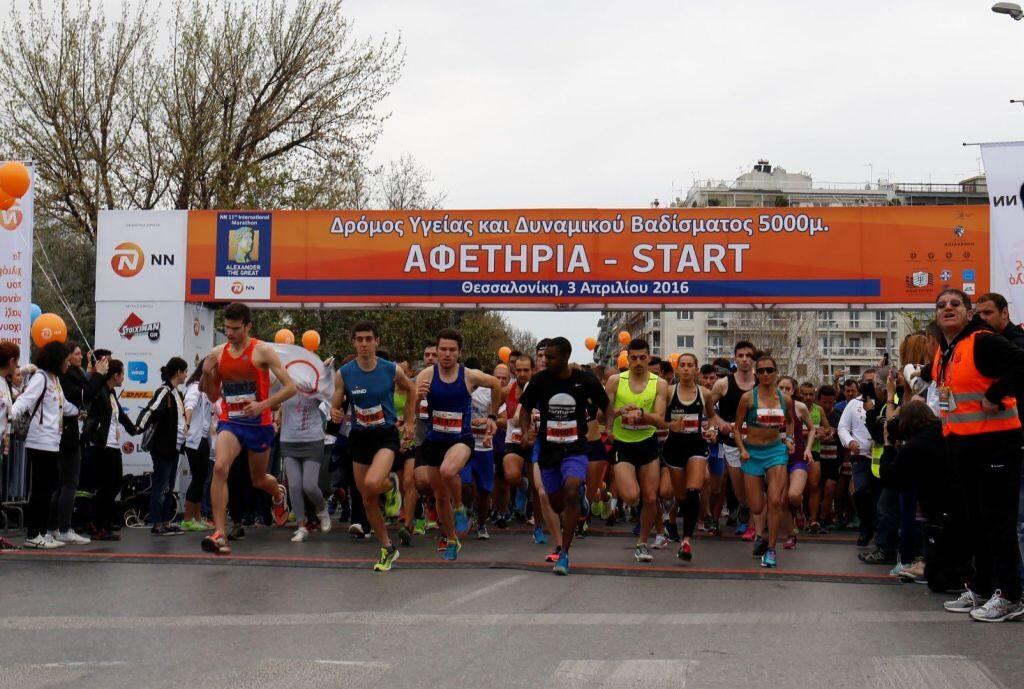
PLENTY OF NOVELTIES FOR THE ELEVENTH EDITION OF THE ALEXANDER THE GREAT MARATHON in Greece ©Giorgios Karagiannis
PLENTY OF NOVELTIES FOR THE ELEVENTH EDITION OF THE ALEXANDER THE GREAT MARATHON in Greece
Thessaloniki, April 3, 2015 – The record participation, the new racecourses, the high competitive level of the champions taking part, the smiles and the joy of people of all ages and physical conditions, combined with a perfect day for running, gave the city of Thessaloniki the most beautiful party this year.
Many are the innovations that the organizers introduced for the eleventh edition of the Alexander the Great Marathon, the second most important Greek marathon.
Before the race, on Thursday, the Marathon Sport Expo opened the doors, housed in a new pavillion in the context of the Thessaloniki Fair "Helexpo", and in the three days of opening welcomed in its 1,500 square meters more than 60 exhibitors and nearly 20,000 visitors, with a set-up equal to the major international marathons.
Particularly noteworthy, the stand of the General Secretariat for Sports of the Hellenic Ministry of Culture, who has exhibited a selection of a wider collection of Olympic torches and medals from the early years of the 20th century to the present day.
Important changes have also been made to the race tracks: about 2 km were modified in the initial part of the marathon route, thus removing some troublesome curves and making it even more straight and fast, therefore more favorable for those who aspire to improve their personal best.
Deeper alterations affected the 5km path, which now mostly follows the route of the October's Night Half Marathon, and completely unfolds within the city center, allowing participants to attend the arrival of the other races before going to the start line.
Lastly, for all distances, the finish line has been moved about 250 meters, just after the White Tower, in the large open space on the promenade in front of the Alexander the Great's statue, greatly improving the use of space for everyone: organizers, journalists, photographers, spectators and especially for runners who have just finished their race.
A long-awaited change and – given the numbers – really necessary, after the impressive growth in participation recorded in the last editions.
The final number of participants has indeed confirmed the record result achieved last year with 20,191 registered runners – from 51 countries and 5 continents – of which 1,759 ran the marathon, 3,833 the 10 km, 12,599 the 5 km and 2,000 elementary schools students took part in the 1 km race.
Actually runners were many more, considering the many people who spontaneously joined the races and ran together with the other participants without the bib number and the chip for timekeeping.
The 42.195 km that separate Pella from Thessaloniki saw the triumph of the Kenyan Abel Kibet Rop, who passed the finish line in 2:17:41, showing a better shape than last year when he achieved only a second place in the 10 km. Behind him the compatriots Silas Kiprono Too, silver for the second time in a row in 2:17:54 and Moses Kipruto Kibire (2:18:10). Off the podium also this year the Ethiopian Teklu Geto, that after the successes of 2012 and 2013 and the second place in 2014, he had to retire due to an injury. Kostas Rigas marked the best performance among Greek athletes, ranking fifth with personal best in 2:30:02.
In the women's marathon the gold medal went to Hellen Jepkosgei Kimutai, also from Kenya, with a time of 2:41:50, ahead of the Croatian Marija Vrajić (2:52:29, third last year) and the Romanian Maria Magdalena Luca (2:58:42, second in 2013 and 2014). The fastest Greek runner was Anna Vesyropoulou, who finished the race in fifth place in 3:17:36.
The winner of the 10 km race was the Kenyan Joel Maina Mwangi (30:19) followed by the Russians Iskander Yadgarov (30:42) and Pavel Adyshkin (31:04) while the Greek best result was the fourth place of Ioannidis Iasonas with a time of 32:12.
Among women prevailed the Hungarian Zita Kácser (37:01) followed by the Russian Darya
Chudaikina (37:06) and the Greek Vasiliki Karageorgaki (37:59).
This eleventh edition of the Alexander the Great Marathon achieved also a charity record, with as many as 50 organizations of social cooperation, involving almost 2500 runners, receiving a significant economic contribution in proportion to the numerical strength of their teams.
The next running appointment in Thessaloniki, Greece's second city and capital of the Greek region of Macedonia, will be on October 8th, with the fifth edition of the Thessaloniki Night Half Marathon, which promises an equally large participation and even greater emotions.
The eleventh edition of the Alexander the Great Marathon is organized by the Thessaloniki's MEAS Triton sports federation, under the auspices of the Greek National Commission for UNESCO, the Greek Olympic Committee, the Hellenic Athletics Federation (SEGAS) and AIMS, and realized with the support of the Greek National Tourism Organization with other Government Institutions and numerous volunteer groups.
www.alexanderthegreatmarathon.org | www.atgm.gr
Giorgios Karagiannis
