 EN
EN
MOWA 2025 - Logo
MOWA Donation Ceremony, New York Athletic Club, 31 October 2025 NYCM founder and 15 running champions & record breakers honoured by MOWA
Sie sehen gerade einen Platzhalterinhalt von Standard. Um auf den eigentlichen Inhalt zuzugreifen, klicken Sie auf den Button unten. Bitte beachten Sie, dass dabei Daten an Drittanbieter weitergegeben werden.
Dear friends of the MOWA, – 1 November 2025 – The prestigious World Athletics Heritage Plaque was last night (31 October) awarded to Fred Lebow, the late New York City Marathon founder during the Museum of World Athletics (MOWA) Donation Ceremony at which the careers of 15 running stars from the last five decades were honoured.
With about 55,000 runners ready to toe the line Sunday (2) for the 55th edition of Lebow’s fabled race, marathon champions, pioneers, and other world and Olympic medallists gathered at the New York Athletic Club (NYAC), a short distance from Central Park and the finish line.
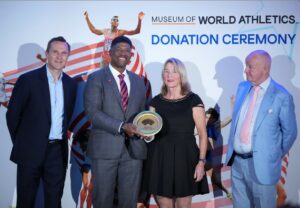
Jon Ridgeon, NYCM Director Ted Metellus, Jessica Tinianow and Michael H. Burke – Photo: World Athletics – MOWA
Three Boston victories, a donation from each
“Thank you for giving me the opportunity to be with my friends here. This is a big family,” said Rosa Mota, the 1987 World and 1988 Olympic marathon champion from Portugal. A three-time Boston Marathon winner, Mota donated to MOWA the shoes from her 1987 Boston victory, her gold medal from 1988, and the singlet & bib from her third Boston win in 1990.
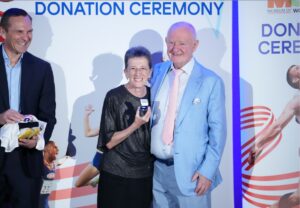
Jon Ridgeon, Rosa Mota and Michael H. Burke – Photo: World Athletics – MOWA
Mota’s contribution and the apparel and medals from the other 14 honourees have helped the MOWA collection grow by leaps and bounds.
“Simply put, there would be no collection, no exhibitions, without the generosity of our athletes,” said Jon Ridgeon, CEO of World Athletics.
And the athletes owe some of their success to the clubs and organisations that support them.
Ridgeon thanked NYAC President John Duggan and the NYAC, which received the Heritage Plaque in 2024 and has been a valuable partner in working to promote the history of the sport.
NYAC members include Thomas Burke, who won the inaugural Olympic 100m and 400m in 1896; four-time Olympic discus champion Al Oerter; and 1999 World Championships 50km bronze-medal winning race walker Curt Clausen, the current president of USA Track and Field and one of the athletes making donations in the President’s Room at the club.
“This was the room I was married in,” said Clausen, who donated his vest, shorts, bib and shoes from that 1999 World Championship race, and the bib number from the World Race Walking Cup of the same year where he set the still standing American 50km record.
Ridgeon also thanked Michael H. Burke, the founding patron of MOWA, for his generous support of the Heritage programme. Burke whose patronage financed the entire ceremony, presented the athletes with special MOWA Donor Pins.
More than half of the contributors were marathoners who helped promote a global long-distance running boom.
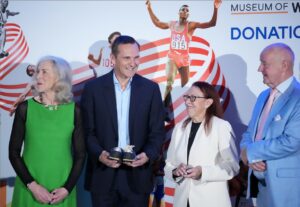
Katherine Switzer, Jon Ridgeon, Jaqi Hansen and Michael H. Burke – Photo: World Athletics – MOWA
Switzer and Hansen – women’s distance running pioneers
On the women’s side, Kathrine Switzer was the first woman to officially run the Boston Marathon (she registered in 1967 using her initials). When race director Jock Semple tried to yank Switzer from the course, her boyfriend at the time, a hammer thrower, blocked the attempt.
About halfway through the race, Switzer forgave Semple. “He was just trying to protect his race, and he thought I was a clown,” she said. “And it was going to be up to me and other women like me who were going to have to change his mind.”
Switzer donated her tracksuit from the Avon International Running Circuit, one of the biggest motivators for getting women’s distance running into the Olympic Games, and the jacket she wore while doing ABC television commentary of the inaugural Olympic women’s marathon in LA84.
Fellow American Jacqueline Hansen through her role as President of the International Runners Committee was one of the advocates for women’s running who took World Athletics (then the IAAF) and the International Olympic Committee to court to add more events.
In 2021, Hansen donated to MOWA the shoes from her second world marathon best, when she became the first woman under 2:40 by clocking 2:38:19 at the 1975 Nike-Oregon Track Club Marathon.
With this ceremony taking place on the 50th anniversary of that race, Hansen said that although her group did not win in court, “within 30 days they announced the 10,000 would go into the Seoul Olympics, they replaced the 3000 with the 5000 in the next Games and later on we added the steeplechase, and with that we gained parity.”
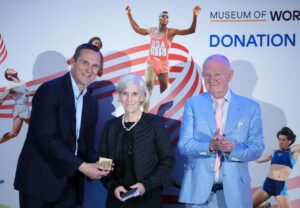
Jon Ridgeon, Joan Benoit Samuelson and Michael H. Burke – Photo: World Athletics – MOWA
Samuelson – passion & fire
The entire podium from the inaugural women’s marathon at the 1984 Los Angeles Olympics is now represented in the MOWA collection.
Gold medallist Joan Benoit Samuelson donated her winner’s medal from the 1985 Chicago Marathon, where she set an American record of 2:21:21, as well as a postmarked envelope from the 1984 Olympic Village.
“It’s all about passion,” Samuelson said. “If you don’t have passion you don’t have fire and if you don’t have fire, you can’t ignite anything. It ignited in my heart, and for better or worse, I’m still at it.”
Nine NYCM victories which followed ‘retirement’
The silver medallist was Norway’s Grete Waitz, who sadly died of cancer in 2011. Four years ago, her husband Jack donated to MOWA a pair of her running shoes from the 1982 season, and that donation was celebrated once again in the city whose marathon she won nine times.
Jack said Grete had decided to retire in 1978 but agreed to run the NYC Marathon. One race led to another and she won 47 races that year. Waitz went on to capture the inaugural World Championships medal in 1983.
Mota was the bronze medallist in Los Angeles. She said women were only allowed to run shorter distances in Portugal until she won the 1982 European Championship in the marathon. “After that, everyone wants to run,” said Mota, who in Seoul became the first Portuguese woman to win an Olympic gold medal in any sport.
Kastor – “Inspiring the next generation”
Twenty years after the inaugural Olympic marathon, Deena Kastor won the bronze medal in 2004. She donated her shoes — with her name embroidered — and singlet from those Games.
“What a privilege to be in this room with the women who paved the way through administration and in your performances,” said Kastor, who also won three world cross country silver medals and broke Samuelson’s American record.
She also praised MOWA for preserving the history of the sport. “I am absolutely so grateful that you are creating something that can inspire the next generation.”
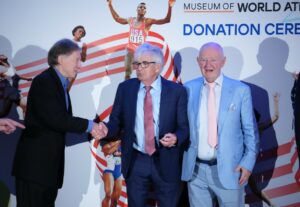
Bill Rodgers, Frank Shorter and Michael H. Burke – Photo: World Athletics – MOWA
Happy 78th Birthday Frank!
In 1972, Frank Shorter became was the first American man to win the Olympic marathon since 1904. Shorter, who was serenaded by the gathering on his 78th birthday, had previously donated his USA team shirt from the 1971 Pan American Games, where he won both the 10,000 and marathon. He has now added a 1972 USA team T-shirt to the MOWA collection.
Shorter said his good friend Bill Rodgers watched his victory in Munich. “He said, “I can do that. And he did!”
Shorter and Rodgers both qualified for the 1976 Olympics, where Shorter took home the silver. “We found something that was us,” Shorter said, “and we wanted to see how good we could get.”
Rodgers – “Crushed” in Montreal inspired NYC & Boston victories
Although Rodgers did not win an Olympic medal, he is one of the most prolifically successful marathoners in history. ‘Athletics is such a tricky sport because you get crushed sometimes,” said Rodgers.
After getting crushed at the 1976 Olympics, Rodgers claimed his first of four straight New York City Marathon titles, “and beat the crap out of me,” said Shorter. Rodgers, who donated his NYCM winter training jacket to MOWA, also won four Boston Marathon titles and set world records at 15 miles and 25km.
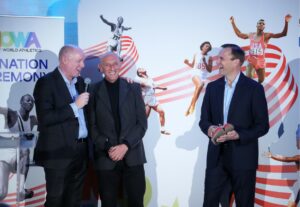
Chris Turner, Orlando Pizzolato and Jon Ridgeon – Photo: World Athletics – MOWA
“In the last two miles, I decided to win”
Orlando Pizzolato of Italy, who won consecutive NYC Marathons in 1984 and 1985, donated the shoes from his first victory to the museum in 2023. He was briefly reunited with them at the ceremony. He said he didn’t expect to win that year, and stopped at every water station in the last six miles. As he moved closer to the front, Pizzolato said, “In the last two miles, I decided to win.”
“We eat cheese. We don’t run.”
Swiss marathoner, Viktor Röthlin who won the bronze medal at the 2007 World Championships, donated his 2014 European Championships singlet, bib and shoes.
The four-time Olympian, who won the 2010 European title and the 2008 Tokyo Marathon, said when he saw there were 74 Kenyans in the Top 100, he decided to train in Kenya. After all, Switzerland did not have a marathon tradition. “We eat cheese,” Rôthlin said. “We don’t run.”
Shorter’s shorts
Dave Wottle, the 1972 Olympic gold medallist in the 800, donated his USA Team singlet from the 1972 pre-tour, which he said fitted better than his Olympic uniform. Because he was helping his new wife with her accommodation in Munich, he was late to pick up his Team USA kit. All that remained was an extra-large singlet — he had requested medium — and a pair of 3X shorts.
Shorter, who was his roommate, offered to loan him a pair of Florida Track Club shorts, which looked similar to the USA uniform. Wottle said Shorter told him, “If you win, you can have them.” Shorter did not get them back.
Wottle had already donated his famous baseball cap to the U.S. Track & Field Hall of Fame, and it resides in New York at The Armory.
Jim Spivey, the 1987 World Championships bronze medallist in the 1500, can still fit into his 1996 Olympic team jacket and wore it to the ceremony. Spivey donated his tracksuit top from the Atlanta Games, his third Olympics.
Before the 1992 U.S. Olympic Trials, Spivey said his coach instructed him to take the lead in the third lap and with 200 meters to go “visualize people breaking into your home”, and their names were his biggest rivals. Spivey won the race at age 32.
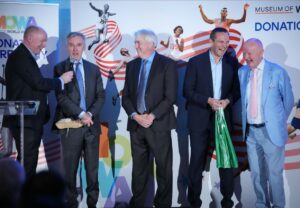
Chris Turner, Frank O’Mara, Ray Flynn, Jon Ridgeon and Michael H. Burke – Photo: World Athletics – MOWA
Four Irish world indoor titles
Two-time world indoor 3000 champion Frank O’Mara of Ireland donated his winning shorts, bib and top from the 1991 Worlds in Seville. Countryman Marcus O’Sullivan, three-world indoor champ in the 1500, donated the singlet and shoes from the first of those victories in Indianapolis 1987, and a trophy from his USA Mobil Grand Prix Mile title, but had to miss the ceremony due to his commitments as a collegiate coach at Villanova. He was represented by Ray Flynn, who teamed up in 1985 with O’Mara, O’Sullivan, and Eamonn Coghlan (who has previously donated to MOWA to shatter the world record in the 4 x One Mile relay in Dublin. The record of 15:49.08 still stands.
O’Mara quipped that the most memorable aspect of that race, which raised money for famine relief in Ethiopia, was “the fact that Eamonn was the slowest of us. I don’t think he broke 4:00.” (He ran 4:00.02.)
“I so wish,” joked Chris Turner, Heritage Director and MC for the ceremony, “Eamonn was here tonight.”
Karen Rosen for World Athletics Heritage
Click here to enter MOWA andTake a virtual journey through Athletics history
For more information about MOWA and the World Athletics Heritage Collection – click here
#MOWA
#WhereChampionsLive
