 EN
EN

Athletics Integrity Month November 2025 - Header
Integrity isn’t an initiative, it’s the culture we choose to build – Australian Athletics
As Australian Athletics reaches the end of its first Athletics Integrity Month, one thing has become unmistakably clear: integrity is no longer a policy area that sits off to the side of our sport but the backbone of every safe start line, every fair selection decision, every trusted coach-athlete relationship and every interaction that now forms part of the athletics experience.
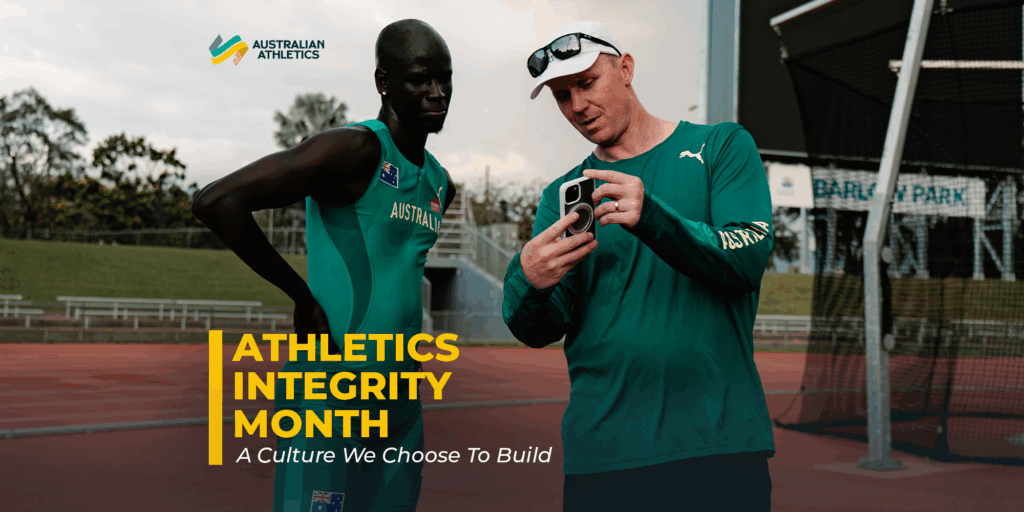
Across the last four weeks, hundreds of administrators, coaches, volunteers and officials leaned into the difficult, the practical and sometimes the uncomfortable.
Through seminars on the National Integrity Framework, safeguarding, complaints management and digital safety, a simple truth emerged: sport does not become safe by accident, it becomes safe because people choose to make it safe.
Top Five Learnings from Athletics Integrity Month
1. A National Integrity Framework is only powerful when people understand it
The National Integrity Framework has existed for several years, but its strength lies not in its pages but in its adoption. The webinars revealed that for many at club and community level, the NIF can feel intimidating, complex or something that just happens at national level.
But as Australian Athletics GM of Integrity, Briar Sefo reminded participants, the NIF is designed for everyone. Every volunteer who rakes a pit, every coach accredited through Australian Athletics, every official in a vest, and every staff member is bound by it.
Understanding who is covered and what is prohibited is foundational. As Sefo explained through the 200-metre finish-line photo she often uses in education sessions: “That one image captures athletes, coaches, staff, contractors, officials, spectators and volunteers. Every one of them has a role to play and every one of them can be part of the solution.”
This clarity empowers clubs to do something that seems simple but is transformational – set expectations and model culture.
2. Safeguarding is not paperwork, it’s prevention
The Safeguarding in Practice webinar tackled some of the hardest, most emotional topics. With honesty and care, Sefo walked through why safeguarding matters, what makes offending possible, and what stops it.
The reality is stark: harm is often subtle, opportunistic and preventable.
The sport’s responsibility is equally clear: reduce opportunity, increase oversight, and build cultures where harmful behaviour cannot take root.
From recruitment to communication practices, travel arrangements, and facility access, participants were guided through practical steps that reduce risk. These steps that do not require money or staff, just intention and consistency. The reminder was powerful:
“We can only eat the elephant one bite at a time. Every small action is a barrier that makes the environment safer for every child.”
These aren’t theoretical principles but the things that keep children safe at training tomorrow.
3. Integrity now lives online and so does harm
One of the most critical insights from Integrity Month came from Shannon Dixon of the eSafety Commissioner. Her session made it clear just how dramatically the digital landscape has reshaped the risk profile for sport.
Clubs once thought safeguarding was confined to the track, the stadium or the the training group. But today, an athlete can be abused, impersonated, doxed or shamed without anyone seeing it happen.
Dixon’s example was cutting: an 18-year-old athlete tripping at Nationals, the clip cut from a livestream, and more than 50,000 strangers watching, commenting and mocking him across Instagram within days.
This isn’t the exception. More than half of young people in Australia report experiencing cyberbullying; over a quarter experience online hate. Sport does not sit outside this reality.
Online behaviour is behaviour. The damage is real. And sport must build the same protective structures online as we do on the field.
4. Complaints management is not about punishment, it is about trust
Trust is the currency of community sport. But trust is not just built through medals or good weekends of competition but how a club or organisation handles a problem.
The Complaints Management webinar lifted the lid on a process many fear or avoid, breaking down the core principles:
- receiving complaints safely and accessibly
- triaging and confirming jurisdiction
- managing conflicts of interest
- taking a trauma-informed approach
- investigating appropriately
- determining outcomes proportionately
- communicating with transparency
- preserving confidentiality and records correctly
Sefo captured the heart of this work in one line:
“People will only come forward if they believe the process is safe and they’ll only believe the process is safe if the people running it treat them with dignity.”
Clubs and organisations do not need to be legal experts. They need to be empathetic, structured, consistent and willing to say: We will hear you, and we will act.
5. The future of integrity is collaborative
The strongest message across the month was this: no club, no coach, no parent, no athlete and no national body can do this alone.
Integrity is a network of policies, people, systems, expectations, and behaviours working together to protect our community.
And as Athletics Integrity Month showed, there is a hunger for conversation, clarity and confidence. Clubs want guidance. Coaches want resources. Parents want reassurance. Athletes want psychological safety. Volunteers want support. Administrators want frameworks that work in the real world.
Australian Athletics’ role is not to police our sport, but to lead, educate, empower and partner with the people on the frontline. We cannot eliminate all harm but we can make athletics the hardest possible place for harm to occur.
By Sascha Ryner, Australian Athletics
Posted: 28/11/2025
