 EN
EN
At the very core of the London Marathon’s ethos is its dedication to the growth of sports participation in London and beyond. Since the event was founded in 1981, by Chris Brasher and John Disley, it has been committed to developing sport and recreation facilities and access in London and in the areas where it organises events.
Thirty-five years ago Disley and Brasher had a vision that all of the London Marathon profits would go to support this cause. They turned this revolutionary vision into reality by creating The London Marathon Charitable Trust, which was set up to distribute the profits of the London Marathon to charitable causes in and around London boroughs.
The Trust continues to support that original vision of a society in which all people participate regularly in sport and physical activity, contributing to individual physical and mental wellbeing, as well as to a sense of community cohesion. To achieve this goal, The Trust awards grants to projects that offer high-quality, accessible and affordable facilities for sport and physical activity in the areas in which London Marathon Events Ltd organises mass-participation sporting events – from London and Surrey to Silverstone and Aylesbury Vale.
Since its founding, The Trust has allocated grants amounting to in excess of £57 million across more than 1,000 projects, grants of anything from a few thousand pounds to hundreds of thousands, helping to pay for everything from astro pitches in Islington to cricket fields in Ealing, sprung floors in a Hackney circus space and a climbing wall in Isleworth. Gym equipment, multi-use games areas, basketball courts, training tracks, boxing rings, changing rooms and parkour spaces have all been funded over the years.
Projects in all 32 of the London boroughs and the City of London have received funding at some stage, although deciding where the money should go is never an easy decision.
Trustees receive online applications on a rolling deadline and make awards at quarterly meetings. All successful applicants must have a viable plan, not just to rebuild facilities and replace equipment, but to increase participation among inactive groups. This is what makes The Trust special, according to Chief Grants Officer, Sarah Ridley.
“Our desire is to get people up and active, and without good facilities it is hard to do that,” she says. “But we only give money when organisations have a real commitment to supporting participation in the long term.
“Lots of facilities require funding for refurbishment, to patch pot holes in tennis courts, for example, but we can’t fund all these. Our money goes to projects where it really makes a difference, where organisations are enticing people off the couch and where they have a plan for the future.”
The Trust in action
Last year was a record-breaking year for The London Marathon Charitable Trust. The profits from all of the events organised by London Marathon Events Ltd totalled a staggering £5.2 million, which was all gifted through Gift Aid to The Trust. This enabled The Trust to pay out 59 grants totalling £4,494,163 from funding received the previous financial year.
Wey Kayak Club, for example, has used a £50,000 grant from The Trust to help build a new secure store for 50 boats at Guildford Waterside Centre, and pay for new kayaks. The investment has enabled the 53-year-old venture to grow from 250 to 380 members, to offer new sessions to school-age children, train more than 40 volunteer coaches, and improve access for para-canoeists.
At the other end of the spectrum, £2 million of Trust money helped turn the elite-level Olympic VeloPark in Stratford into a cycling facility for clubs and local people, with cross country, road and BMX circuits created next to the famous velodrome.
Every runner in this year’s Virgin Money London Marathon contributes to The Trust’s work, enabling more grants to be awarded to projects that will ultimately offer more people access to sport and recreation facilities. Last year saw some exciting developments, here are some of the highlights.
The Archer Academy
The Archer Academy in East Finchley, London was awarded a grant of £500,000 from The Trust to install state-of-the-art sporting facilities. Thenew facilities, which will be available for use by both pupils at the school and the local community, include a bespoke indoor climbing wall, which is suitable for disabled users, and an all-weather 3G pitch with floodlighting.
Through this project the Stanley Road playing fields, which were abandoned for 12 years, have been given a new lease of life with the creation of this innovative sporting centre on the site. It is anticipated that the facilities will offer a massive boost to the North Barnet area, with an estimated 40,000 people a year able to benefit from sporting opportunities in the evenings and weekends.
London Marathon Events Ltd Director and Paralympic gold medallist, Baroness Tanni Grey-Thompson, led the official opening, meeting with pupils from the school and locals eager to use the facilities, saying: “It’s absolutely incredible to see what the donation from The London Marathon Charitable Trust has done and it is great to see how proud the children are of the new facilities.”
Headteacher of the academy Lucy Harrison said: “The London Marathon Charitable Trust has enabled us to have sports facilities we wouldn’t have had. It is fantastic to see the benefit that the facilities will bring to both the school and the local community.”
Creating a new community hub
Grants from The Trust totalling £142,000 contributed to the creation of the Healthy Lifestyle Community Centre at Abbotshall in Catford.
The funding helped to regenerate the playing field and construct a community hub to provide junior football and cricket, sports day facilities, changing rooms, an exercise and fitness hall, community meeting rooms, a community cafe and community garden. Response to the initiative from the local community has been magnificent with the centre being fully used seven days a week.
The venue is also being used for a crucial initiative to prevent the onset of health problems by supporting inactive residents aged 14 and over. Bespoke 13-week activity programmes including 30 minutes of sport-related activity per week, will be provided to inactive residents for them to follow.
The new programme will work in partnership with local GPs, pharmacies and secondary schools to support the health of more than 1,000 participants a year. The aim is to enable them to become more active and healthy and therefore reduce the need for individuals to consult their GPs in future. The project is forecast to achieve a social return on investment of £40 for every pound spent.
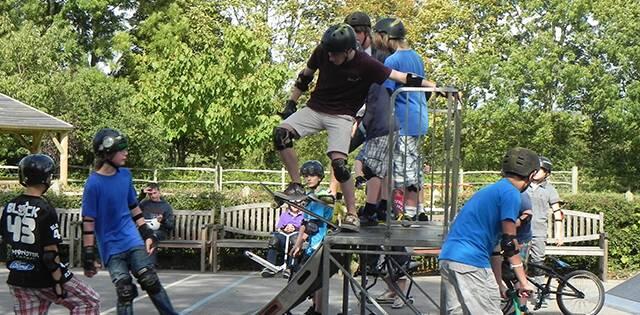
“In a way, our aims are the same as the Marathon itself,” says Ridley. “The Marathon gets people active through running, we do it by funding projects, whether it’s a running track or playing fields, a skatepark or a community hall.”
How it works
The London Marathon Charitable Trust provides grants for capital projects that both inspire and increase the numbers of people regularly taking part in physical activities.
The London Marathon Charitable Trust was created in 1981, the inaugural year of the London Marathon, to meet one of the six objectives set by race founders Chris Brasher and John Disley: “to raise money for the provision of recreational facilities in London”.
Every year, the profits achieved by London Marathon Events Ltd are transferred under Gift Aid to The London Marathon Charitable Trust and the Trustees award grants to organisations that further The Trust’s objective to encourage people to become more active.
The Trust’s objective “to provide or assist in the provision of facilities for recreation or other leisure time occupation” was subsequently widened to enable grants to be made for projects in any area where London Marathon Events Ltd currently stages an event. These are: the 32 London boroughs and the City of London, Surrey, South Northamptonshire, and Aylesbury Vale.
In the past 12 months, the LMCT has restructured its grant-making process and now makes grants four times a year (previously it was annually in December). Grants are now made in three categories:
• Small Capital Grants, from £5,000 to £19,999, intended to help improve existing amenities or to build new facilities and support more people to become physically active.
• Major Capital Grants, from £20,000 to £150,000, for the renovation, modernisation or creation of significant facilities for organisations already encouraging people not physically active to participate in sporting activities.
• Strategic Grants, a separate fund to deliver major sports and recreation facilities. Applications for Strategic Grants may be submitted on an invitation-only basis.
The Trust’s current priorities are to fund the capital component of projects that increase participation, especially among individuals and groups who are currently physically inactive or have low levels of activity, plus children and young people outside of school hours.
An ‘inactive person’ is defined as an individual who has participated in less than 30 minutes of moderate intensity exercise in the previous four weeks. Sport England suggests that some 25 per cent of people across the country are inactive.
“We are really looking at the impact of capital spending on participation and activity,” explains Chief Grants Officer Sarah Ridley. “As we are unable to fund all applications, we are looking for good quality applications from organisations that are committed to getting people active.”
More information about The Trust, the criteria and the application process can be found at: www.lmct.org.uk
Source: Virgin Money London Marathon
