 EN
EN
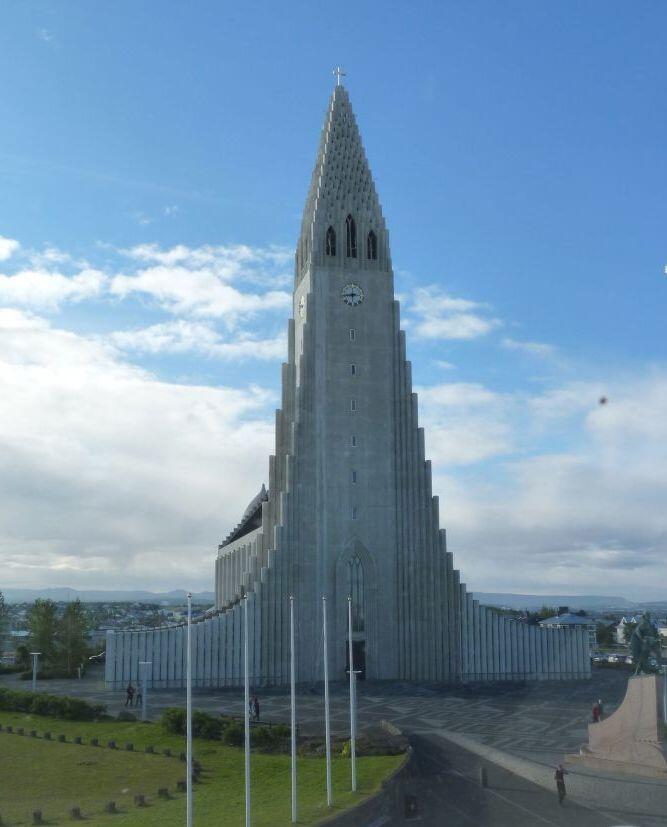
The Hallgrims Kirk in Reykjavik - Photo: ©Horst Milde
In the summer rain on Lava Island – LAUFZEIT reader trip to the 30th Reykjavik Marathon 2013 – Wolfgang Weising reports
There are moments when all clichés come true. While last year’s Reykjavik Marathon took place in a summer of the century with temperatures above 20°C and sunshine, the same event in 2013 was accompanied by cloudy skies and continuous rain.
Europe’s proverbial bad weather accompanied the 30th anniversary of the island republic’s largest sporting event with average, “normal” weather. The Icelanders are already accustomed to the harsh life on the edge of the Arctic Circle, so the runners among them took it in their stride that the sun wasn’t shining at the start – especially as the temperature was around 13°C, ideal for running.
As a result, the wet anniversary still saw record participation figures of 14,272 registrations for all competitions. It was not until 2005 that the 5,000 athlete mark was exceeded. In addition to the festive atmosphere of the run, which included a family run for young and old and a 5 km run without timing, the half and full marathon races started on the competition routes.
Both ended where they had started, near the old town and a park with a large pond. The competitive races started at 8:40 a.m. on August 24. It should be noted that this was a Saturday, and not just any Saturday.
Since its inception, the Reykjavik Marathon has been held on the weekend together with the “Long Night of Culture.” Initially scheduled for the Sunday after the cultural night, the race has been held on the Saturday before the spectacle for several years now, which is more convenient.
Almost the entire population of Iceland (36 percent of Icelanders live in the capital alone) visits Reykjavik for this event, and the whole night is filled with colorful hustle and bustle.
Berlin provided inspiration
The anniversary was accompanied by very special guests from Berlin. The founder of the BERLIN MARATHON and long-time race director Horst Milde and his wife Sabine were guests of honor at the end of a tour of Iceland.
Why?
It was in 1983 when Knútur Oskarsson and his business partner came across the BERLIN MARATHON while looking for new tourist ideas for Iceland. At the International Tourism Exchange in Berlin, they sought contact with the organizers of the Berlin Marathon and met Horst Milde and Bernd Hübner (who has completed the BERLIN MARATHON 36 times to date).
Oskarsson still raves about the legendary meeting in the Milde bakery, where they were introduced to the secrets of organizing a city marathon over coffee and cake by the Berliners.
The premiere of the Reykjavik Marathon in 1984 attracted 251 participants from seven countries. Two years later, there were almost 1,000. As has been evident to this day, it was not just the beginning of a city marathon, because the up-and-coming capital city marathon has sparked a nationwide running movement in Iceland.
Numerous other running events have since established themselves on the volcanic island. The great role model from Berlin has left a lasting mark on the Reykjavik Marathon.
Some things have even remained in the Icelandic version that have quietly disappeared from the scene in Berlin.
The hearty pasta party is still free for all participants at the small marathon expo, with entry fees of €60, €42, or €34 (marathon/half marathon/10 km until April 1, then rising to €74/€56/€44).The entry fees also include a participant T-shirt, medal, Powerrade drinks, and free admission to Reykjavik’s thermal baths and pools.
It is worth noting that participant T-shirts were also available for the little ones and very little ones at the marathon expo, which took place in a spacious sports hall (3,372 children alone took part in 2012). Iceland’s best in the field In keeping with the “great example,” the organizational processes gave little cause for criticism.
Everything had been thought of, and the route was well supervised and largely ran along the seashore. Fortunately, the calm sea in the drizzling rain meant that the wind was only moderate. However, a few tricky inclines prevented the course from breaking any records. But records are hardly the point here, even though the winning times were impressive and there was prize money to be won.
These amounted to 100,000/70,000/40,000 Icelandic kronur (ISK) for the marathon and 70,000/40,000/20,000 for the half marathon (1 euro is approximately 162 ISK).Käri Steinn Karlsson, Iceland’s best marathon runner, was at the starting line for the half marathon.
He finished 42nd in the Olympic marathon in London with a time of 2:18:17. He won the 21.1 km race in 1:07:40, with no competition. In the women’s race over the same distance, his compatriot Helen Ölafsdöttir won in 1:22:57. The marathon winners of the anniversary event came from Great Britain – James Buis crossed the finish line first in 2:33:49, while Melanie Staley did so in 2:55:14.
The event records of 2:17:06 for men (Ceslovas Kundrotas/LTU, 1993) and 2:38:47 for women (Angaharad Mair/GBR, 1996) thus remained unchallenged.
Among the 851 registered marathon finishers were 70 Germans. In the half marathon and 10 km races, the figures were 2,111/67 and 5,253/29 respectively. As has been the case without interruption since 1995, the participants of the LAUFZEIT reader trip were also among the field.
LAUFZEIT and its partner agency in Iceland have brought hundreds of Germans to the starting line, which has led to the development of a friendly relationship with the organizers around managing director Frimann Ari Ferdinandsson.
The performances of the reader travelers were impressive. Here are a few examples: Lukas Kueper achieved the best marathon result with 3:24:57 in 114th place. In the M60 category, Jürgen Fernholz won the age group classification (ten-year age groups were evaluated) in 3:36: Martina Mischnick was the best woman in the LAUFZEIT travel group, finishing ahead of her husband Bernd (3:40:32) in 3:35:30…
Blue Lagoon and continental plates
After the sporting activities, there was more enjoyment to be had on the trip. A visit to a fish restaurant after the marathon – anyone who comes to Iceland will find out what it means to eat fresh sea fish from the North Atlantic – was just as much a part of the trip as a dip in the Blue Lagoon, an unforgettable experience of immersing yourself in the warm waters under the open sky in the middle of Iceland’s endless lava fields.
The rift valley that runs through the rocky landscape, where the American and Eurasian continental plates drift apart at a rate of 2 cm per year, is also impressive. On the Sunday after the marathon, the sun finally came out.
Further destinations followed, and some participants couldn’t resist taking a short trip by plane to Greenland.•
And if you want to feel the North Atlantic air blowing around your nose, make a note of the 31st Reykjavik Marathon: August 23, 2014.
Wolfgang Weising in LAUFZEIT 10/2013
