 EN
EN
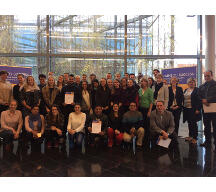
ICSSPE Leadership and Good Governance - ICSSPE / DOSB Event in Berlin ©ICSSPE/CIEPSS
ICSSPE/CIEPSS – ICSSPE Leadership and Good Governance – ICSSPE / DOSB Event in Berlin – Education is Crucial – ICSSPE President at Council of Europe
Leadership and Good Governance – ICSSPE / DOSB Event in Berlin
 From 25th to 27th of November 2016, 40 young future sport leaders from all over the world took part in the Paths to Success seminar in Berlin.
The seminar which focused on leadership and good governance, helped participants to acquire skills and abilities to support a change management and good governance discussion within their organisation.
The participants widened their project management, presentation, communication, negotiation and conflict resolution skills, under the leadership of professional coach Amanda Bennett. Moreover, Darren Bailey, Football Regulation and Administration Director, Valentin Capelli, Policy Officer EOC EU Office, and Jens-Sejer Andersen, International Director Play the Game, shared their experiences and provided first-hand examples on Good Governance.
Paths to Success: Inspiring future leaders was jointly organised by ICSSPE together with the German Olympic Sport Confederation (DOSB) and the Freie Universität Berlin. The seminar was supported by the Federal Ministry of the Interior (BMI), Germany, and Olympic Solidarity.
Education is Crucial – ICSSPE President at Council of Europe

“A central element to promote good governance within the global sport movement is education.”
This was one of the assertions made by ICSSPE President Uri Schaefer during his intervention at the 14th Council of Europe Conference of Ministers responsible for Sport, which took place 29th November 2016 in Hungary, Budapest.
The groups of stakeholders for whom educational programmes are most typically developed are, of course, athletes, their coaches and officers within the sport organisations. However, Uri Schaefer warned, a group that is too-often excluded from education and information are the parents of young athletes. When these parents are envisaging their child's athletic future, there is a risk that they forget the need for overall healthy development. “Parents need to learn about the opportunities, but also about the challenges linked to a professional career in sport”, he warned.
During his speech, Uri Schaefer referred also to the importance of measuring the impact of policies and the success of programmes, process monitoring and evaluation when implementing good governance measures. In addition to internal monitoring structures, sport organisations need external evaluation from agencies whose stakeholders have no vested interest in the sport organization.
While attending the Ministerial meeting Uri Schaefer had the opportunity to also meet with IPC President Sir Philip Craven.
ICSSPE Perspectives – Recent and Up-coming Publications
 By publishing the Perspectives series, ICSSPE aims to facilitate the application of sport science results to practical areas of sport by integrating the various disciplines. In each volume of Perspectives, contributions from experts from different disciplines and countries address a specific, current theme.
The latest books in Perspectives are:
Elite Sport and Sport-for-All: Bridging the Two Cultures?
Edited by Richard Bailey, Margaret Talbot
Sport is often perceived as being divided into two separate domains: mass participation and elite. In many countries, policy and funding in these two fields are managed by separate agencies, and investment is often seen as a choice between the two. Elite Sport and Sport-for-All explores the points of connection and sources of tension between elite and mass participation sport. The book’s multi-disciplinary and international line-up of contributors seeks to define, examine, and develop solutions to this problematic relationship.
Drawing on research and case studies from around the world—with examples from Denmark, Canada, South Africa and Israel—the book explores key contemporary issues including:
- does effective talent identification require depth of participation?
- do elite performances inspire greater participation?
- the role of the Paralympic movement in mass participation and elite sport;
- and the economic aspects of their co-existence.
The first study of its kind, Elite Sport and Sport-for-All addresses a central dichotomy in sport policy and, as such, is important reading for all students, researchers, policy-makers or administrators working in sport development and policy.
More information can be found here.
Sport, Education and Social Policy: The state of the social sciences of sport
Edited by Gudrun Doll-Tepper, Katrin Koenen, Richard Bailey
This important study brings together world-leading researchers to reflect upon the state of the social scientific study of sport. Addressing three core themes in sport studies – equality, education and policy – the book looks back over the development of sport research in recent decades and offers new insights into future lines of enquiry.
Presenting a unique collection of authoritative perspectives from some of the best-known scholars in the social scientific study of sport, the book engages with key contemporary issues such as gender stereotypes in physical education, ethnicity, inclusion and critical race theory, physical literacy, physical activity and health, and international sport governance. Its chapters address major topics such as the globalisation of physical activity initiatives and the involvement of the EU in developing sport policies, as well as shedding light on new areas of research such as the growing participation of Muslim women in sport.
Sport, Education and Social Policy: The state of the social sciences of sport is fascinating reading for any researcher or advanced student working in sport studies, physical education or kinesiology. It is dedicated to the memory of the late Professor Margaret Talbot, former President of ICSSPE.
For more information please follow the link.
Routledge will shortly publish some new ICSSPE Perspectives, including:
- Physical Activity and Educational Achievement: Insights from exercise neuroscience (due mid-2017)
- Sport and Health (due late 2017)
- Ageing Across the World: health promotion through exercise and physical activity
- Managing Sport Internationally
All ICSSPE members can get a discount of 20% on all Perspectives volumes. Please contact the ICSSPE Office to get the password for this discount.
Finally, we are always keen to talk to ICSSPE members about their ideas for new Perspectives volumes. Ideally, these books would be multi-authored, including the contributions of colleagues from different regions and different disciplinary backgrounds.
If you are interested, please contact the ICSSPE Office: kkoenen@icsspe.org
International Master of Adapted Physical Activity – Call for Applications
The KU Leuven, Belgium, Palacky University Olomouc, Czech Republic, and a number of associate partner institutions are inviting application for a Master degree in Adapted Physical Activity.
The International Master of Adapted Physical Activity (IMAPA) is a 2 year Master and combines the expertise of more than 20 universities and organisations throughout the world.
The programme offers students state-of-the-art research and teaching methodology in adapted physical activity (APA) and the social, pedagogical, and technical aspects of physical activity adapted to the needs of persons with a disability.
IMAPA is a flexible programme, allowing students to design the content of their curriculum depending on the competences they wish to acquire. Students can follow the entire programme as KU Leuven students, or fit a number of selected courses within their home university programme, while remaining registered at their home university.
IMAPA graduates will have the competences to work with persons with an impairment in career domains such as education, coaching, personal training, physical therapy, occupational therapy, medicine or other health care professions. Programme graduates can also pursue a research career through the knowledge and expertise acquired in adapted physical activity and a kinesiology related scientific discipline.
Please find more information here or contact Prof. Dr Yves Vanlandewijck at Yves.vanlandewijck@kuleuven.be
ICSSPE/CIEPSS
Hanns-Braun-Strasse
Friesenhaus II
14053 Berlin
Germany
Tel:+ 49-30-36418850
Fax:+ 49-30-8056386
E-mail:icsspe@icsspe.org
German Road Races e.V. (GRR) auf facebook:
https://de-de.facebook.com/germanroadraces
German Road Races e.V. (GRR) auf twitter:
https://twitter.com/germanroadraces
