 EN
EN
Sie sehen gerade einen Platzhalterinhalt von Standard. Um auf den eigentlichen Inhalt zuzugreifen, klicken Sie auf den Button unten. Bitte beachten Sie, dass dabei Daten an Drittanbieter weitergegeben werden.
Three years later I moved to Japan for grad school, and through a long string of coincidences I came across a teenaged kid named Yuki Kawauchi down at my neighborhood track. I never imagined he’d become what he is, but right from the start there was just something different about him. After his 2:08:37 breakthrough at the 2011 Tokyo Marathon he called me up and asked me to help him get into races abroad. He’d finished 3rd on the brutal downhill Sixth Stage at the Hakone Ekiden, and given how he’d run the hills in the last 6 km at Tokyo ’11 I thought he’d do well at Boston or New York. “If Meb can win them there’s no reason you can’t,” I told him.
Due to his work schedule Boston was never possible, but New York fell on a long weekend in Japan and he was able to run there three times. Unsuccessful the first two, the night before his third run as we were heading out for dinner Bill came into the hotel lobby and walked straight over to us. “Hi Yuki, I’m Bill,” he said. “I really admire what you’re doing.” Totally ecstatic, as we walked away Kawauchi said to me, “Bill Rodgers! Luck is on my side this time! Tomorrow is going to be a good day.” The next morning he finished a respectable 6th, outkicking the great Meb Keflezighi for his best-ever performance in the World Marathon Majors.
As his name grew he caught Boston’s eye, and at the 2016 Berlin Marathon Boston’s John Hancock Elite Team coordinator Mary Kate Shea approached me about him running in 2017. It wasn’t possible, but Mary Kate invited me to come anyway. The second night there she asked if I wanted to go to a Red Sox game, and when I came down to the lobby Bill and 1983 Boston winner Greg Meyer were waiting. “Hi Brett,” said Bill. “Let’s go.” In the John Hancock corporate box at Fenway we talked about Kawauchi and I asked Bill if he wanted to say hi. I shot a short video of him. “Hi Yuki, it’s Bill Rodgers,” he said. “I know you haven’t run Boston yet. You HAVE TO run Boston.” I texted it to Kawauchi, and half an hour later his response came back. “OK,” he said. “I’ll do it.”
Sie sehen gerade einen Platzhalterinhalt von Standard. Um auf den eigentlichen Inhalt zuzugreifen, klicken Sie auf den Button unten. Bitte beachten Sie, dass dabei Daten an Drittanbieter weitergegeben werden.
The Lead-Up
During the women’s marathon at the London World Championships Mary Kate and I fleshed out the details for Kawauchi to run Boston in 2018. Having run Boston six times I knew that Kawauchi had to go run on the course in advance, and that meant going at the New Year when he had a week off work for the Japanese public holidays. I also knew he’d want to run a race while there and found a little local marathon in Marshfield just south of Boston on New Year’s Day at the end of the trip. Completely coincidentally, Mary Kate was a member of the club that put it on, so in London I asked her to get it certified as part of Kawauchi’s Boston invite so that he could break the sub-2:20 world record there.
When we got to Boston on Dec. 29 it was cold. Way cold. Breath turning to ice on your face cold. We stayed right at Lower Newton Falls past the 25 km point of the Boston course, splitting it into two runs on the 30th and 31st. After running the downhill first 25 km he said, “I’ll need to get out my training log for the Hakone Sixth Stage and do some of those workouts again to get my legs ready.”

That night we had a surprise dinner with Rodgers, 1976 Boston winner Jack Fultz, and 1979 Boston 3rd-placer Bob Hodge. All of them gave Kawauchi advice on tackling the Boston course, especially its downhills, but the most valuable came from Rodgers. “Seko was better than me,” he said of his 1979 win over the legendary Toshihiko Seko, the last Japanese man to win Boston back in 1987. “The only reason I beat him was he didn’t know the course and I did.”
Kawauchi’s run at the below-zero Marshfield New Year’s Day Marathon has been covered before. Between that and his win at the hot and humid Mar. 18 Wan Jin Shi Marathon in Taiwan he covered both extremes of the possibilities inherent in Boston weather. At the Hofu Yomiuri Marathon he practiced negative splitting. At Wan Jin Shi he tried out fast-starting frontrunning over rolling hills. Addressing the course, the weather, different tactics in his preparations, what was left for Kawauchi to face was the most daunting obstacle, the competition. Defending champ and London world champion Geoffrey Kirui. Silver medalist Tamirat Tola. A long list of Africans far faster than he’ll ever run. But above all, one name. Galen Rupp.
It was never spoken between us, but we both knew it was all about Rupp. An Olympic medalist, the runner-up last year who ironed out the flaws to win Chicago with a mind-blowing last 10 km. The product of Salazar, the Nike machine and all its financial and technological clout. The core reason for the Nike Oregon Project’s existence. Saitama governor Ueda had called Kawauchi the Rocky of the marathon world after his breakthrough in 2011. This was Rocky IV. How could one runner with no coach, no sponsors, no budget, no technology, a full-time job, go about overcoming someone so much more powerful?
By using his head. Looking at Rupp’s marathons to date and those of his teammate Suguru Osako, taken all together it became clear that the NOP only had one approach: exert the minimum effort possible until 30~32 km and then just do it. Sit and kick. Sit and kick. Sit and kick. That was all they had, and it seemed pretty clearly telegraphed that Rupp would kick off Heartbreak for the win. If you could just neutralize that last 10 km they had nothing. The only question was how.

The Week
The whole week leading into the race the forecast grew worse daily. Every other athlete had to have been looking at it with increasing trepidation, but Kawauchi’s enthusiasm and confidence, the positivity of his state of mind, only grew. At the 2010 Tokyo Marathon, the 2013 Nagano Marathon, the 2016 Zurich Marathon and elsewhere he’d excelled in freezing cold and wet conditions. Even Marshfield had played to his advantage. He knew he could handle it and that most of the others probably couldn’t. “Looks like a gift from God,” I said. He nodded. “God’s just handing it to me and saying, ‘OK, man, this is your chance to show the world what you can really do.’”
We arrived Thursday afternoon, and 15 minutes after checking into the hotel we ran out on the course together from the finish to Heartbreak Hill and back. We’d planned to run the first half of the course Friday and the second half Saturday, but after the Thursday run Kawauchi said, “This is going to come down to a race over the second half. I ran the Hakone Sixth Stage so I’m not worried about the downhills. I want to run the second half twice.” So, Friday afternoon we rode out to Whole Foods in Wellesley at the 14 mile mark and ran the last 20 km, speeding up in the hills and kicking after Cleveland Circle. Saturday morning he did it again alone, faster. Saturday afternoon he and some of the other elites did a surprise appearance at the finish line. “Let’s get a pic of you and Rupp,” I said. “No,” he replied. “We’ll take that one on the podium.”

The Day
Race day dawned even worse than we’d expected, and the whole trip out to Hopkinton we sat next to each other without speaking, Kawauchi listening to music and me looking out the window at the light coating of snow on the ground, the waves of rain and driving wind, and two rows ahead to where Rupp and Salazar sat, Rupp with some kind of electric stimulator attached to the nodes behind his ears and Salazar staring straight ahead.
In the Korean Presbyterian Church by the start line in Hopkinton the other elites immediately claimed spots around the walls of the gym or scurried off to private rooms upstairs. Kawauchi sat himself down in the center of the gym inside a ring of chairs to prepare himself. I sat on one of the chairs thinking what a trip it was to be there after having been outside looking in six times, and about what to say to Kawauchi before the start. When he went out to warm up I said hi to Meb’s brother and agent Hawi, who I hadn’t seen for a while. “What’s Yuki planning to do today?” Hawi asked. “Run the best race of his life,” I answered.
Coming back from his warmup completely soaked, Kawauchi changed into his race kit in prep for the departure for the starting line. Almost everyone around him opted for jackets, but he went for his regular singlet and shorts with the addition of arm warmers, racing gloves, a cap and clear sunglasses. The time to leave for the staring line came, and just before he went out the door this was the last thing I said to him: “There’s no one here tougher than you. Be smart. Be strong. Don’t be afraid. This is the day you were born for.”
The Race
How do you go about beating people who are better than you? Look to Ali and Foreman. Open with something they’re not expecting. Take them outside their comfort zones. Get inside their heads. Make them make stupid mistakes. Conventional wisdom said that nobody who goes out hard in Boston wins. Kawauchi has made a career out of testing conventional wisdom. Everyone takes that admonition, that if you go out fast in Boston you can’t win, as a warning. But look at it from another angle. It’s not a warning, it’s a clue. A clue on how to win. If no one who goes out fast can win Boston then if you make everyone else go out fast they can’t win.
Straight into the wind and rain Kawauchi opened with a 4:37 mile, world record pace on Boston’s downhill first mile. The main pack followed a few seconds back. Running the same plan he’d tried out on the hilly Wan Jin Shi course a month earlier, Kawauchi was covering three bases at once:
- “I knew that since it was cold people would want to go out slow,” he said post-race. “That would let too many weaker athletes stay with us, so I wanted to get rid of them and keep the lead pack down to a manageable number.”
- Anyone who was worried about conventional wisdom, that going out too fast on the Boston course would hurt them later, would feel anxious and lose mental focus, self-doubt growing when they should have been feeling calm and relaxed.
- Anyone who wasn’t thinking about conventional wisdom would be pounding the fatigue into their legs and burning up energy they’d need later in the cold. Maximizing the competition’s self-inflicted damage early on. Just like Ali and Foreman, Ali whispering in Foreman’s ear, “Come on George, is that all you’ve got? Hit me.” Foreman losing control, hitting Ali with all he had, faster, harder, burning himself up while Ali endured, waited, goaded him on.
Everyone fell for it, getting into a quick-paced rhythm and rolling through 5 km on 2:07 pace. “Going out fast was one of several strategies I’d considered,” Kawauchi said post-race. It was the one he probably would have settled on in any case, but the weather sealed the deal. When the pack caught him Kawauchi let them go by and relaxed enough to drift behind, letting them run straight into the wind and rain at a pace better suited to a well-groomed flat course. “That was the only part where I was a bit nervous,” he admitted, “but just like I’d hoped they slowed down after a while, and once I caught back up I was ready to go.”
Sie sehen gerade einen Platzhalterinhalt von Standard. Um auf den eigentlichen Inhalt zuzugreifen, klicken Sie auf den Button unten. Bitte beachten Sie, dass dabei Daten an Drittanbieter weitergegeben werden.
Phase two of the plan: breaking Rupp. Pre-race Rupp had said, „I train in Oregon, so cold and rain don’t worry me,“ so there was reason to be concerned. “Concentrating only on Rupp was the best approach I could take,” Kawauchi said. “It kept me from getting distracted by all the others.” Over the middle stage of the race through 25 km Kawauchi made a series of surges to keep the pace moving whenever it slowed beyond his liking, refusing to let Rupp and the others rest and conserve energy in the cold. “I couldn’t let them get comfortable,” he said. As expected Rupp stayed in the pack whatever its pace, never seeming to exert himself. But on Kawauchi’s last surge the pack splintered, and among those who couldn’t keep up was Rupp. What was at first a few strides turned into measureable distance, and just like that Rupp was out of sight, then out of the race.
Throughout the middle part of the race Kirui and a few others took turns at the front in between Kawauchi’s attacks. Kawauchi mostly ignored them, but whenever it was Kirui out front he was right there behind him sheltering from the wind. Over time Kirui seemed to notice, his focus maybe slipping the tiniest bit, a hint of irritation, a hint of distraction. He responded to Kawauchi’s last move with a hard, hard surge into the hills after 25 km, dropping the few remaining from the lead group and rapidly opening a lead. “I couldn’t go with that,” said Kawauchi. “I figured he was probably focused on getting away from Rupp too but iI thought it was too hard too soon ,so I didn’t worry about it and decided to run with Shadrack Biwott and Abdi Nageeye through the hills.” Nageeye soon dropped, but Kawauchi waited until the peak of Hearbreak Hill to dispose of Biwott, taking advantage of having run the last part of the course three days in a row, his resistance to the cold, and his characteristic closing strength to set off in pursuit of the world champ. Phase three.
Sie sehen gerade einen Platzhalterinhalt von Standard. Um auf den eigentlichen Inhalt zuzugreifen, klicken Sie auf den Button unten. Bitte beachten Sie, dass dabei Daten an Drittanbieter weitergegeben werden.
At 35 km Kirui was up by over a minute and a half, but after making the left turn at Cleveland Circle he hit the wind fully head-on and began to fade even as Kawauchi gained momentum behind him. “I’d been running that part of the course every day so it was really familiar and comfortable,” he said. “All I thought about was finishing with my best running, forward, forward, forward.” Kawauchi never noticed passng Kirui, vaguely aware of a presence on the other side of the road near the Citgo sign but not looking to see if it was a woman or man.
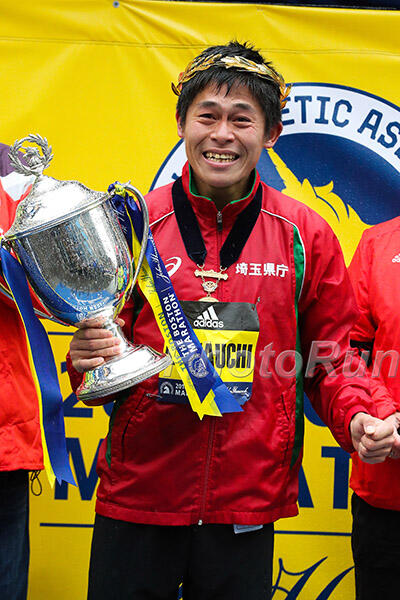
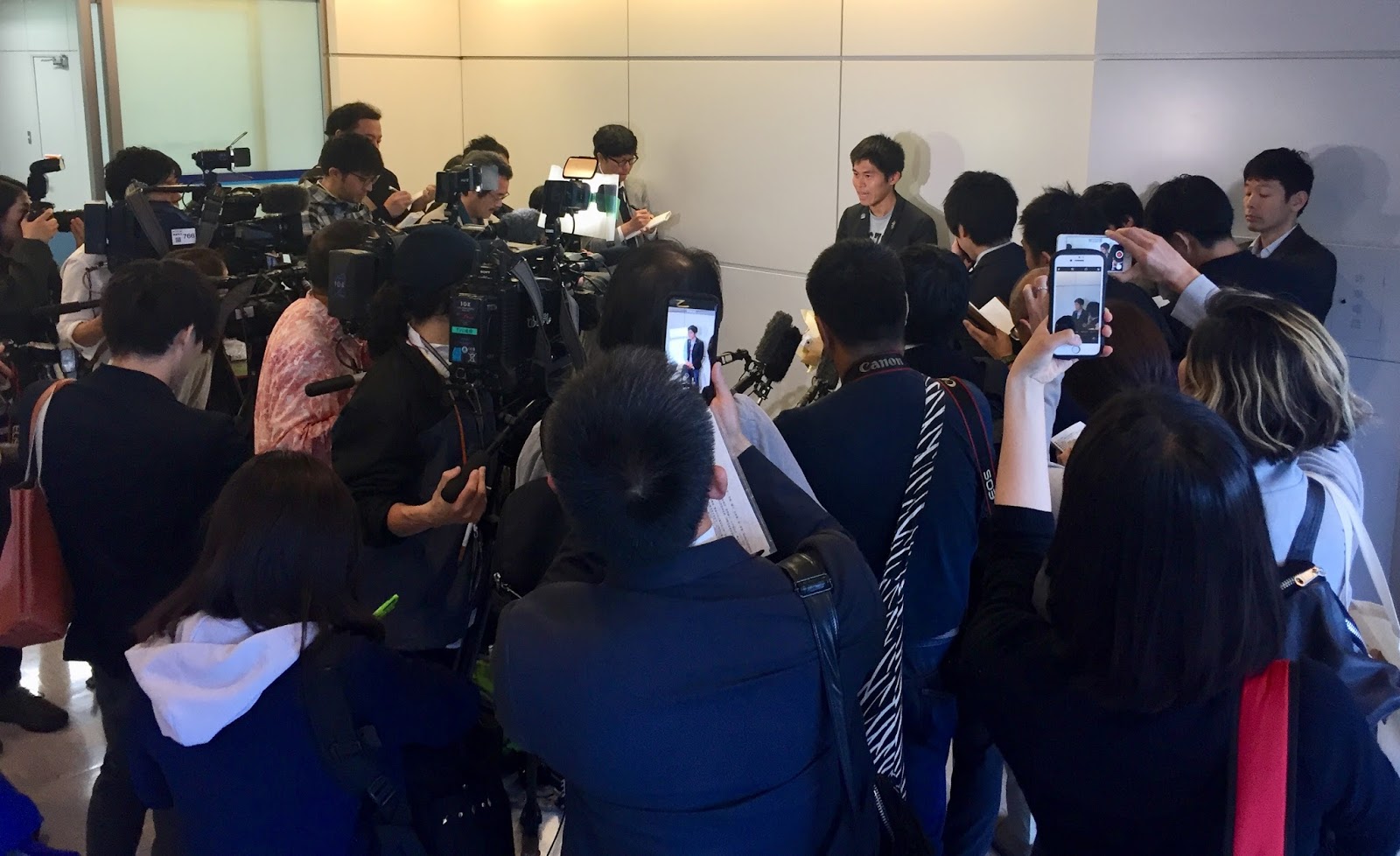
Half shocking, half seeming like an historical inevitability, Kawauchi broke the tape to become the first Japanese winner since a month after he was born 31 years ago, the first Japanese winner male or female of a World Marathon Majors race. A dominant performance that capped Osako’s 3rd-places finishes in Boston and Fukuoka last year and Yuta Shitara’s national record in Tokyo to fully baptize the rebirth of Japanese men’s marathoning. The reaction back home was just what you’d expect, with dozens of TV and print journalists from every national network and major newspaper pouncing upon him the second he walked through the doors at Narita.
How it Happened
How did it happen? He was lucky that the weather played to his greatest strengths, but Kawauchi came to Boston fully prepared for any situation. He was smart, strong, unafraid. There hasn’t been a marathon where someone so fully controlled everyone else around him since Wanjiru in Beijing ’08. This was the work of a master artist at the height of his powers, crafting a work of lasting beauty in his own recognizable and idiosyncratic idiom. “It felt like the hand of fate,” he told me later. “All through the race I kept remembering what you said. ‘This is the day I was born for.’ I’m so glad I ran Boston.” For me too it felt like the completion of a journey, something that started with Morishita in Barcelona, passed through my life and running, through one of Boston’s greatest champions, and somehow came to this. I think all I’ve really wanted was to see again what I saw in Morishita that day. And at last, there it was.

© 2018 Brett Larner, all rights reserved
