 EN
EN
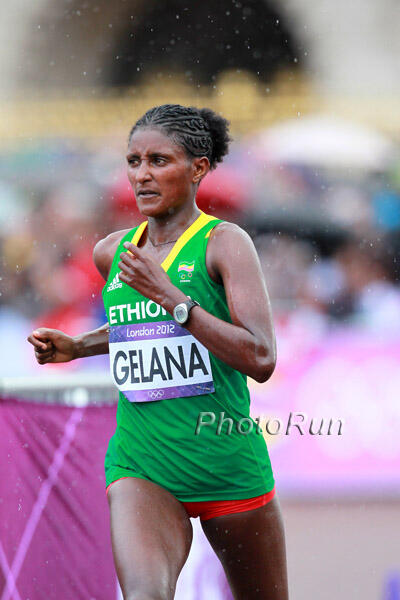
2012 London Olympic Games London, England Aug03-12 2012 Photo: Victah Sailer@Photo Run Victah1111@aol.com 631-741-1865 www.photorun.NET
Globe Runner blog » Butcher’s Blog – Articles by Pat Butcher – GELANA PAYS THE PRICE – London Marathon Bad Management
The clash at the 15k drinks station between Olympic women’s champion Tiki Gelana of Ethiopia and Josh Cassidy, one of the men’s wheelchair favourites was an accident waiting to happen.
The vast majority of international marathons with wheelchair events start them before the able-bodied runners, in order to avoid the sort of collision between Gelana and Cassidy, which ruined Sunday’s London Marathon women’s race.
Cassidy should have known better, should have realised that, with a drinks station just metres ahead on one of the narrowest parts of the course, the women would be moving across to take their bottles. It’s hard enough to identify bottles, even without wheelchairs buzzing around, as Mo Farah testified when he finished his Sunday morning spin to halfway.
And as for the organisers’ crass statement, issued late Sunday evening, attempting to absolve themselves of responsibility for the collision, and doubtless pressuring Gelana and Cassidy to make placatory statements, well it might as well have been scripted by any number of bankers, who accept million dollar bonuses for mismanagement, while trying to make believe they’ve done nothing wrong.
Though she raced to catch up, and her Kenyan rivals sportingly waited for her and others affected by the collision to rejoin them, Gelana’s race was effectively ended at 15k. As Paula Radcliffe, commentating for BBCTV mentioned, it is to be hoped that limping through the rest of the race, to finish in 2.36.55, isn’t going to affect her permanently. And if she was thinking that her fee would be reduced if she dropped out, then the organisers owe her even more of an apology.
None of this should diminish the quality of Priscah Jeptoo’s victory. The Kenyan came agonisingly close to catching Gelana in the final stages of the Olympic marathon last year; and deserves all the kudos she earns from this year’s win.
As far as the men’s race goes, there was no more eloquent dismissal of the ‘two-hour marathon’ believers than the way the men’s early leaders fell apart, following a first half in 61.34, a split, which if repeated, would have produced a world record by half a minute. As it was, Tsegay Kebede, who backed off the suicidal pace at 25k had to do no more than run 5.05 miles, and a second half in 64.30, in order to look as if he was sprinting through a bunch of zombies in the final stages.
In short, by setting up an untenable early pace for the men, and ignoring the high possibility of a collision between women and wheelchairs, the organisers overreached themselves, and paid the penalty of believing their own hype that they’ve got the best (and best organised) marathon in the world.
Unfortunately, as ever, the victims were the runners, and none more so than Tiki Gelana.
Pat Butchers BLOG

Uncharitably, one might ask whether wheelchairs have any place in a footrace. That said, given that the best wheelies complete the course some 50 mins. faster than the women, the potential for an accident was obvious.
As to the men’s race, and the radical loss of pace in the final miles (by my rough calculations, almost all the time was lost after 35 km, when the leaders were still on schedule for close to 2 hours, 4 mins. ), what were the weather conditions? In particular, which way was the wind blowing? This is a key point which the commentators seldom address. A tail-wind early on would inevitably have resulted in a fast opening half, while a direct head-wind (even just a breeze) in the closing miles along the embankment would have had a devastating effect on tired legs.
Best,
Tim J
An excellent set of sheer common-sense comments, Pat. And I get fed up with commentators repeating the mantra that London is the best marathon in the world. It may or may not be – however one measures such events! – but it’s not up to us to say so, surely?
Tim Johnson has excellent points too, re the pace – and do you think that the presence of Mo Farah had anything to do with that fast first half?
Yours in Sport. Craig.
Hi Craig,
re Farah, no, I don’t think he had any impact on the pace, indeed I suspect he found it surprisingly fast, which is one reason why he was with the second group, the other being he seemed to be respecting the fact that he wasn’t going to finish, and didn’t want to influence the pace.
as to the publicity stunt which was his participation in the first place…….!
there was far too much talk about a guy who wasn’t going to finish
worth bearing in mind that multiple world champion, and half-marathoner sublime, Zersenay Tadese has never cut it at the marathon
the London winners and poor Gelana are much more deserving of our attention
At my home in East London, there was not a breath of wind on the Sunday morning of 21st April, 2013. It was also cool (just under 10 deg. C) with a gradual increase in temperature approaching noon. Perfect conditions for marathon racing in London that we may not see again for years. Of course, along the Thames, there may have been some presence of wind as the elite athletes headed into the second half of the race – I was not there, so I cannot say.
The early pace in the men’s race was indeed suicidal, with the leaders passing 21.1 km in 61:34; and many of them paid for it big time as they ‘hit the wall’, slowing down dramatically after 35 kilometres as Tim Johnston noted. Here is proof that even if you do assemble a top class field of studs, and lay on talented pace makers to get them to halfway on world record pace, that is still no guarantee of even a course record being set. The old maxim that, ‘Marathon races start at 21 miles’ was never better illustrated.
Yes, talk of,”we may see a two-hour marathon soon” really is glib. People who repeat this mantra really do not know what they are talking about, and have no concept of what is required.
And yes, there was way too much focus on Mo Farah running only half the course – to check it out for 2014, as we were constantly told. He was even on a TV chat show on Friday night talking about it. Specifically not mentioned (by host Graham Norton or Mr Farah himself) was the amount of money he was being paid to do his research on foot. But then, as Mo keeps insisting, “It’s not about the money.” Quite so, but the cash does come in handy when you have a wife and three expensive daughters to feed, I expect.
I was frankly amazed that Olympic Champion Tiki Gelana was not badly injured by that racing chair. After falling, she surged to catch up, but as Ms. Radcliffe observed, her race was effectively over at that 15km drinks station anyway.
Next year, the wheelchair events (for men and women) must be scheduled to start well before any of the foot races. It’s a simple piece of scheduling, and very easy to organise. Perhaps also next year BBC commentators will cease from constantly reminding us that we are watching “the greatest marathon race in the world.”