 EN
EN
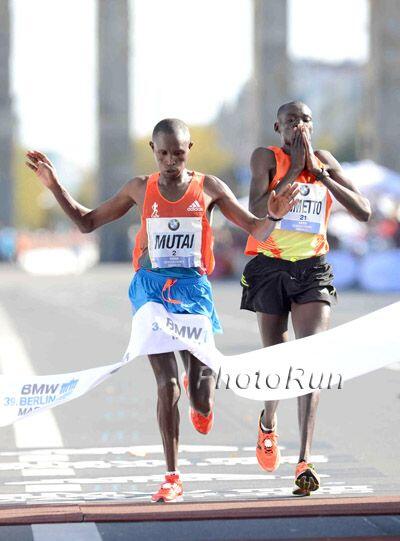
2012 BMW Berlin Marathon Berlin, Germany September 30, 2012 Photo: Jiro Mochizuki@PhotoRun Victah1111@aol.com 631-741-1865 www.photorun.NET
Globe Runner blog » Butcher’s Blog – Articles by Pat Butcher – BACK TO THE FUTURE? Marathon Conspiracy?
The slow motion finish of the Berlin Marathon on Sunday, when debutant Dennis Kimetto failed to challenge his elder statesman training partner Geoffrey Mutai, who thus clinched the Marathon Majors' half-million dollar prize for the 2011-2012 series, has inevitably given rise to a plethora of conspiracy theories
It certainly looked odd. After a long surge in the third quarter of the race, which took the pair to within shooting distance of Patrick Makau's world record of 2.03.38, the pace dropped dramatically in the final three kilometres, leaving the way open, it seemed, for the lanky Kimetto, at 28 a late arrival on the world marathon scene, to wheel up an 11th hour challenge to his mentor.
But it never came. Kimetto seemed content to stay a stride behind, which is where he finished, as Mutai breezed unchallenged down the finish straight, to win in 2.04.15, with Kimetto one second behind.
Cue outrage across marathon cyberspace, with accusations of race-fixing, and that Kimetto had been told not to threaten Mutai's marathon purse. It was certainly disappointing, since when the potential record evaporated the expectation was of a grandstand finish, which never came.
What has been overlooked by those who may not have seen the whole race is that Mutai is the man who was right behind the pacemakers throughout the early stages of the race, and was also the man who initiated all the breaks when the pacers dropped out, successively at 21k, 30k then 31k. Then when he only had Kimetto for company, it was Mutai who strode into a five metre lead after 35k and though Kimetto rallied to within a stride by 40k, the expected challenge never came, and we got the curious spectacle of Kimetto shadowing Mutai through the finish line.
Following which Kimetto bent double with the effort (and I don't think he was kidding), suggesting that he had already been at his limit in those final stages. But how many times have you seen someone ‘kill' themselves to get past an opponent, often ending up flat out?

If it was a ‘fix', then we have been here before, many times. Coincidentally there was a similar finish in Berlin 2003, when Sammy Korir did what many pacemakers have done in recent years (often to the extent of winning the race).
Korir kept going, and gave his illustrious colleague Paul Tergat the biggest scare outside of a Haile Geb sprint, when Korir tracked Tergat right to the line, in much the same way as Kimetto did with Mutai, albeit Korir was five metres back. But at least, Tergat and Korir were, as we used to say, ‘eyeballs out'.
The ‘only' prize then was victory and the world record, and it went to Tergat, at 2.04.55, with Korir a few strides and one second behind, 2.04.56.
But many people felt that Korir had let his famous compatriot win, or rather did not want to commit the fault of lésé-majesté, or in common parlance, disrespect. The Mutai-Kimetto situation could have been as simple as that, which would still make it disappointing. And leave it open to misinterpretation, and criticism.
There was little doubt in the Zurich Golden League 1999, when another couple of Kenyans were duking it out at the head of the steeplechase field. Bernard Barmasai had won the first four GL races, and was in contention for the gold bars which went with an undefeated run. When Christopher Koskei challenged Barmasai in the closing stages of the race, and looked like he had the beating of his colleague, Barmasai was seen to talk to Koskei, after which the latter relented, and Barmasai went on to win the race.

Though both athletes denied collusion, the then International Amateur Athletic Federation (the name has since been modified – to protect the guilty?) ruled that Barmasai (left) had brought the sport ‘into disrepute', and though they allowed him to continue to race on the Golden League circuit, they made him ineligible to share in the jackpot.
Now all of the above reads uncomfortably like the situation which prevailed in the ‘pedestrian' world of late 19th century athletics, when athletes would run under assumed names in different parts of the country (UK and USA), or simply run poorly in one race in order to get a better handicap in the next (since most meetings were handicap meets back then).
There were even those who would ‘throw' races at the behest of betting syndicates; and pick up a better ‘bonus' than victory might have afforded them.
And that, dear readers, is what led to the formation of the Amateur Athletics Association in 1880, a movement which spread across the world.
And whose philosophy is followed by over 99% of those who ran in Sunday's Berlin Marathon.
Pat Butchers BLOG
Posted on October 2, 2012 by Pat 1
This entry was posted in Butcher's Blog.
Bookmark the permalink.
