 EN
EN
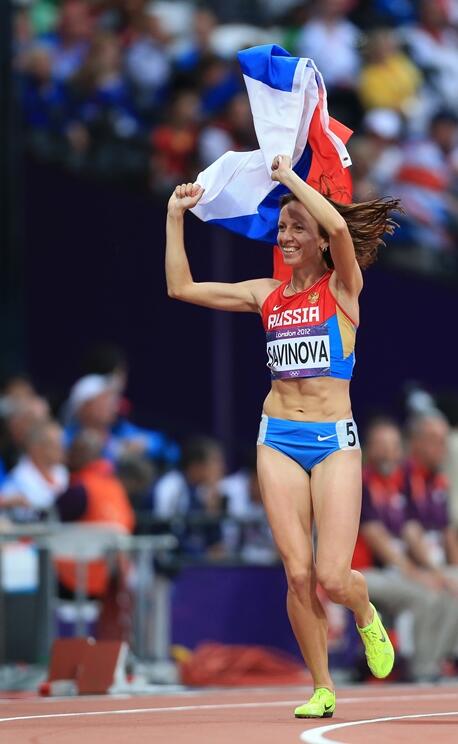
Mariya Savinova claimed the Olympic title at 800m. ©EAA - European Athletics
European Athletics (EAA) – News – Women’s middle distance & steeplechase
European Athletics continues its 2012 End of Year Review with the women's middle distance & steeplechase.
800m
Last year, Russia's Mariya Savinova only lost one race all summer and her World Championships victory helped earn her the accolade of being the 2011 European Athlete of the Year.
In 2012, her record was not quite as brilliant but she was still Europe's undisputed top women over two laps of the track thanks to her unquestionable ability to peak when it counts, and she took the Olympic title in some style.
With 130m to go, Savinova kicked for home and hit the front before crossing the line in 1:56.19, the fastest time in the world this year.
Savinova had advertised that she was rounding into shape with a 1:57.42 outing in the heats of the Russian Championships – as a defending world champion she had already been selected for the Olympics and didn't start the final in Cheboksary – and then didn't race again until London.
From a continental perspective, this event was dominated by Russian women, who occupied the top six places in the 2012 list.
Former World Junior Championships 400m hurdles gold medallist Yekaterina Kostetskaya ran the second fastest European time of the year with 1:57.46 at the Russian Championships but chose to concentrate on the 1500m at the Olympics.
However, there was a big breakthrough for another Russian, Yekaterina Poistogova.
Still only 21 and eligible to run in the 2013 European Athletics U23 Championships, Poistogova started the year with a best of only 2:02.11, which dated back to 2009 when she was the bronze medallist at that year's European Athletics Junior Championships.
However,having gone faster than that twice indoors, Poistogova then improved her best on three more occasions outdoors, culminating in the 1:57.53 she clocked when she came home as the surprise bronze medallist at the Olympics.
Fellow Russian Yelena Arzhakova followed up her success at the European Athletics Championships, where she was a convincing winner in 1:58.51, but also making the Olympic final where she was the third Russian – and third European – home in sixth place.
1500m
History repeated itself very quickly at the London 2012 Olympic Games as the gold and silver medallist from the European Athletics Championships six weeks early, the Turkish pair of Asli Cakir and Gamze Bulut, repeated their feat.
In Helsinki, they took advantage of an unevenly paced race and pushed hard at the bell, to cross the line in 4:05:31 and 4:06.04 respectively.
Cakir, who had also won a World Indoor Championships bronze medal in front of an ecstatic home crowd in Istanbul to be the first European home back in Match, had uncorked a 57.91 last lap to secure her victory.
In London, the sedentary pace over the first half of the race, played to the Turkish women's strengths.
Cakir ran a 58.12 last lap to become the first Turkish athlete to win an Olympic gold medal. She lead into the home straight and never overtaken while Bulut moved from fourth to second in the final 100m to secure her second significant silver medal of the summer.
The gold medallist also headed the European rankings on time by almost three seconds, running 3:56.62 at the Samsung Diamond League meeting in Paris on 6 July, less than a week after her European triumph.
She was followed on the 2012 European rankings by no less than nine Russians, headed by Kostetskaya who ran 3:59.29 to win at the Russian Championships and then finished ninth in London.
Six European women went under four minutes in 2012 while the prodigious Bulut, who is still only 20, had a best before this season of 4:18.23 but ran a personal best of 4:01.18 in her Olympic semifinal.
3000m steeplechase
Russia's 2012 Olympic champion Yuliya Zaripova only contested three steeplechases, excluding her London heat, but won them all. She was not only the number one European over the barriers by a big margin but clearly the best in the world.
She won the Russian title in 9:09.99, breezed through her Olympic Games heat and finished second in an untroubled 9.25.68, before blowing everyone else away in the London final to add an Olympic gold medal to her world title from 12 months before.
Zaripova adopted the same tactics that served her so well in Daegu. She led from gun-to-tape, the crucial difference being that instead of going flat out from the start, like she had done at the World Championships, in London she was confident enough make the pace but wait until the final kilometre before pulling away and destroying the opposition.
She even seemingly finished with something in reserve, able to find another gear when a rival briefly challenged on the last lap, before crossing the line in 9:06.72.
After London, Zaripova had a fully-fledged attack on the world record at the Samsung Diamond League meeting in Stockholm.
Despite the attempt coming slightly unstuck, without any help from pacemakers after the first kilometre, she still managed a personal best of 9:05.02 for second place on the world all-time list and the fastest time in the world since her compatriot Gulnara Galkina's world record run of 8:58.81 in 2008 (who failed to finish the the Olympic final in the defence of the title she won four years before in Beijing).
The second fastest European of the year was Turkey's Gulcan Mingir, who had caused a big stir when she ran a national record of 9:13.53 at a relatively low-key meeting in Sofia in June.
However, Mingir showed convincingly it was no fluke or timing malfunction when, in the absence of Zaripova, she won at the European Athletics Championships after producing a notable turn of speed over the final 200m to win in 9:32.96.
Sadly, Mingir ran out of steam by the Olympics and didn't progress beyond her heat.
Instead, the next best European after Zaripova in London, and third on the 2012 European standings was Germany's Antje Möldner-Schmidt, who finished seventh in a season's best of 9:21.78.
Möldner-Schmidt had the month before taken the bronze medal in Helsinki behind Mingir and Ukraine's Svitlana Shmidt.
The 2012 European top 30 lists can be found here.
European Athletics (EAA) – News
