 EN
EN
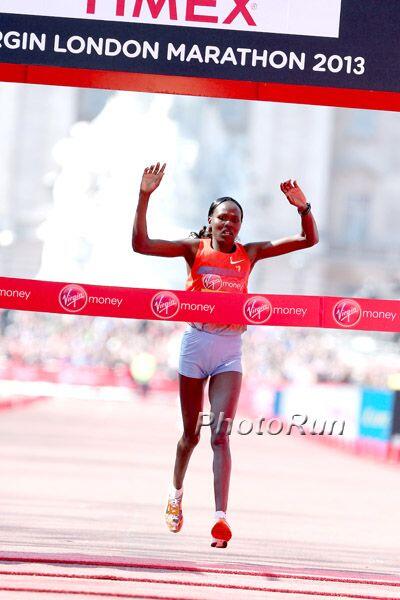
Priscah Jeptoo of Kenya crosses the finish line to win the women's title at the 2013 London Marathon on Sunday. ©Victah Sailer
European Athletics (EAA) – News – Why time stands still for the world’s best women?
It is now more than 10 years since the women's marathon world record was set in London. And as Kenyan Priscah Jeptoo soared to victory in the English capital on Sunday, the irony was not lost in the woman who was helping describe her victory.
Paula Radcliffe, whose record time of 2:15:25 now seems more monumental than it was a decade ago, was in the BBC commentary as Jeptoo won in 2:20:15.
Radcliffe has not yet officially retired, but so much is pointing towards her not running at the major, competitive level again after injury forced her to miss her bid for Olympic Games glory in London last summer.
But even if she does bow out, it seems her record will stay long into the future as her presence as one of Europe's greatest distance runners holds it place at the top of the world list.
But why?
In a time where financial bonuses for breaking records remain high and sport is as competitive as ever, have women running 26.2 miles reached their peak?
Radcliffe was on such a roll when she broke the time in London in 2003 that the mark she smashed was her own world record of 2:17:18 from Chicago just a few months earlier.
Only one woman has threatened Radcliffe's time since then when Russian Liliya Shobukhova won in Chicago in 2011 in 2:18:20.
It is still only the fourth quickest time behind Radcliffe's two world records and then the 2:17:42 that the Briton ran when she won London in 2005.
This topic has been the backdrop of many conversations during the past week and it is Radcliffe herself which has provided two of the most telling answers as to why her time has not been broken.
Speaking to The Observer newspaper, Radcliffe said: "Maybe it's because people are racing each other more than racing themselves."
Speaking to the BBC, she added: "It could be (broken) at any time. It just takes someone to get in really good shape, and get the right conditions on the day."
But significantly, she also said: "My record hasn't even stood as long as the 13 years that Ingrid Kristiansen's did. It is not even the longest standing women's marathon record."
Kristiansen's 2:21:06 was set in London exactly 28 years ago on Sunday and even now it shows how magnificent a time it was.
Jeptoo was only 51 seconds quicker, which probably underlines the point Radcliffe has made.
Do fast times matter anymore?
Jeptoo ran a controlled race which at no stage had "world record" written on it.
It was about the winning, which she did with a superb performance.
But maybe it is the fact that competition from your fellow teammates takes away that element of running for a record instead of running just for victory.
Time will only provide that answer, but it is fair to assume that in 12 months, Radcliffe will still be at the top of that list.
