 EN
EN
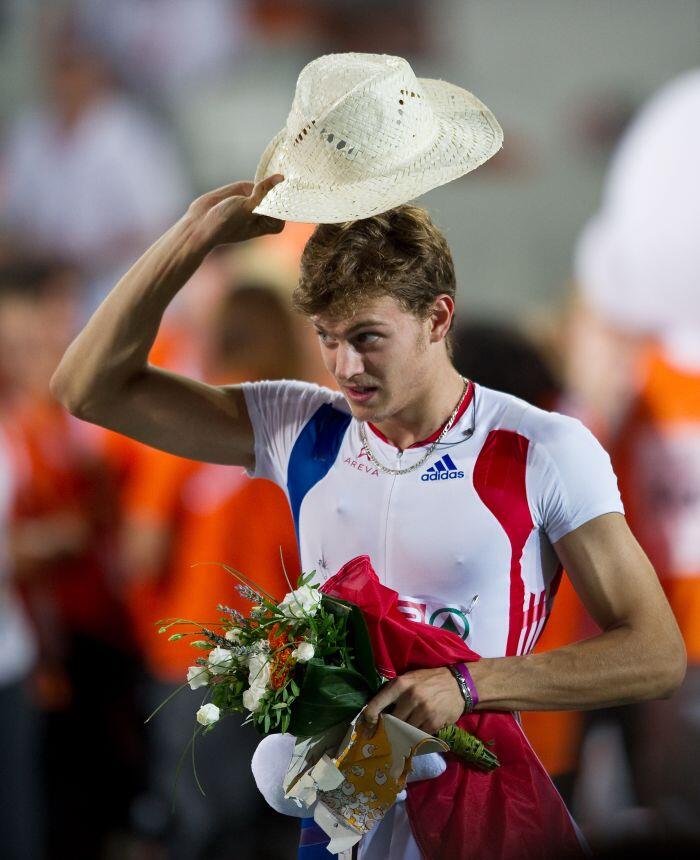
Christophe Lemaitre was part of the French 4x100m team that just missed out on a podium finish in London. ©EAA - European Athletics
European Athletics (EAA) – News – Men’s & women’s relays
Men's 4x100m
The fastest European team of the year was Germany when their quartet of Julian Reus, Tobias Unger, Alexander Kosenkow, Lucas Jakubczyk sped to a national record of 38.02 in Weinheim on the eve of the Olympics, an outing which move up to equal-third on the European all-time list with the former Soviet Union.
Only British and French teams have ever gone fastest among European nations and the Germans went to London harbouring some hopes that they might have a chance of medal.
In fact, the Weinheim time would have got them third place at the Olympics but a poor heat meant that they never even made the final.
Rather than Germany, it was France who lead the European challenge against the phenomenal Jamaican and US sprint squads, the former setting a world record of 36.84.
After running an impressive 38.15 in their heat, the second fastest European time of the year, their team of Jimmy Vicaut, Christophe Lemaitre, Pierre-Alexis Pessonneaux, Ronald Pognon almost made it onto the podium, clocking 38.16 for fourth place, just 0.04 behind bronze medallists Trinidad and Tobago.
It was not a completely barren year for the Germans, who had taken the silver medals at the European Athletics Championships but once again on the big occasion, they didn't get it quite right and finished behind an inspired and well-drilled Dutch team.
From the outside lane, The Netherlands clocked a national record 38.34 in Helsinki. Excellent third and fourth legs from Giovanni Codrington and 200m silver medallist Patrick van Luijk were the key to enabling the Dutch to come home a metre ahead of Germany and win this particular event for the first time in the Championships history.
The Netherlands improved even further in their heat at the Olympic Games and clocked 38.29 for third place of the 2012 European list, although they were just slightly slower in the final with 38.39 for sixth place.
Hindered by the absence of 100m silver medallist Vicaut, France had to settle for the bronze medals in Helsinki while Great Britain, arguably the European Athletics Championships favourites after being the fastest in the heats, failed to finish in the final after an incomplete baton change.
The list of recent relay disasters for Great Britain, who won the Olympic gold medals in 2004, continued in London when they were disqualified for an out-of-sector handover. The mishaps at the two big 2012 championships can be added to failures at the 2008 Olympic Games, 2010 Europeans Athletics Championships and 2011 World Championships, despite their abundance of individual talent.
Men's 4x400m
This event revolved really revolved around the two big outdoor championships although Great Britain had done well to take the silver medals at the World Indoor Championships back in March.
A Belgian team of Antoine Gillet, Jonathan Borlée, Jente Bouckaert, Kevin Borlée took the title in Helsinki, for whom the Borlee brothers were instrumental in their country winning this event at the European Athletics Championships for the first time.
After Nigel Levine had given Great Britain a five-metre lead over France and Germany at the end of the first leg, Jonathan Borlee uncorked a stint of 44.3 to bring Belgium into second behind Britain.
The leading pair maintained their places on the third leg but 2010 European 400m champion Kevin Borlée then cruised to the front en-route to a clocking a 44.22 leg and Belgium won by four metres in what was then a Europe-leading time of 3:01.09. Great Britain clocked 3:01.56 for the silver medals and hold off bronze medallists Germany.
At the Olympics, it was a very different British quartet and a different result. Sporting three changes in the final with hurdlers Jack Green and Dai Greene running legs two and three, as well as Martyn Rooney on the anchor leg, they finished a creditable fourth with 2:59.53, the only European team to go under three minutes this year and the fastest performance by a European team since 2008.
Much of the credit has to go to Rooney, who ran 44.09 on the final leg to take Britain from sixth to fourth.
Russia finished fifth in London with 3:00.09, the second fastest European time of the year, while European champions Belgium, this time with Kevin Borlee on the opening leg in the final, finished sixth in 3:01.83.
Women's 4x100m
Ukraine, whose current generation of sprinters first made a major impression at the 2010 European Athletics Championships when they took the gold medal in this event in Barcelona, were again Europe's best team by a significant margin.
The slick team of Olesya Povh, Hrystyna Stuy, Mariya Ryemyen, Yelizaveta Bryzhina ran a national record of 42.04 to take the London 2012 Olympic Games bronze medals, in a race that saw the United States set a world record of 40.82.
It was fastest time by a European team since France won at the 2003 World Championships and the 11th fastest ever, with eight of those better times coming from East German teams in the 1980s.
Ukraine were also odds-on favourites to retain their title at the European Athletics Championships after they ran 42.70 in their Helsinki heat but made a rare slip when Povh failed to transfer the baton to Natalia Pogrebnyak at the first change in the Finnish capital.
They could only look on as Germany won in what was then a Europe-leading time of 42.51. The Netherlands pulled off a big surprise when they finished second with a national record of 42.80 while Poland finished third in 43.06.
The Dutch were to go even quicker at the Olympics, clocking 42.45 in their heat to finish as the second fastest European nation. However Germany finished fifth in the London final to be the second European team home, with The Netherlands sixth.
Three nations – Ukraine, The Netherlands and Germany – ran under 43 seconds in 2012 while another seven went under 44 seconds.
Women's 4x400m
Russia's team of Yuliya Gushchina, Antonina Krivoshapka, Tatyana Firova and 400m hurdles winner Natalya Antyukh could do little to keep up with a stunning US team at the Olympic Games, who ran the fastest time for 19 years when they won in 3:16.87.
However, Russia can take a huge amount of pride from the fact that their own time of 3:20.23 was the fastest European time in their same period, since their compatriots set a national record of 3:18.38 at the 1993 World Championships.
Russia was second at the first changeover and never relinquished that position. Arguably the biggest contributors to their success were Krivoshapka, who ran 49.8 on the second leg and anchorwomen Antyukh, who clocked 49.67 to hold off bronze medallists Jamaica.
Ukraine finished fourth in London with their team of Alina Lohvynenko, Olha Zemlyak, Hanna Yaroshchuk, Nataliya Pyhyda setting a national record of 3:23.57, a time only Russia beat among the European teams in 2012.
However, it was Ukraine that took the honours at the European Athletics Championships with Yuliya Olishevska, Olha Zemlyak, Nataliya Pyhyda and Alina Lohvynenko making up for the disaster in the women's 4x100m by their team mates and taking the title with 3:25.07.
Ukraine were only fifth after the first leg but Zemlyak went past four runners to get her team in front and that's where they stayed all the way to the line.
France, who were to finish sixth at the Olympics, one place behind hosts Great Britain, took the silver medals in Helsinki with an outing of 3:25.46 while the Czech Republic finished third in 3:26.02.
The top 12 European performances in this event, from the leading five nations – Russia, Ukraine, Great Britain, France and Czech Republic – came at either the Olympic Games or European Athletics Championships.
It's worth also mentioning that although this is primarily a review of the outdoor season, Great Britain took the title at the World Indoor Championships in 3:28.76.
The 2012 European top 30 lists can be found here.
European Athletics (EAA) – News
