 EN
EN
European Athletics (EAA) – News – A year to the day: Remembering the 20th European Athletics Championships
On the first anniversary of the Barcelona 2010 European Athletics Championships Opening Ceremony, we look back on the many memorable moments of the 20th edition of the celebrated event.
To celebrate this special anniversary of Barcelona 2010, we are able to bring you this stunning video retrospective, while you can also enjoy some of the best images from the championships in this final picture book.
Every championships has its defining moments – Cathy Freeman at the Sydney Olympics; Bolt in Beijing; Klüft, Kallur and Olsson in Göteborg’s sea-of-yellow Ullevi stadium in 2006.
For the host nation, Barcelona 2010 will doubtless be remembered for the two 1500m finals when Arturo Casado in the men’s and, 24 hours later, Nuria Fernández in the women’s brought back memories of Fermin Cacho’s extraordinary Olympic gold medal winning run in the same event in the same stadium on Montjuic back in 1992.
Like Cacho 18 years earlier, both had the Spanish fans on their feet as they romped across the line ahead of more fancied rivals. For Casado, tipped by Cacho himself, it was a tactical triumph as he led home three Spaniards in the top four, while the emotional Fernández described her victory on the final evening as “the best race of my life” and “a dream come true”.
“I have been fighting for this for 15 years and finally at 33 I got the gold medal,” said the Swiss-born middle distance runner after leading Spain to gold and bronze ahead of Russia’s big favourite Anna Alminova.
Those may have been Spain’s only triumphs from the 47 events but there were other sweet moments for the hosts’ athletes, not least José Manuel Martínez’s joyous reception as he swept around the final jam-packed bend to finish second in the marathon, the 38-year-old leading Spain to Marathon Cup victory; and world champion Marta Domínguez gracefully accepting defeat in the steeplechase despite her huge disappointment at failing to land gold as the championships’ poster-girl.
Yet, perhaps Spain’s biggest success was to stage the 20th European Athletics Championships in such a magnificent setting as Barcelona’s Olympic stadium. Perched high on Montjiuc, with the beautiful Catalan capital spread out beneath it, the hallowed arena hosted crowds of up to 38,000 each day.
Medal honours
That there were some empty seats visible throughout the event maybe meant that Spanish sports fans had enjoyed enough success for one year. In competition terms, at least, these were not Spain’s greatest championships (they won “only” eight medals compared to 11 in 2006), as Russia adopted their usual position at the top of the table while France and Britain outperformed even their own most optimistic predictions to rank second and third.
Russia finished with a total of 10 golds, six silvers and eight bronze medals. France pipped Great Britain & N.I. with eight golds, six silvers and four bronze medals, while Britain claimed six gold, seven silvers and six bronze.
The French, in particular, had a brilliant week. Not only did they win eight gold medals – double their previous championships best – but in 20-year-old sprinter Christophe Lemaitre they had the most successful individual and the undoubted star of the show.
 |
| Christophe Lemaitre claimed 100, 200 and relay gold to light up Barcelona in 2010. |
The rise and rise of Lemaitre
Lemaitre had arrived in Barcelona with the weight of expectations on his young shoulders. Topping the rankings in both sprints, and with a national 100m record of 9.98 to his name, Lemaitre could have been excused for feeling the pressure.
But if he did, it never showed as he lived up to his billing, and his potential, in superb fashion. The super strong Frenchman powered from behind to take both individual titles, only the seventh male athlete to win a European sprint double, before becoming the first man in history to add the sprint relay gold.
While all too often his skin colour seemed to attract the most attention (especially in the Spanish press, sadly), it was Lemaitre’s performances that really stood out as he became the first Frenchman since Claude Piquemal back in 1962 to win the 100m, and showed huge determination to claw his way back from fifth with 50m to go to win the 200m with a dip at the line.
Perhaps it is a mark of his personality that Lemaitre picked out the relay as his most important triumph because, he said, it was “a team effort”.
In fact, his individual successes inspired “a team effort” by the French throughout the championships as Renaud Lavillenie and Romain Barras won pole vault and decathlon golds; Mahiedine Mekhissi and Bob Tahri dominated the steeplechase to finish first, in a championships record, and second respectively; and Yohann Diniz walked solo for three hours forty minutes to retain his 50km walk title, one of only two athletes to successfully defend their Göteborg crowns (the other being Norway’s javelin champion Andreas Thorkildsen).
With the dramatic emergence of Myriam Soumaré, France also provided the championships’ biggest breakthrough act. Soumaré, a last-minute inclusion in the French team, improved from 23.01 to 22.32 for a stunning 200m win after she had already taken a shock bronze medal in the 100m just two days earlier.
Farah’s redemption
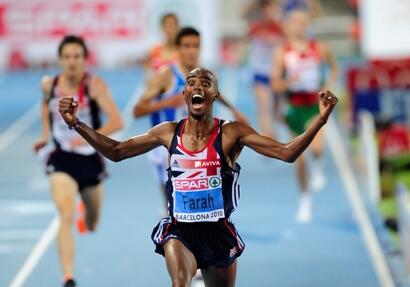
While Lemaitre was the French star, Mo Farah was Britain’s. Four years after losing by just 0.09s to Jesús España over 5000m, Farah found redemption, and more, as he exceeded the achievements of all Britain’s past distance running greats with a 5000m-10000m double that puts his name up there on Europe’s honour board with Emil Zátopek (1950), Zdiszlaw Krzyszkowiak (1958), Juha Väätäinen (1971) and Salvatore Antibo (1990).
While the twice beaming face of Farah provided Britain’s brightest moments, in terms of standards, it was their world champions who led the way, as Jessica Ennis and Phillips Idowu produced world class performances to win their heptathlon and triple jump crowns.
Ennis beat the Olympic champion Nataliya Dobrynska with 6823 points, 83 more than Carolina Klüft’s championships record and just eight short of Denis Lewis’s national record, while Idowu leapt to his lifetime best to defeat the much-fancied Frenchman Teddy Tamgho with 17.81.
There was also great success for British hurdlers as Dai Greene won with seven metres to spare over his training partner Rhys Williams in the one-lap version, the first one-two in this event since 1954, while Andy Turner served up a surprise victory in the 110m final.
 |
| Natalya Antyukh claimed a stunning win in the 400m hurdles in Barcelona. |
Russian female dominance
As usual, Russia’s 24-strong medal haul came largely thanks to their women who provided the championships’ only podium sweeps – in the 400m, led by Tatyana Firova, and the 20km walk, the title going to the irrepressible Olga Kaniskina, although special mention should be made of Natalya Antyukh and Yuliya Zarudneva, who were brilliant winners of the 400m hurdles and 3000m steeplechase finals respectively, each in championship record times.
Elsewhere, there were expected victories for Russia in the men’s high jump (Aleksandr Shustov beating Ivan Ukhov) and the women’s pole vault (Svetlana Feofanova enjoying life again in the absence of Yelena Isinbayeva), while Stanislav Yemelyanov set Russia on their way in the men’s 20km walk.
Similarly, three of Germany’s four golds were claimed by women – Verena Sailer in the 100m, Betty Heidler in the hammer, and Linda Stahl, a dramatic winner of the javelin – while Christian Reif became the only German male champion with his 8.47 long jump on the final evening, a performance that broke Robert Emmiyan’s 24-year-old record by 6cm and shot Reif to the top of the world rankings.
In fact, half of the eight championships records came in that final session, including the 68.87 throw that won discus gold for Poland’s Piotr Malachowski after a tough duel with Robert Harting, and Blanka Vlasic’s CR-tying 2.03 to win the high jump after a shaky start.
Championship firsts
Surprisingly, Vlasic wasn’t Croatia’s first post-independence European champion as the world number one was pipped to that honour by Sandra Perkovic. The 20-year-old discus thrower won the European junior title last year and added the senior crown in Barcelona with her last throw, snatching gold from Romania’s Nicoleta Grasu, 18 years older and a veteran of five championships.
Other “firsts” in Barcelona included Slovakia’s first European champion (Libor Charfreitag in the men’s hammer) and Turkey’s first European gold thanks to Elvan Abeylegesse who dominated the women’s 10000m on day two much as Farah had done the men’s 24 hours earlier.
Three days later, one gold became two for Turkey as Nevin Yanit broke the national record twice en route to defeating the favourite Carolin Nytra in the 100m hurdles. And by the end of day six it was three as Abeylegesse finished second behind her compatriot Alemitu Bekele in the 5000m. All three medallists in that race broke Domínguez’s 2006 championship record, the last of the eight new marks to be set at Barcelona 2010.
Overall, however, these championships were less notable for records than thrilling contests for these were days when medals mattered most. This was epitomised by the men’s 400m in which only seven hundredths of a second separated Britian’s Michael Bingham in second from Frenchman Leslie Djhone in sixth, while pre-race favourite Jonathan Borlée was only five hundredths further back in seventh.
Just up ahead, winning by just over a metre, was Jonathan’s twin Kevin who came from fifth to first in the last 50m to take gold in his best time of the season, 45.08. The younger brother by just five minutes, Kevin Borlée thus became the first Belgian man to win a European title since Karel Lismont won the marathon in 1971.
Röthlin’s incredible comeback
Hardly special in performance terms, the Barcelona marathons threw up some remarkable stories of their own, not least Viktor Röthlin’s extraordinary comeback victory in the men’s race. After finishing second in 2006 and third at the 2007 worlds, Röthlin was running his first marathon since a near fatal double pulmonary embolism in February 2009 followed by surgery to his right heel last autumn.
As they set off around the city’s baking streets at 10.05am even Röthlin didn’t know if he would complete the distance. But 25km later he was pulling away from his rivals, and after 2 hours 15 minutes 31 seconds he was celebrating Swiss National Day with a gold medal around his neck having won by 2 minutes 19 seconds, the widest margin for 52 years.
There was a similarly unlikely tale in the women’s race, where Zivilé Balciunaité finished first by more than a minute. It was only her second marathon victory in 26 starts. Later that year, though, Lithuanian Balciunaité was banned for two years by her national federation for a positive drugs test and is currently appealing this decision.
Among the non-finishers in that women’s marathon was Portugal’s former Olympic and world 10000m champion Fernanda Ribeiro, one of two athletes making a record-equalling sixth European championships appearance, the other being Romanian javelin thrower Felicia Moldovan.
Ottey keeps going
Ribeiro was 41, yet she wasn’t the oldest competitor on show as the remarkable Merlene Ottey celebrated 30 years competing at the highest levels of the sport by anchoring Slovenia’s 4x100m team to seventh place in their semi-final.
At 50, the former Jamaican is now the oldest competitor in European championships’ history, yet she says she wants to continue for many years more.
So don’t bet against her being around next year when the continent’s best track and field athletes, Monsieur Lemaitre et al, gather again in Helsinki for the 21st European Athletics Championships.
Outstanding television success
The continued popularity of the European Athletics Championships was underlined by a total television audience of 368 million tuning in to watch Barcelona 2010.
The cumulative figure (excluding news audiences) was higher than for the Göteborg 2006 European Athletics Championships. Göteborg 2006 had a total audience of 340 million over the seven days of the championships, with Barcelona 2010 beating that figure despite the competition being one day shorter.
Seventy-six sports broadcasters produced 1,583 hours of coverage for this summer’s European Athletics Championships. There were 1,425 broadcasting hours for the previous edition.
“These excellent TV figures show the continued importance of our sport on the continent and underline the demand for a European Athletics Championships to be staged every two years,” said European Athletics President Hansjörg Wirz at the time.
Following on from the success in Barcelona, European Athletics and EBU agreed to continue their long-standing partnership to ensure athletics remains on free-to-air television. Their agreement includes coverage of the Helsinki 2012 European Athletics Championships, which runs between 27 June and 1 July in 2012, and the Zurich 2014 championships.
European Athletics (EAA) – News
