 EN
EN
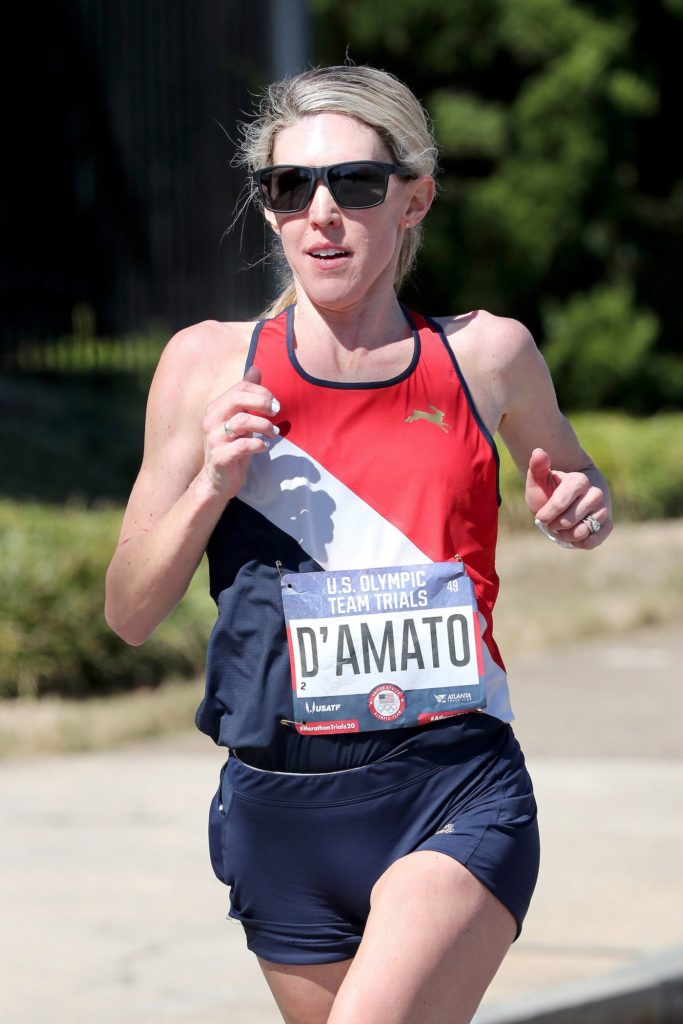

As of right now the two fastest women’s marathon times this year are the 2:19:12 American NR by Keira D’Amato at the Jan. 16 Chevron Houston Marathon and the 2:20:52 by Japan’s Mizuki Matsuda at the Jan. 30 Osaka International Women’s Marathon. Dr. Helmut Winter, in charge of the pace projection system used in Houston, wrote to JRN this week to point out that both women had almost identical splits at 30 km, D’Amato clocking 1:39:14 and Matsuda 1:39:15. Both women ran with male pacers, and both set new course records. How else did their runs compare?
Both started with almost identical splits, D’Amato in 16:25 for the first 5 km and Matsuda in 16:28. In D’Amato’s case she more or less held that through 15 km with an average split of 16:25 before slowing on a section of the course that included its toughest hill. From 15 km to 30 km she clocked 50:00, averaging 16:40 per 5 km. But despite slowing she was never off her target of breaking Deena Kastor’s 2:19:36 NR, her slowest projected finish time being 2:19:34 at 30 km. From there she returned to the kind of pace she had over the first 15 km, with splits of 16:28 and 16:26 to 35 km and 40 km and enough left to kick to the finish.
In Matsuda’s case, after starting off on NR pace she immediately backed off, hitting 15 km in 49:42 for an average of 16:34 and holding steady with a 16:38 split from there to 20 km. Mizuki Noguchi’s male-paced 2:19:12 NR wasn’t that far out of reach, but the focus seemed to be more on beating Mao Ichiyama’s 2:20:29 best, the fastest time ever by a Japanese woman on Japanese soil and the women-only NR. But after 20 km Matsuda returned to her opening pace, going 16:27 and 16:28 to 25 km and 30 km and her projected finishing time ticking back toward Noguchi’s record. If she’d been able to hold that until the end she would have been close it, but after hitting 30 km she slowed progressively the rest of the way, ultimately missing both Noguchi’s and Ichiyama’s marks in 2:20:52.

Mizuki Matsuda – Berlin Marathon – Berlin, Germany September 16, 2018 – Photo: Victah Sailer@PhotoRun – Victah 1111@aol.com – www.photorun.NET #run.photo
It’s interesting that Matsuda’s split from 20 km to 30 km, 32:55, was almost identical to D’Amato’s from 30 km to 40 km, 32:54. It’s tempting to say that Matsuda went too early and that if she’d held off longer like D’Amato she might have held it together better at the end and at least found the 23 seconds to hit Ichiyama’s time. That’s probably true, but she did actually hold it together better than in 2020, when she ran 2:21:47 after going through halfway 3 seconds faster.

In that race the female pace crew was steadier, averaging 16:34 per 5 km through 25 km and never more than 3 seconds off that in either direction, while the men this time averaged 16:33 through 25 km with a range of 7 seconds in either direction. But after 25 km, even though she slowed dramatically this time every one of her splits was still faster than in 2020. Or, in other words, she died harder in 2020.
Part of that is that she was on her own in 2020 after the female pacers stopped, while this time the male pacers stayed with her until just before the turn toward the stadium entrance. But even so Matsuda did show development this time, even if she didn’t meet her pre-race goals.
A little more reliable pacing help, a little more self-control at the part of the race where it’s most needed, and she might be able to come closer to the kind of NR time shared by D’Amato and Noguchi.
© 2022 Brett Larner, all rights reserve
Brett Larner – Japan Running News
