 EN
EN
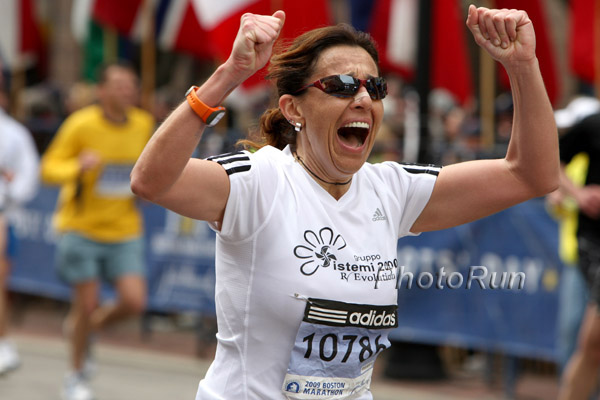
2009 Boston Marathon Boston, Ma April 20, 2009 Photo: Victah Sailer@Photo Run Victah1111@aol.com 631-741-1865 www.photorun.NET
BOSTON MARATHON – Running Strong Year ‚Round – The Boston Athletic Association B.A.A.
Established in 1887, the Boston Athletic Association is a non-profit organization with a mission of managing athletic events and promoting a healthy lifestyle through sports, especially running.
Our expanded leadership
 When Guy Morse (seen right) took the reins of the B.A.A. in 1985, he was given a rotary phone and an empty office in the old Boston Garden.
The days of the B.A.A. Games at the Boston Garden and the B.A.A. clubhouse were long gone, but the organization held onto its marquee event, the Boston Marathon, and the B.A.A. Running Club as the only two visible pieces of its illustrious past.
As race director, Guy Morse and the B.A.A.'s Board of Governors attracted a principal sponsor for the Boston Marathon in John Hancock Financial Services, and with the company's assistance instituted a prize money structure to help bring the world's fastest runners to Boston.
The change not only brought faster runners to Boston, but it brought more runners to the historic course. From 1986 to 2010, the race grew from 4,904 entrants to 26,690, and the men's and women's course records have improved a combined five times.
In 1996, for the 100th running of the Boston Marathon, Morse and the B.A.A. worked with the eight cities and towns along the Boston Marathon course for a one-year exception to have a largest-ever field size. On April 15, 1996, 38,708 runners were given entry into the Centennial race.
For seven years, this single-time exceptional field size stood as the largest marathon in history, as the B.A.A. had worked for years ahead of time to appropriately commemorate the milestone.

Every step of the way, the progressive actions of Morse and the B.A.A. have been reflective of the vision of the B.A.A. Board of Governors. Since its inception in 1887, the B.A.A. Governors have voluntarily led the organization through good times and bad. Joann Flaminio, a vice president in the investment industry, has served as president of the Board since 2011, when she took over for Tom Grilk, who served from 2003-2010 in that role.
Since January 1, 2011 Grilk has served as executive director of the B.A.A, while Morse became the senior director of external affairs, another reflection of the organization's intention to further and positively impact the community its calls home.
As the Boston Marathon has grown in popularity in the last 27 years, so has the breadth of the entire organization. In 1997, with help from adidas and the City of Boston, the B.A.A. began the "Relay Challenge" a thorough youth running program each spring which culminates with middle-school students pounding the pavement in a relay race near the Boston Marathon finish line on race weekend.
Each autumn, middle-school runners from Boston-based schools compete in the Middle School Cross Country Championships. Here's a video from the 2010 event.
In 2001, the inaugural B.A.A. Half Marathon brought thousands of runners through the scenic Emerald Necklace Park System of Boston. And in 2008, the B.A.A. hosted the U.S. Olympic Team Trials – Women's Marathon leading to the Beijing Games. While the organization has deepened its roots in youth running and charitable philanthropy throughout the year, the Boston Marathon has grown at a staggering rate.
In 2006, the B.A.A. teamed up with the Bank of America Chicago Marathon, the Virgin London Marathon, the ING New York City Marathon, and the BMW Berlin Marathon to form the World Marathon Majors. That event series was now joined by the Tokyo Marathon in 2013.
Boston Marathon Official Charity Program
The selected charities of the Boston Marathon Official Charity Program raise more than $11 million annually, and serve areas of need within Greater Boston. The funds and positive impact are important to the success of the B.A.A.'s mission, and the Association is proud to support these charities and their fundraising endeavors.
With special regard to our field of Boston Marathon qualifiers, the B.A.A. has integrated its charity program into the race – an effort which recognizes the community in and around the Boston Marathon, and the year-round philanthropic endeavors of the Boston Athletic Association.
Boston Marathon Official Charity Program began in 1989 when the American Liver Foundation became the first charity to receive official entries into the Boston Marathon. The Dana-Farber Cancer Institute came aboard in 1990, and since then the program has grown to support at least 30 charities each year.
To learn more about our Charity program – click here
More than the Marathon
Under the leadership of Guy Morse, and the Board of Governors, the B.A.A. has grown to an organization for all seasons. The last 27 years have demonstrated the B.A.A.'s commitment to and support of the greater Boston area, especially the eight cities and towns along the Boston Marathon route. For the 2011 Boston Marathon, the towns of Hopkinton, Ashland, Framingham, Natick, Wellesley, and Brookline, the cities of Newton and Boston, and the Commonwealth of Massachusetts will receive a combined $753,000 from the B.A.A., an increase from the record $703,000 they received in 2010 and the $654,000 they received in 2009. Additionally, the B.A.A. has pledged $815,000 for the 2012 Boston Marathon for the same purpose.
"The Boston Athletic Association is pleased to make this commitment to our host communities," said Morse. "With the support of the Boston Marathon's principal sponsor John Hancock Financial, we'll continue to underwrite the significant expenses of logistical course support to the Marathon communities, through planning and cooperation with the Massachusetts Executive Office of Public Safety. It also remains our hope that some funds from our donation be directed towards youth and community programs whenever possible."
In addition to financial support, the B.A.A. recognizes the generosity of the eight host cities and towns by playing host to the B.A.A. Invitational Mile the Sunday before the Marathon. Spring of 2009 was the first B.A.A. Invitational Mile, which included scholastic sections.
Two high school-aged boys and girls are selected to represent their respective city or town in a one mile race around Copley Square. The race finishes at the same historic line as the Boston Marathon. In 2010, middle school races were added.
Source: Boston Athletic Association B.A.A.
