 EN
EN
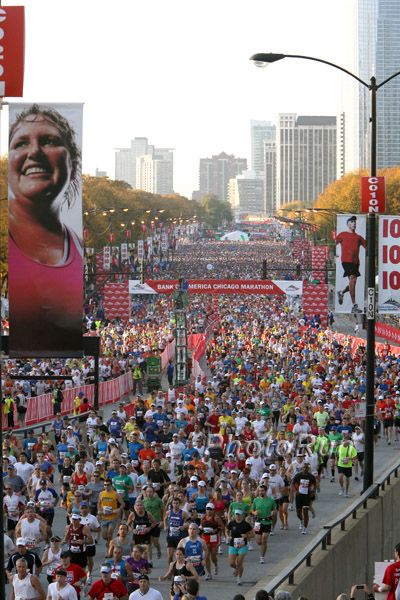
2010 Bank of America Chicago Marathon October 10, 2010, Chicago, IL Photo by: Lisa Coniglio Victah1111@aol.com 631-741-1865 www.photorun.NET
Bank of America Chicago Marathon – Sunday, October 13, 2013 – Race History 1991 – 2001 – Part II
October 27, 1991: Joseildo Rocha, 2:14:33; Midde Hamrin-Senorski, 2:36:2
The 14th Chicago Marathon did not start on a positive note. The loss of another title sponsor drastically reduced the prize money for winners to $7,500, compared to $30,000 the previous year. Around 7,500 started the race, but only 5,908 actually finished.
Thus, even with ideal racing conditions, Rocha of Brazil and Hamrin-Senorski of Sweden finished with the slowest winning times since 1981 for both men and women. The oldest male competitor, 75-year-old Art McLendon, made his 11th race appearance, finishing in seven hours. Ann Walters won the women’s wheelchair competition in 1:53:33, a streak she continued for the next six years through 1996. No other athlete has won six consecutive Chicago Marathon races.
October 25, 1992: Jose Cesar De Souza, 2:16:14; Linda Somers, 2:37:41
Under perfect running conditions, 8,214 runners competed in this year’s Chicago Marathon. With a lack of depth of world-class runners, Chicago’s 15th Marathon was difficult to predict. DeSouza, with his unmatchable 5:11 per mile pace, won the men’s competition to become the second consecutive champion from Brazil. Somers of Pleasant Hill, CA, set a personal best, winning the women’s competition by a two-minute margin. She would later represent the U.S. in the Marathon at the 1996 Atlanta Olympic Games. However, both winning times were again the slowest since 1981. DeSouza and Somers each walked away with $7,500 for their victories. In the wheelchair competition, Ann Walters, uncontested, set a new course record of 1:44:29, a record that still stands today.
October 31, 1993: Luiz Antonio Dos Santos, 2:13:14; Ritva Lemettinen, 2:33:18
Snowfall, 34-degree temperatures and 12-degree wind chills greeted the 6,941 runners in the 16th Chicago Marathon on Halloween (the latest race date in Chicago’s history). As the snow along the lakeshore pelted runners in the face, some dropped out with hypothermia. With prize money at $20,000 for the first men’s and women’s finishers, Dos Santos of Brazil and Lemettinen of Finland trudged through the wintry conditions to claim victory with the fastest winning times since 1990. Dos Santos became the third straight Brazilian man to win while Lemettinen was briefly disqualified with charges of running behind two male pacers who blocked the wind from her path, a violation of USA Track & Field Rule 66. The decision was later overturned due to unclear wording of Rule 66, and her victory was restored. Ann Walters won the women’s wheelchair competition, continuing the streak she started in 1991. This year marked her easiest victory in 1:57:34; she was the only female competitor.
October 30, 1994: Luiz Antonio Dos Santos, 2:11:16; Kristy Johnston, 2:31:34
A new title sponsor and the accompanying financial boost from LaSalle Bank put a freshly christened “LaSalle Bank Chicago Marathon” back among the world’s top races, a position not seen since 1986. Over 10,000 runners competed in cool and cloudy weather to make the 17th Chicago Marathon a spectacular event. Dos Santos successfully defended his title with a time of 2:11:16. Johnston, a native of Coos Bay, OR, out-battled the women’s competition to finish in 2:31:34. After claiming victory, she collapsed into Race Director Carey Pinkowski’s arms at the finish line. Both Dos Santos and Johnston took home $30,000 out of the $200,000 total purse for their victories.
October 15, 1995: Eamonn Martin, 2:11:18; Ritva Lemettinen, 2:28:27
A brisk morning and gusty winds greeted the 10,802 participants in the 18th running of the Chicago Marathon. The winds quickly died down, but the men’s competition remained a strategic one. It was very close throughout as Martin of Great Britain bolted past Carlos Bautista of Mexico in the last 200 meters to claim victory by just three seconds. The women’s race was not nearly as tight. 1993 women’s winner Lemettinen returned to Chicago and took the lead in the first two miles of the race. With only 35 men finishing before her, Lemettinen claimed her second Chicago title in 2:28:27, beating her personal best time by 51 seconds. Martin and Lemettinen pocketed $35,000 of the $250,000 total purse for their victories. Other finishers included 75-year-old Warren Utes of Park Forest, IL, who set his seventh national age group record with his time of 3:18:07. In the wheelchair competition, James Briggs of Champaign, IL, beat Scott Hollonbeck, also of Champaign, by one second, claiming victory in 1:37:12. Ann Walters, another Champaign resident, kept her streak alive and won the women’s competition in 1:57:27.
October 20, 1996: Paul Evans, 2:08:52; Marian Sutton, 2:30:41
Almost 11,000 runners enjoyed ideal weather conditions for the 19th running of the Chicago Marathon. With a 4:54 minute per mile pace, Englishman Paul Evans won the men’s competition in 2:08:52, the eighth fastest time in the world for 1996. Sutton, also of Great Britain, won the women’s race in 2:30:41, after trailing American Kristy Johnston for the first 25 miles. Evans and Sutton were both awarded $40,000 for their victories. Americans still fared well as Jerry Lawson (2:10:04) and Johnston (2:31:06) both finished second, signaling a resurgence in American distance running.
Jacob Heilveil won the men’s wheelchair competition in 1:39:57 while Ann Walters won the women’s race for the sixth year in a row in 1:52:13. Marathon organizers were not only pleased with the race results, but also a long-term agreement with the LaSalle Bank ensured financial backing and stability for the race. With such corporate support, the Marathon finally had the foundation to be a world-class event for years to come. Furthermore, the Marathon and the Chicago Area Runners Association (CARA), formed in 1978 partly as a protest movement, had long since settled their differences. By 1996, CARA was running its highly successful Marathon training program, with nearly 700 participants at four different locations throughout the Chicagoland area.
October 19, 1997: Khalid Khannouchi, 2:07:10; Marian Sutton, 2:29:03
The 20th Anniversary LaSalle Bank Chicago Marathon was truly a record-breaking event. Perfect weather conditions and an unprecedented 650,000 spectators welcomed a record 16,372 registrants, 14,322 of whom finished. In addition, this year’s race showed a new diversity, with all 50 states and 47 countries represented. The event awarded $300,000 in prize money and an additional $197,000 in time bonuses. Khannouchi, a Moroccan based in Brooklyn, NY, and hoping to become a U.S. citizen, came to Chicago to make his marathon debut. Not only did his 2:07:10 give him the victory, but he also set course, debut and North American records while running the fourth fastest marathon time ever. Khannouchi took home the $50,000 first prize, plus an additional $50,000 bonus for his sub-2:07:30 performance.
American men fared well as Jerry Lawson of Jacksonville, FL, placed seventh in 2:09:35, just outside of the American Record. Also, Todd Williams of Knoxville, TN, placed 10th in 2:11:17, the second best American debut time ever. In all, five men cracked 2:09 and eight finished under 2:10. Great Britain’s Sutton returned to Chicago as the women’s defending champion to claim victory again. After battling a messy nosebleed beginning at mile 20, Sutton made an impressive finish with a personal best of 2:29:03. She received $50,000 plus a $4,000 bonus for her sub-2:30. In the wheelchair competition, Saul Mendoza of Snellville, GA, and Candace Cable of Truckee, CA, won with their times of 1:37:42 and 1:57:32, respectively. This year’s Marathon also took a big step in expanding its international field, with 1,074 foreign athletes competing, a 202 percent increase over 1996.
October 11, 1998: Ondoro Osoro, 2:06:54; Joyce Chepchumba, 2:23:57
Records were the order of the day once again at the 21st Chicago Marathon with new high marks set for runners (20,063 registrants) and spectators (700,000) under beautiful weather conditions (50s and calm). For only the first time in marathon history four men with personal bests under 2:08:00 were at the start line: defending champ Khalid Khannouchi from Morocco, Kenyans Moses Tanui and Elijah Lagat and South Africa’s Gert Thys. Experience proved fruitless as a marathon rookie stunned the field and the world.
Newcomer Ondoro Osoro of Kenya emerged victorious from the pack, running one of the fastest marathons in history. Khannouchi had a comfortable lead after a surge at mile 21, but ligament damage in his left foot (suffered just two weeks earlier), compounded by a cramping calf, spelled his doom as Osoro surged past with less than a mile to go. Khannouchi held on for second (2:07:19), with Thys (2:07:45) and Homewood, Illinois-based Kenyan Joseph Kahugu (2:07:59) close behind. Osoro set course, world debut, North American and Kenyan national records with the then third fastest performance in marathon history. He earned $105,000 ($55,000 for first and a $50,000 time bonus).
In the women’s race, South Africans Colleen De Reuck and Elana Meyer pushed the pace early with Joan Benoit Samuelson’s course record of 2:21:21 in sight. The quick pace proved too much, however, as patient Kenyan Joyce Chepchumba stormed past Meyer at mile 19, then De Reuck at mile 22 to win in an impressive 2:23:57, 1998’s fourth fastest women’s time and 15th fastest ever. Chepchumba pocketed $85,000 ($55,000 for the win and a $30,000 time bonus). Defending champ Marian Sutton never found her groove, finishing 10th in 2:35:41.
Race organizers debuted the ChampionChip timing system to ensure exact timing for every runner at the start, half-marathon and finish. The 17,731 starters (now an exact count thanks to the Chip) and 17,204 finishers (a 97 percent completion rate), including 40 wheelchair finishers, were all new Chicago records.
October 24, 1999: Khalid Khannouchi, 2:05:42; Joyce Chepchumba, 2:25:59
Hollywood couldn’t have scripted it better: a World Record for the men, a photo finish for the women and a monster field. Chicago had it all on this chilly (mid 30s at the start) yet sunny October morning. Kenya’s Moses Tanui had a 26-second lead on the pack by mile 20 and stretched that to 33 seconds by mile 21 when Khalid Khannouchi took over the second position. From that point on, it was a two-man race with Khannouchi effectively reeling in Tanui. As Tanui grabbed fluid at the elite station at the 40K mark, Khannouchi flew by him and was chasing only the record book. The men’s leaders had already been on World Record pace most of the race, but Khannouchi had switched into another gear, finishing in an incredible 2:05:42, the first man ever under 2:06, and 23 seconds ahead of Ronaldo da Costa’s old World Record. Tanui trailed him in and just missed the old world mark by 11 seconds (2:06:16), still good for the third fastest marathon ever run. Khannouchi collected $65,000 for the win, a $100,000 bonus and a new Volkswagen Beetle for breaking the World Record. American David Morris, an Alaskan native who had been training and racing in Japan, put forth an impressive run of 2:09:32. He finished fourth behind defending champ Ondoro Osoro (2:08:00).
The 1998 winner, Chepchumba, headed the deep women’s race. Stunned when she tripped near mile 10 (skinning her left knee, hip and both elbows), she rose to her feet, regained her composure and slowly reeled the lead pack back in. In the last several miles the race boiled down to her and fellow Kenyan Margaret Okayo. They would come down the final stretch on Columbus Dr. side by side, with Chepchumba’s track speed making the difference, winning by less than one step (2:25:59 to 2:26:00) and earning $80,000 plus a $15,000 time bonus. In all, $715,200 of prize money was awarded – the largest payout in Marathon history.
In all, an incredible 29,256 Marathoners registered, with 25,145 starters and 24,654 finishers. Runners representing all 50 states, plus 2,241 international runners from a record 80 countries, were cheered on by an estimated 820,000 spectators.
October 22, 2000: Khalid Khannouchi, 2:07:01; Catherine Ndereba, 2:21:33
Khalid Khannouchi, in another display of marathoning magnificence, won his third Chicago Marathon in 2:07:01. Khannouchi set the American Record after being disappointed at not being able to represent the U.S. in Sydney Olympics earlier that year.
In nearly ideal conditions, Khannouchi beat a strong field including Moses Tanui and three other Kenyans: Fred Kiprop, Josephat Kiprono and Peter Githuka. Kenyans finished in the next five places, Kiprono finishing 28 seconds behind Khannouchi. Then it was Tanui, Githuka, Kiprop and William Kiplagat. It was also a good day for the American men as eight placed in the top 20, with notable performances by Eric Mack (2:12:42 in his debut), Josh Cox (2:13:55), Peter De la Cerda (2:16:14) and Gary Stolz (2:17:33).
Catherine Ndereba joined Ingrid Kristiansen (1986) as the only women to win Boston and Chicago in the same year. Ndereba’s winning time (2:21:33) was the fastest time in 2000. Ndereba shadowed Kenyan compatriot Lornah Kiplagat after closing down an early gap of 15 seconds, finally taking the lead in the 23rd mile. Kiplagat hung on for a personal best 2:22:36, the fastest non-winning time in history. Americans Libbie Hickman, Christine Junkermann and Kristy Johnston ran together for much of the race before Hickman prevailed as the first American in 2:32:09.
A record 27,956 finishers made this race the fourth-biggest marathon in history.
October 7, 2001: Ben Kimondiu, 2:08:52; Catherine Ndereba, 2:18:47
The 2001 Chicago Marathon was another historic race – a record number of runners, more than 950,000 spectators, a pacer surprising all by winning and a new women’s World Record. In 2001, registration reached a record 37,500 registrants.
Catherine Ndereba ran the race of her life, producing a new women’s World Record with a stunning time of 2:18:47. After a slow start and an early challenge by friend and fellow Kenyan, Lornah Kiplagat, she ran alone most of the second half of the race. Ndereba put the World Record well within her sights when she ran miles 23 and 24 in 5:12 and 5:09 respectively. Her performance, the first ever sub-2:19 marathon run by a woman, lowered the World Record by 59-seconds, set only a week before in Berlin.
In one of the most stunning upsets in Chicago Marathon history, Ben Kimondiu – a pacesetter hired to push a fast pace for the first half of the race – decided to stay in the race and won in impressive fashion, out-kicking heavily favored Paul Tergat in 2:08:52. It was the first and only time in Chicago’s history that a pacer led from start to finish. Rod DeHaven was the fastest American, placing sixth with a personal best time of 2:11:40.
Source: Bank of America Chicago Marathon
Bank of America Chicago Marathon – Sunday, October 13, 2013 – Race History 1977 – 1990 – Part I
