 EN
EN
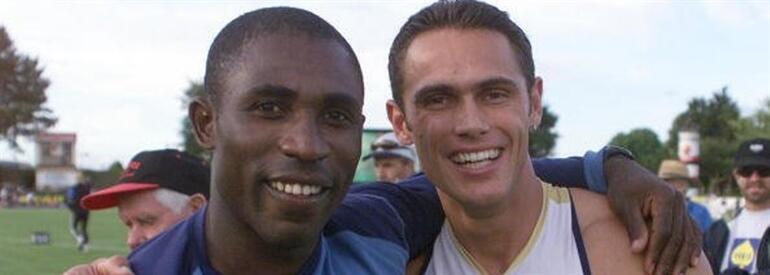
Athletics New Zealand - News - 100m Record 20 Years On - Ghanaian-born Kiwi Gus Nketia (pictured above with Chris Donaldson, New Zealand's second fastest ever sprinter) had just slashed more than 0.20 from his 100m lifetime best to record a scintillating 10.11 in the first round heats of the 1994 Commonwealth Games in Victoria. ©Athletics New Zealand
Athletics New Zealand – News – 100m Record 20 Years On
Some 20 years ago this week the current New Zealand 100m record of 10.11 was set by Gus Nketia. Steve Landells reflects on the landmark by chatting to Gus and Kerry Hill, the coach who helped guide him to the achievement.
It was described by his coach as a “Beamonesque” moment and you can see why.
Ghanaian-born Kiwi Gus Nketia (pictured above with Chris Donaldson, New Zealand's second fastest ever sprinter) had just slashed more than 0.20 from his 100m lifetime best to record a scintillating 10.11 in the first round heats of the 1994 Commonwealth Games in Victoria.
The time represented a gargantuan advancement in the career of the quietly-spoken and modest sprinter. What his coach, Kerry Hill, believes was akin to the gravity-defying leap made by US long jumper Bob Beamon at the 1968 Mexico City Olympic Games, who enhanced his personal best from 27ft to 29ft – completely bypassing 28ft – to set a world record mark which was to last 23 years.
“I was gobsmacked,” admits Kerry, of Gus’ dramatic new PB and national record. “I thought he might run low 10.2s or high 10.1s, but to run 10.11 was amazing. I just remember being in a large stadium (with a 30,000 capacity) and hearing the voice of (Sir) Graeme Avery (founder of the Millennium Institute) on the other side of the track calling out Gus’ name and shouting out ‘Oh, my God’ when he saw the time. I’ll never forget it.”
The next question was could Nketia, who was prone to bouts of painful sciatica, back up his stunning heat performance in subsequent rounds?
Now aged 43 and living in the Australian capital of Canberra with his wife and two sons, Gus answers with genuine surprise that his national 100m record remains untouched after 20 years.
“Has it been that long?” he replies. “Doesn't time fly?”
Born in the city of Kumasi in Ghana in 1970 he first arrived in New Zealand to represent the land of his birth at the 1990 Auckland Commonwealth Games. Barely 19 at the time and boasting a respectable PB of10.59 he advanced to the semi-finals of the 100m at Mt Smart Stadium.
Yet he was so taken by the warmth of the people of New Zealand and the opportunities it presented he decided to stay. He was granted a visa and it was his good fortune he met up with Hill, the New Zealand head coach at those Auckland Games. The leading speed coach viewed Gus as a decent addition to his sprint group and he set about developing a raw but “determined” athlete.
Off the track life was tough. Gus carried out a number of menial jobs to survive and bounced around from one low income area to another. He often relied on Kerry for transport. Scratching out enough money to eat was a struggle.
Despite this he made gradual improvements on the track. In 1991 he landed the first of four successive national 100m titles and gradually chipped his PB down. During the 1993-4 domestic campaign his best was 10.43.
Kerry had also helped Gus secure an apprenticeship as a woodturner on Auckland’s North Shore, this brought greater financial security but working five-and-a-half days a week in manual job came at a cost.
“A lot of the time at work Gus would be slightly leaning forward land to work the lathe and this gave Gus some nasty sciatica down his back and legs,” explains Kerry. “Gus thought it was hamstrings but it was sciatica.”
In 1994 Kerry took up a position as head coach in Singapore, but rather than prove a bar to Gus’ preparations for the Commonwealth Games held in August that year it worked in his favour. For two months in the countdown to Victoria he lived and trained with Kerry in Singapore- a move which had multiple benefits.
Removed from the New Zealand winter he enjoyed an intense period of training in hot humid conditions, ideal for sprinting. Yet, critically, the greatest benefit to Gus’ training stint in South East Asia was being away from the daily grind of manual work allowed his sciatica to ease.
Arriving in Victoria, Gus was excited but realistic. His lifelong ambition had been to compete against the best and he faced the cream of the sprinting crop in Canada led by reigning World and Olympic 100m champion Linford Christie of England and Frankie Fredericks, the reigning world 200m champion, from Namibia.
He set himself the goal of a personal best, but his excitement quickly turned to nerves and he endured a difficult night’s sleep before his first round heat.
“I just couldn’t stop thinking about the race,” he says. “I woke up very nervous and I went to the warm up track where I remember Kerry saying to me ‘you are in good form, just go out and enjoy yourself.’ I then went to the call-up room and said ‘this is it’.”
In heat five of the first round of the 100m the adopted Kiwi blitzed to 10.11 – a performance which stunned many observers. Gus was immediately thrust into the mix as a potential medallist.
Yet for New Zealand’s fastest ever man the race had “felt just like any other” and as he explains: “It was only when the media told me after the race, ‘do you know you have run 10.11’ did I realise the time. The first thing that came to mind was for so long 10.1 and 10.0 seemed such a difficult time to achieve. When Linford (Christie) ran those times it seemed so fast, but now I was that fast.”
Yet Gus refused to be carried away on the emotion of the run. It was just one race, one heat and he adopted the mature attitude of taking the rest of the competition round by round.
Kerry also recalls urging caution.
“I thought (after he ran 10.11 in the heat) that this could be an amazing weekend, but could he repeat it or will the sciatica catch up with him? Every time he ran his legs got very sore,” he adds.
Later that day in round two he did back it up – cruising through to the semi-finals, which were to take place the next day, in a time of 10.13 for second.
That night the Auckland-based athlete went to bed knowing he faced the prospect of taking on the formidable Christie in his semi-final and again struggled to rest.
Sadly, his Commonwealth Games 100m quest was quickly to unravel. After two hard runs in the opening two rounds the sciatica returned. As soon as the Kiwi left the blocks in his semi-finals he felt intense pain in his legs, but this was not going to stop him in his dogged pursuit of a place in the final.
“I thought whatever happens I’m just going to finish the race,” he recalls.
Battling through the discomfort he stopped the clock in 10.19 to finish third and advance to the final. He had made the top eight but at what cost?
Receiving intense physio between the semi-finals and final – which was to take place a couple of hours later – the Kiwi was patched up and pitched into battle forth fourth time in two days.
Unable to even carry out any block starts in warm up he tried to shield his injury woes from the opposition by unstrapping the tape from his legs in the call up room.
But the final proved a race too far for his ailing body as he wound up eighth and last in 10.42 (which was later upgraded to seventh following a drugs suspension of a rival athlete) and Christie secured the gold.
The eventual outcome was hugely disappointing, but once the physical and mental pain receded, pride was the overwhelming emotion.
“I got what wanted from the Games- a PB – so to make the final was a bonus,” he adds “To take the New Zealand record was something I’m proud of. When I arrived in the country I was a 10.5 100m runner, so I was happy to take the national record to a respectable level.”
Hill echoed this view and adds: “This was a kid who was struggling to survive in life in terms of food and work and getting a trade behind him, so I was pretty chuffed Gus made the Commonwealth final.”
Aged 23 at the time, Gus never ran quicker than that first round in Victoria. On his return to New Zealand he went back full-time as a woodturner and with Kerry based in Singapore he moved on to work with number of other coaches with mixed results.
In 1995 he finished sixth in the 60m final at the World Indoor Championships in Barcelona – where Kerry acted as NZ team manager – and later that year matched the second quickest time in his career with a 10.13 performance in Germany before reaching the 100m semi-finals at the World Championships in Gothenburg.
At the Atlanta Olympics Gus made the quarter-finals, but injuries were to take their toll and he eventually retired from the sport in 2001.
He later worked as a printer for the New Zealand Herald in Auckland before three years ago moving across the Tasman to settle in the Australian capital city to carry out a similar role with the Canberra Times.
Yet there could be an interesting postscript to the Nketia sprinting story. Today he coaches his two sons, Edward, 13, and Gus Jnr, 11, with the older of the two siblings showing particular promise.
“Edward is quite good and for the first three years we have been here he has won the 100m and 200m and long jump in ACT for his age group,” adds Gus Snr.
The prospect of another sprinting Nketia is an exciting one – the only shame is that should Edward progress he could well be appearing in the green and gold of Australia rather than in the Black Singlet.
A singlet his father served with such distinction in a relatively brief but memorable international career.
