 EN
EN
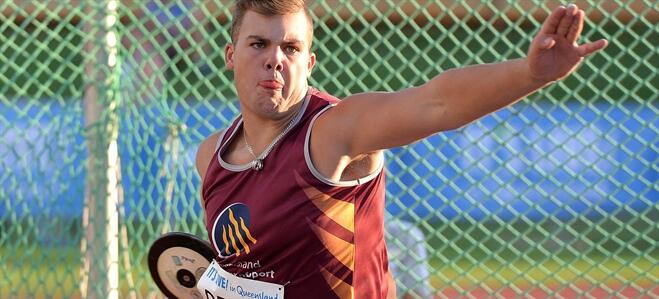
Rising discus star Matthew Denny has won a surprise silver medal at the World University Games in Gwangju, Korea. ©Athletics Australia
Athletics Australia – News – World University Game in GWANGJU 2015
Rising discus star Matthew Denny has won a surprise silver medal at the World University Games in Gwangju, Korea.
The Griffith University business student was the youngest athlete in the final and launched a lifetime best of 62.58m in round four to clinch his first medal in senior international competition.
In a slippery circle and constant rain, the 19-year-old showed experience beyond his years to handle the conditions superbly. A change of shoes after the warm up to a pair with more grip resulted in an opening round throw near his lifetime best of 62.11m to sit in second place after two rounds.
Shuffled back to third, the 2013 world youth champion stepped into the greasy ring for his fourth attempt to launch the platter into second place. It settled at a new Australian under 20 record and landed the first ever medal for Australia in the event at a Universiade.
Despite a strong challenge from Lithuanian Andrius Gudzius, Denny hung on to silver by just four centimetres. Belgian Phillip Milanov took the gold with 64.15.
The Queenslander had a trip to Europe for pre-Games competitions last month where he threw his previous best of 62.37m and some technical tinkering with coach Graham Pitt had him feeling confident, more so when an afternoon downpour made conditions difficult.
“As soon as it started pouring rain I knew I had the upper hand because I know I can throw well in the rain no matter what. Everyone was having trouble at the start, even me but I changed my shoes and got more grip,” an elated Denny explained.
“I bombed out the sixty-two in the first round and I knew that would put the pressure on.”
Denny’s effort takes the athletics tally to five medals, gold to Dane Bird-Smith in the 20km walk and bronze to Naa Anang in the long jump, Michelle Jenneke in the 100m hurdles and the women’s 20km walk team.
Following the afternoon rain, slippery conditions greeted the hammer throwers for the final. Lara Nielsen (University of South Queensland) opened with 62.53m, but followed with two fouls to still safely make it through to the top eight in seventh position. She improved to 63.34 in round five to place seventh. The winner was Azerbaijan’s Hanna Skydan with 70.67m.
In the men’s 4x100m heats, 100m finalist Jin Su Jung (Sydney University) and semi-finalist Tom Gamble (University of Queensland) joined Nick Hough (Sydney University) and Hugh Donovan (Queensland University of Technology) produced a slick display of baton changing to win their heat and qualify for Sunday’s final, running 39.26 for third fastest overall.
In the 4x400m heats Deluca Lawson Matthew (University of Melbourne), Alex Carew (Deakin University), Ray Smith (University of NSW) and 400m finalist Alex Beck (Bond University) combined to finish second in their heat in 3:07.95 to qualify sixth fastest for the final.
In the men’s 800m semi-final, Timas Harik (Melbourne Polytechnic) had the advantage of being drawn in the third semi-final, and with the first two, plus the next two fastest times, knew exactly how fast he needed to run to make the final. In seventh at the bell, but in a tightly bunched field, Harik fought hard to the line to finish sixth in 1:49.59 to land in 16th place overall.
In the men’s long jump qualifying Australia’s two representatives, Angus Gould (ANU) and Nick van Gelder (University of Sydney) missed a spot in the final.
Michelle Jenneke (University of Sydney) has sprinted to the bronze medal in the women’s 100m hurdles at the World University Games in Gwangju, Korea.
The ebullient hurdler captured one of Australia’s four bronze medals of the day and fourth medal overall in athletics, after the women’s 20km walkers finished third in the team event earlier.
Jenneke endured a long delay as officials pontificated over a disputed first attempt to start the race, and pushed aside a cramping calf in the final stages, to clinch her first senior international medal in 12.94 (w: +0.1).
She finished behind winner Danielle Williams of Jamaica (12.78) and Nina Morozova of Russia (12.84).
The Sydney University mechatronics student stormed from the blocks to challenge for the lead, before fading over the final few barriers.
“I came out of the blocks really well and the first few hurdles were really good, but my body started to fatigue a bit and then the cramp in the calf,” an elated Jenneke said after being surrounded by Korean media.
“It’s just the start of my international campaign, I didn’t want to do any damage so I may have backed off a little bit and just tried to maintain my place.”
Jenneke’s trademark pre-race dance has attracted plenty of attention with Korean media and she again backed up the show with a strong performance, the 21-year-old building an impressive resume.
She adds the Universiade bronze to her Youth Olympic silver medal and fifth place in the Commonwealth Games final.
Whilst the time was the fastest ever by an Australian at the University Games, more importantly for Jenneke, it was under the Rio qualifying mark of 13.00, ticking off an important box ahead of the world championships in Beijing next month.
“I’m so happy with that race,” Jenneke said.
“I felt so good in the warm up and I set myself the goal of breaking 13 [seconds] and getting the qualifier for Rio.”
21-year-old Abbie Taddeo (Australian College of Physical Education) finished eighth in the final with 13.42.
Earlier, Australia’s 20km walkers won bronze in the women’s team event in extreme conditions.
After three days of rain, strong sunshine greeted the competitors, but the rising temperatures were also accompanied by a blanket of humidity that tested the field.
The Uniroos trio of Rachel Tallent (University of Canberra), Stephanie Stigwood (University of Tasmania) and Nicole Fagan (University of Sydney), outlasted their competitors for the team medal to finish behind walking powerhouses Russia and China.
In the individual race, Tallent was the best of the Australians making her way from 17th early in the event, to finish seventh in 1:37.40, whilst Stigwood came in 14th in 1:42.05 and Fagan 18th with 1:46.42.
Despite Tallent being forced to stop with a thigh cramp and Fagan battling the steamy conditions, they made good on their pact to come to Gwangju and bring home a medal.
“At the start I didn’t think it was that hot but come about 5k it was like, wow, it’s really hot outside,” Tallent said, forced early to pour cool water over her head by team coach Brent Vallance.
The University of Canberra student is the sister of triple Olympic medallist Jared Tallent and will join her brother on the team for the world championships in Beijing next month, with this race a key lead in event.
“Individually, my goal was to come away with a positive experience in the lead in to world champs, start slow and work my way through the field, which I did pretty well.”
Fagan said the team medal was the big aim.
“As far back as nationals [in March] we were discussing could we get a team together. We were talking about getting a medal all week.”
Stigwood said once they knew that Ukraine were out of contention the goal was to ensure they made it to the finish.
“I was more concerned about staying clean with the red cards as I already had one and the cautions were flying out everywhere, so along with the team plan I decided to stay safe and stay comfortable.”
In the men’s 400m final, Alex Beck (Bond University) produced another lifetime best, this time a barrier breaker, as he smashed through 46 seconds to record 45.91 for sixth.
Having run a PB of 46.06 in the semi-finals, it’s been two good days for the 23-year-old, and he will return for the 4x400m heats on Saturday.
Luguelin Santos of the Dominican Republic won the gold in 45.73.
Benjamin Jaworksi (University of Western Sydney) lined up in the men’s 200m semi-final, and after running a great bend from lane two, hung on in the straight to finish fourth in 21.17 (0.2), qualifying for the final.
Retuning just over an hour later, he finished eighth in 21.26 (-2.5).
After finishing sixth in the 100m final yesterday, Deakin University’s Ashley Whittaker returned for the women’s 200m semi-finals, where she finished fourth in 24.14 (-1.3) to place 13th overall.
In the men’s 110m hurdles, Sydney University’s Nick Hough clobbered the first few hurdles and almost fell, before recovering to finish third in his heat in 14.11 seconds (-1.5).
However, it wasn’t enough to qualify for the final, finishing 13th overall.
In the men’s 800m 1st round, Timas Harik (Melbourne Polytechnic) finished third in his heat in 1:50.36 to automatically qualify for the semi-finals on Saturday.
And finally, in the sweltering humidity, the men’s 5000m heats were the final event of the night with Stewart McSweyn (La Trobe University) running a measured race for seventh in his heat in 14:28.33, sneaking into Sunday’s final as 15th qualifier.
With thanks to David Culbert, at Australian Uniroos Media
Athletics Australia – News
