 EN
EN
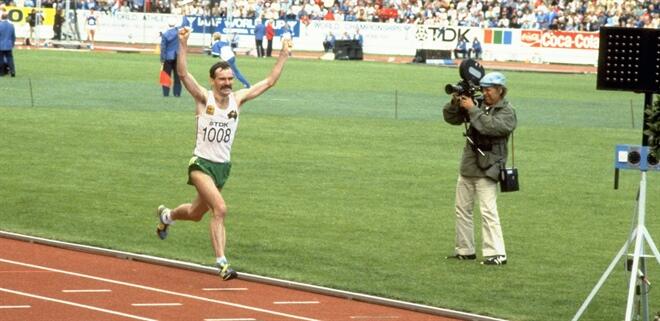
Australian success at world titles began with 'Deek' in 1983 ©Athletics Australia
Athletics Australia – BEIJING 2015 – Views – Australian success at world titles began with \’Deek\‘ in 1983
For the green and gold, it all began with Rob de Castella in 1983. It was the first ever world titles to be held, and it was ‘Deek’ who reigned supreme in the marathon in a time of 2:10:03.
It would take nearly 20 years for Dmitri Markov to add to the Australian men’s gold medal tally in 2001, before Nathan Deakes won the men’s 50km walk in 2007 and Steve Hooker the pole vault in 2009.
This year’s IAAF World Championships launch in the Chinese capital on 22 August, with the Australian Flame team to prepare for the pinnacle able-bodied athletics event of the season at a team camp in Wakayama (JPN).
Stockholm (SWE) will play host to the final IAAF Diamond League event before the world titles tomorrow, and Australia will be represented at the event by Benn Harradine (Qld, discus throw) and Alana Boyd (Qld, pole vault).
For more information on the IAAF Diamond League, please click here.
AUSTRALIAN HONOUR ROLL: Men IAAF World Champions
– Rob de Castella (Vic) 1983 Marathon
– Dmitri Markov (WA) 2001 Pole Vault
– Nathan Deakes (Vic) 2007 50km Walk
– Steve Hooker (WA) 2009 Pole Vault
ROB DE CASTELLA AO MBE: Marathon, 1983
It took many years for the IAAF to decide to conduct their own world championships, but since the inaugural championships in 1983, it has grown to become one of the world’s leading sporting events.
Australia sent a large team of 29 athletes to Helsinki (FIN) with Rob de Castella one of its best hopes in the marathon. In the lead up he had won three major races, Fukuoka (1981), the Brisbane 1982 Commonwealth Games and Rotterdam (1983), but the marathon is one of the most unpredictable events and it really depends on your performance on the day.
On the final day of the 1983 event, the marathon was held and de Castella was the favourite. The racing started around 26km when three Africans and ‘Deek’ opened up a 100m gap, before being quickly rounded in by the 30km mark as the pack now numbered 20 athletes.
“I was very surprised that there were so many guys up there for so long. You couldn’t relax because there was so much chopping and changing, you had to really concentrate,” de Castella recalled.
Only Ethiopian Balcha went with de Castella as he moved to the front on an uphill section at about 35km. De Castella struck again with 3km to go, running on to win by 24 seconds in 2:10.03. He remains the only non-African distance winner in championships history.
The 1983 world championship was a very different race to his three previous wins in Fukuoka, Brisbane and Rotterdam.
“Helsinki was a technical race for me in terms of strategy. I employed a series of surges to break the field initially and then to break the Ethiopian Balcha, and went on to win fairly comfortably,” de Castella said.
Post retirement de Castella has contributed enormously to athletics and sport. He was the AIS Director from 1990 to 1995 and now works extensively alongside his charity, the Indigenous Marathon Project.
DMITRI MARKOV: Pole Vault, 2001
The 2001 men's pole vault was considered a wide open event after the retirement of six time world champion, Sergey Bubka (UKR) and the injury to defending champion Maksim Tarasov (RUS). As a result, for the first time in World Championship history, the gold could go to an athlete who is not from a former Soviet country.
Ironically, though, two of the contenders were a Russian (Dmitri Markov) and a Belarusian (Victor Chistiakov), now competing for Australia. In his first competition for his new country, Markov finished second at the IAAF World Championships in Seville (ESP) in 1999 and in doing so posted a new Australian record of 5.95m. His personal best, a magical 6.00m, was set while still competing for Belarus.
In Edmonton (CAN) in 2001 Markov successfully negotiated the qualifying round with a clearance at 5.70m. But disaster struck after the qualifying when he hit his foot on a table in his hotel room, aggravating an injury he had picked up in Germany two months earlier. After the final Markov revealed the dramas he had endured to compete.
"My foot was sore," he admitted, "I spent ten hours yesterday and another three hours today just icing it,” Markov said.
“I remember him the morning after he had kicked his foot, he could not stand,” Brent Kirkbride, Australian team physiotherapist, said.
With strapping and injections, he took to the field for the final with a strategy of minimum jumps.
He passed the first two heights and used only five jumps to win his first world title at 5.95m before continuing onward into the stratosphere with a 6.05m clearance, a height unprecedented in World Championships history. Markov then directed the bar to be raised to 6.10m, but it was not to be with none of his attempts close.
NATHAN DEAKES: 50km Walk, 2007
He had won Commonwealth gold medals and Olympic medals but in Osaka in 2007, Nathan Deakes walked away with victory in the 50km walk.
“This is what every athlete dreams of,” Deakes said.
“It is a great feeling, records are to be broken, but nobody can take from you away the world champion title.”
The temperature was already in the high 20s at shortly after 7am when the walkers left an eerily empty Nagai Stadium after four and a half laps around the track. Deakes led them out of the stadium with the lead pack.
After being positioned well throughout the race, Deakes put in a decisive 5km between 35 and 40km, as the heat around him caused carnage. The iron man Deakes was now in the lead by 39 seconds. Once Deakes had taken the lead his victory never looked in doubt. He maintained his relentless pace slowing slightly in the last 10km, although never more than his challengers.
As he approached the stadium Deakes gave a thumbs up sign to Aussie fans at the side of the course. By now he was sure of the gold and the grimace of pain and sweaty concentration he’d shown for the last 10 kilometres turned into a smile.
The Australian, who has been preparing for the World Championships in Italy, entered the stadium in a winning position. He crossed the line in 3:43:53, his face streaming with tears.
“I had my plan and executed well,” he said. “I will remember forever the feeling when I came into the stadium and it was clear I was the champion. It was quite emotional. I think it was my tenth 50km, so it’s a great jubilee.”
STEVE HOOKER: Pole Vault, 2009
You would have thought that Steve Hooker, as Olympic champion in the men’s pole vault and world number two outdoors in the season, would have fancied his chances of taking gold at the World Championships in Berlin. But the truth is, he did not.
Hooker reacted with disbelief at his ‘luck’ in winning after a remarkable sequence of events. It all began with a thigh injury suffered at the Australia team training camp in Cologne 12 days earlier, which had him rating his chances of contesting the final at only 50-50, and then left him grimacing in the qualifying round.
“I think potentially at these championships the gold is out of my reach,'' Hooker said, after qualifying with just one jump. He was in obvious pain as he limped away from the mat.
Two days later he had the final and not knowing how his body would cope, he waited until the bar was raised to 5.65m. Still uncertain he continued to wait, until the bar reached 5.85m and he took his first attempt, narrowly missing it. With his competitors, Romain Mesnil and Renaud Lavillenie, who had come in at 5.50m, clear at 5.85m and 5.80m respectively, Hooker gambled and took his second attempt at 5.90m, and cleared, taking the gold with just two jumps in the final.
“Luckily for me, prior to this injury, I had done such fantastic training that I knew what great shape I was in. There was one specific training session in Leverkusen before I got hurt where, on the pole I jumped on today, I jumped 5.90m and so I knew I had it within me. I could go out with the confidence that I had the right pole and I had the right run-up. If I could just get down the runway it would be enough,” Hooker said.
“I was out there for an hour when everyone else was warming up and I was sitting around through that, so it seemed like a very long time. But, in a lot of ways, it probably worked in my favour. The French boys were very tired, I think, by the end and that probably just cost them a little bit. I was lucky I had this aggressive strategy but even more lucky that it paid off.
“There are three people who need a lot of recognition – that’s Shane Kelly, my physio, who I borrowed from the AIS, Adam Castricum, the team doctor who has definitely helped out a lot, and Alex Parnov, my amazing coach, who together with me came up with this radical, ridiculous plan than somehow has come off.
“It’s a mental battle that you have to fight with yourself and you have to convince yourself that you’re ready, you’re ready to pick up a massive competition pole that’s going to throw you nearly six metres in the air. You’ve got to convince yourself that you’re ready to do an aggressive jump with the stands very close in – and you’ve got to be prepared to take that risk.
“It has been a very, very challenging couple of weeks. I’ve tried to be as honest as possible with everyone throughout the process. Every day it has been a question of whether I jump or not and trying to sleep at night wasn’t the easiest thing. The people around me have made smart decisions and that’s what got me through.”
