
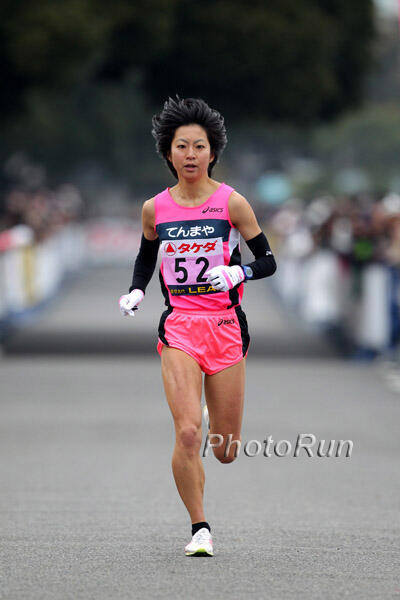
At Mitsui Kaijo she had a smattering of success, again beating Noguchi on the track at the 1997 National Corporate Championships and going as far as the half marathon, but for the most part the transition to the higher workloads at the corporate level was rocky and she was sidelined by injury. A planned early marathon debut at the 1999 Nagano Marathon never made it farther than the entry list. After just a few seasons her short pro career was over, just another of the countless high school stars to disappear into the machinery of the Japanese corporate system.
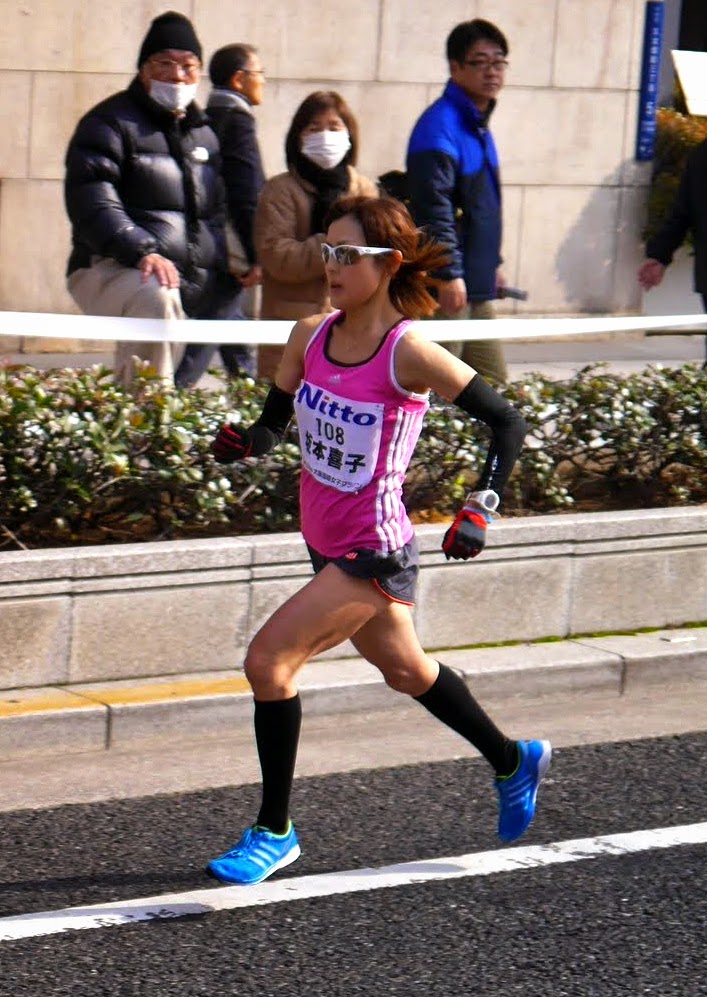
2011 Yokohama Women's Marathon Yokohama, Japan Febuary 20, 2011 Photo: Yohei Kamiyama@PhotoRun Victah1111@aol.com 631-741-1865 www.photorun.NET
A Second Chance to Make the Dream Come True – Yoshiko Sakamoto at the Zurich Marathon – by Brett Larner – Japan Running News
What if you could have a second chance? Drifting toward 40, long out of the game, the chance to make all the things you thought you would do when you were younger happen. What if you had the chance to answer the question, "What if?"
At Mitsui Kaijo she had a smattering of success, again beating Noguchi on the track at the 1997 National Corporate Championships and going as far as the half marathon, but for the most part the transition to the higher workloads at the corporate level was rocky and she was sidelined by injury. A planned early marathon debut at the 1999 Nagano Marathon never made it farther than the entry list. After just a few seasons her short pro career was over, just another of the countless high school stars to disappear into the machinery of the Japanese corporate system.
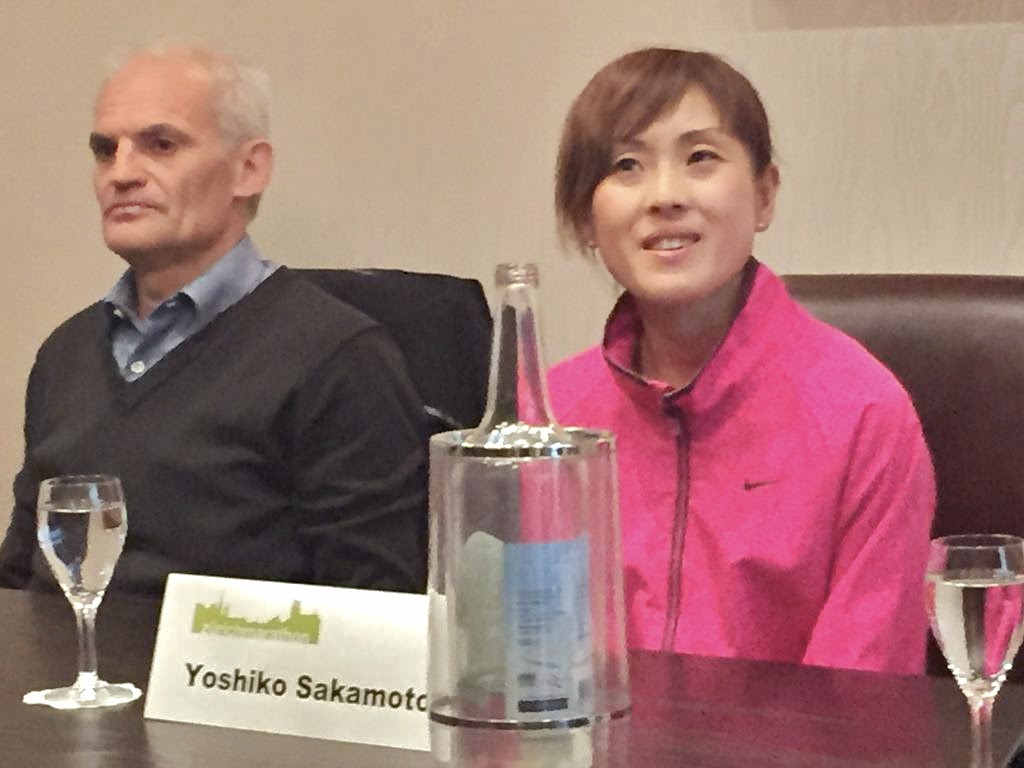
Life went on. She met and married a runner from the Yachiyo Kogyo men's corporate team, taking the name Sakamoto, moving to Mie prefecture and starting a family. As her first two children were born in 2002 and 2003 Shibui, Noguchi and Tosa became the stars of the golden era of Japanese women's distance running, and Sakamoto watched from home as all three went to the 2001 World Championships where Tosa took silver and Shibui 4th, as Shibui set a 10000 m national record in 2002, as Noguchi won silver at the 2003 World Championships and then came home a gold medalist from the 2004 Olympics, as Shibui ran a 2:19:41 marathon national record in 2004 and Noguchi 2:19:12 a year later, and as Tosa picked up a second World Championships marathon medal in Osaka in 2007.
For nine years Sakamoto didn't run at all, but following the birth of her third child in 2010 something changed. Women like Yukiko Akaba and Mari Ozaki came back from having children to success, and Sakamoto found herself asking the question. What if? After surprising herself by finishing 3rd on her stage behind two pros at her local community ekiden in 2011 she made a return to racing with a 5 km win at the Mie prefecture road championships, her time of 16:40 not far off her high school-era Fukushima record of 16:25. In November that year she took the plunge, making her marathon debut at the Aino Tsuchiyama Marathon at age 32.
And it was a decent debut. On a hilly course Sakamoto won in 2:49:05, far from the kind of times her former teammates and rivals had run but still a major confidence boost. Four months later she went for it at the Nagoya Women's Marathon. Her time of 2:37:18 there was on the same level as the kinds of times corporate league women 10 years younger often run in their first or second marathons and immediately put Sakamoto near the top of Japan's amateurs, one of the few to clear IAAF bronze label status.
Self-coached and training by herself she made her share of mistakes and was mostly injured in 2013. At the Kurobe Meisui Half Marathon that spring she was the 1st general division woman in 1:23:05, watching from the side as invited runners Azusa Nojiri and Yuki Kawauchi took the top spots on the podium but still winning a trip to run her first race outside Japan at the 2013 Portland Half Marathon in the U.S.A. 2014 by comparison was a breakthrough year. Now 35, she ran just 4 seconds off the track 5000 m PB she had run 17 years earlier with a 16:32.53 at the Shizuoka Time Trials meet. A few months later she was less than a minute off her pro-era half marathon best when she won the Ibigawa Half Marathon in 1:15:54. In December she took that down to seconds off her best with a 1:15:13 course record win at the Isesan Half.
And so come Sunday, a 36-year-old amateur Japanese runner and mother of three will line up on foreign soil for the first time to go head-to-head with a home ground defending Olympic gold medalist. Her biggest race ever, but with a realistic chance of winning and optimistic of taking her best time even further. It's not the Olympics.
(c) 2015 Brett Larner
all rights reserved
EN
