 EN
EN
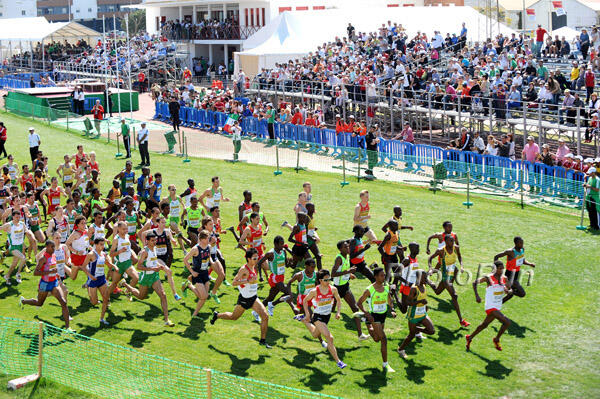
2011 World Cross Country Championships Punta Umbria, Spain March 20, 2011 Photo: Jiro Mochizuki@PhotoRun Victah1111@aol.com 631-741-1865 www.photorun.NET
A Brief History of the World Cross Country Championships – The first 70 years – By Ken Nakamura
The World Cross Country Championships, often considered the toughest footraces on the planet, may be more difficult to win than the Olympics or the World Championships in Athletics. The predecessor of the World Cross Country Championships was the International Cross Country Championships, inaugurated in 1903.
With only four countries (England, Wales, Scotland and Ireland) initially participating, these championships could hardly be considered “international” during their early years. However, by 1972, when 197 runners from 15 countries competed, the championships had gained international stature. Three great runners — Jack Holden (GBR), the 1950 European marathon champion, Alain Mimoun (FRA), the 1956 Olympic marathon champion, and Gaston Roelants (BEL), the 1964 Olympic 3000mSC champion — won four individual titles during the days of International Cross Country Championships. On the women’s side, Doris Brown won five straight championships from 1967 to 1971.
Many Olympic medalists won the International Cross Country Championships. Jean Bouin (FRA), who won the silver medal at 5000m in the 1912 Olympics, won three championships from 1911, while Mohammed Gommoudi (TUN), who won the 5000m in the 1968 Olympics, also won the International Cross Country Championships in the same year. Franjo Mihalic (YUG), Rhadi ben Abdesselem (MAR), and Basil Heatley (GBR), all Olympic marathon silver medalist, won the International Cross Country Championships. However, because participation was generally limited to the runners from the member nations of the International Cross Country Union (ICCU), the championships were not truly “world” in scope. In fact, Emil Zatopek (CZE), 1952 Helsinki triple gold medalist, and Vladimir Kuts (URS), 1956 Melbourne double Olympic champion, never competed at the International Cross Country Championships.
The advent of the World Cross Country Championships
In 1971, the ICCU decided to transfer the organization of the International Cross Country Championships to the IAAF. Two years later, under IAAF auspices, the inaugural edition of the World Cross Country Championships took place at Waregem in Belgium. In 1973, 285 runners from 21 countries contested three races: Men, Junior Men and Women. Sixteen years later in 1989, the Junior Women’s race was added to the program.
Then in 1998, the year 66 countries took part in the championships, in order to entice milers to compete in the World Cross Country Championships, the short courses were added to both the men’s and women’s programs. The short course races, however, were short lived. It was held for the last time in Fukuoka in 2006. Most championships were hosted by European countries, but Morocco (twice), New Zealand, South Africa, U.S. (twice), Japan and Jordan have also provided venues for the World Cross Country Championships.
Because the runners from various backgrounds, from the middle distances to the marathon, gather to compete for supremacy on grass and mud, the World Cross Country Championships are considered more difficult to win than an Olympic medal. John Walker (NZL), who finished fourth in the 1975 World Cross Country Championships, won the gold medal at 1500m at the 1976 Olympics. Carlos Lopes (POR), who won the World Cross Country Championships in 1976, 1984 and 1985, was the silver medalist at 10000m at 1976 Montreal Olympics and the gold medalist in the Los Angeles Olympic marathon.
In 1985, a month after winning the World Cross Country Championships in Lisboa, Lopes set a marathon world best (2:07:12) at Rotterdam marathon. Incidentally, Lopes is the last European born male World Cross Country Champion. John Treacy (IRL), who won the 1978 World Cross Country Championships, also won the 1979 edition in his home country of Ireland, thus became the first male runner to defend the title in the World Cross Country Championships. Five years later, Treacy became the Olympic marathon silver medalist. The most unfortunate runner in the World Cross Country Championships may be Mariano Haro of Spain. Counting from the International Cross Country days, Haro finished in the runner-up position four straight times. In 1973, the inaugural year of the World Cross Country Championships, Haro was pushed by intruder during the race, yet he finished 0.1 second behind the winner.
On the women’s side, the most unfortunate runner may be Catherina McKiernan of Ireland. She finished in the runner up position four straight times from 1992 to 1995. Many of the all-time great distance runners, who won the Olympic medals, have won the World Cross Country Championships medals also. Tatyana Kazankina (URS), who finished second in the 1976 World Cross Country Championships, became a double gold medalist at 800m and 1500m at the 1976 Montreal Olympic Games.
Grete Waitz of Norway, who won five World Cross Country titles, made a stunning marathon debut at New York City Marathon in 1978 when she recorded a world best of 2:32:30. Five years later, Waitz won a gold medal at the inaugural World Championships in Helsinki. Another year later, Waitz won silver medal at the inaugural Olympic marathon in Los Angeles. Another distance that made its debut in the 1984 Olympics is 3000m, and the event’s inaugural champion, Maricica Puica (ROU), won the World Cross Country Championships twice, in 1982 and 1984.
African Dynasty
The 1981 was a historic year, for two distance racing powerhouses Ethiopia and Kenya sent teams to the World Cross Country Championships for the first time in its history. The Ethiopians were an instant success, while the Kenyans were forced to take a back seat to their East African neighbor and rival in the early years of their participation. The Ethiopian men won the team title in 1981, and then defended their crown for the next four consecutive years. The Ethiopian junior men won six straight team titles beginning with their first championship participation in 1982. In 1982 and 1983, Ethiopian runners also captured the individual titles in both senior and junior men’s race. Clearly, it was the beginning of the dynasty for the Ethiopians.
However, starting in 1986, the year John Ngugi won his first individual title, it was Kenya’s turn to build a true dynasty and dominate cross country racing. For the next 18 years — a winning streak without equal in any world championship sporting event — the Kenyan men’s team was unbeatable at the 12km distance. In the short course race, which began in 1998, the Kenyan men’s team won six straight team titles from its first year. As for the men’s junior team, they lost to Ethiopia by one point in 1987, but then won 10 straight titles from 1988. After finishing second in 1998, they won another 12 straight titles.
On hindsight, the year 1986 may have been the true beginning of the African dynasty. For the first time in the history of the World Cross Country Championships, African swept the individual medals in both men and junior men’s divisions. Since then only four non-African born runners have medaled in men’s division. The junior men’s division was even more dominated by Africans. Only Dathan Ritzenhein of the US have won individual medal in the junior men’s division.
After winning four straight titles from 1986, John Ngugi, the 1988 Olympic 5000m champion, also won in 1992, and thus became the first five-time winner. Ngugi’s achievements were exceeded by Paul Tergat, two-time Olympic silver medalists at 10000m and future marathon record holder (2:04:55 in 2003). He won an unprecedented five straight titles from 1995 to 1999. Even fabled track champion and future marathon world record holder (2:04:26 in 2007 and 2:03:59 in 2008) Haile Gebrselassie, who was in the middle of his streak of six consecutive global 10000m titles from 1993 to 2000, could not match the Kenyans in the World Cross Country Championships.
In 1988 Kenyan men swept the medals for the first time. The Kenyans swept the men’s individual medals again in 1993, while the Ethiopians only medal sweep in men’s race came in 2004. In the junior men’s race, Kenyans swept the medals three times, in 1993, 2000 and 2005. On the other hand, the Ethiopians never swept the medals in the men’s junior race.
At their prime, the Kenyans employed superb team tactics. They would designate the runner in the best physical condition as the potential winner, and then did everything in their power to ensure that the designated runner capture the coveted title. This Kenyan tactic may be partially responsible for Gebreselassie’s inability to win an individual World Cross Country championship.
The African women had to wait until the 1990’s before dominating the cross country scene, but even then, they were not as overwhelming as their male counterparts. Ethiopians Derartu Tulu, the 1992 and 2000 Olympic 10000m gold medalist, and Gete Wami, the 1999 World 10000m champion, battled for supremacy in those days, but in 1998 Sonia O’Sullivan (IRL) won both the short and long titles, and Paula Radcliffe (GBR), who has been among the favorites since 1997, finally won the long course titles in 2001 and then defended it in 2002.
Although Kutre Dulecha (ETH) won the women’s short course in 2000 and thus became the first ever to win both the junior (won in 1996) and senior title, Radcliffe is the first to win the junior title (won in 1992) as well as senior women’s long course title at the World Cross Country Championships. Incidentally O’Sullivan is the first to win both the long and short course titles. While non-Africans have won medals in the senior women’s race even as recent as 2011 (bronze by Shalane Flanagan (USA)), in the junior races last non-African born runner who won the medal was Yoshiko Fujinaga (JPN) back in 1999.
Ethiopians strike back with Kenenisa Bekele
All winning streaks come to an end. When Kenenisa Bekele won both the short and long course titles in 2002 and again in 2003, anticipation of an Ethiopian dynasty was in the air. The historic moment — the end of the Kenyan reign — took place in 2004 at Bruxelles. Not only did the Kenyan men lost both long and short course team titles, but Ethiopians also swept the individual medals in both the men’s short and long course races.
Against the nine titles won by Ethiopians, Kenya won only two. The following year, in 2005, although Kenyans kept their junior men’s title streak alive, Ethiopian superstars Kenenisa Bekele and Tirunesh Dibaba were supreme as they both won the short and long course double. Incidentally, Kenenisa Bekele was the first to win both the junior (won in 2001) and senior titles.
The 34th edition of the World Cross Country Championships in 2006 in Fukuoka, the first in Asia, saw another historic moment. Not only did Kenenisa Bekele matched the feat of Paul Tergat by winning his fifth consecutive men’s long course title, but he also won fifth consecutive short course titles. A year later in Mombasa, Kenenisa Bekele was on his way to a historic sixth title on the Kenyan soil. However, Zersenay Tadesse passed him late in the race, ending Kenenisa’s Cross Country winning streak at 27.
A year later in Edinburgh, however, Kenenisa came back with vengeance to win the record sixth title on the long course. The Ethiopians were supreme in Edinburgh. They won all four individual titles. Dibaba sisters, Tirunesh and Genzebe, won senior and junior women’s titles, respectively.
Are the Kenyans returning to supremacy?
However, a year later in 2009 in Amman, Jordan, Kenyans may have started their accent to the top. They won women’s individual title as well as three team titles – men, women and junior men. Another year later, in the 2010 World Cross Country Championships in Bydgoszcz, Kenyans were supreme.
For the first time in the history of World Cross Country Championships, the same country, in this case Kenya, won all four individual titles as well as all four team titles. Furthermore the Kenyans junior teams swept all six individual medals.
In 2011, however, the Ethiopians started a mini-comeback of a sort. They won junior women’s team title as well as senior men’s individual title. So what is in store for the 2013 World Cross Country Championships? Will the Kenyan domination continue? Or will the Ethiopians comeback with the vengeance?
Ken Nakamura
