 EN
EN
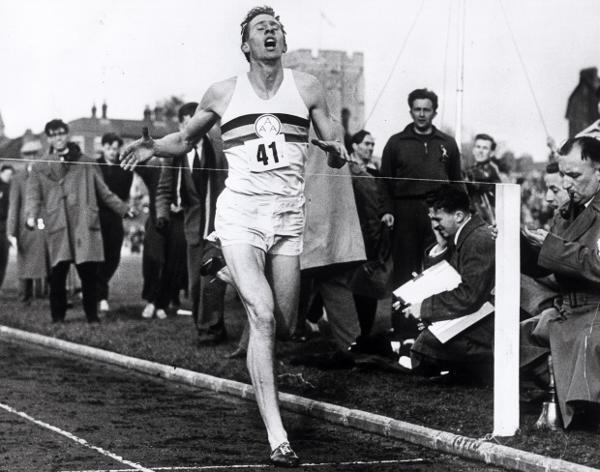
60 years - Sub-4-minute mile on 6 May 1954 - Roger Bannister - By Wikipedia ©picture alliance
60 years – Sub-4-minute mile on 6 May 1954 – Roger Bannister – By Wikipedia
This historic event took place on 6 May 1954 during a meet between British AAA and Oxford University at Iffley Road Track in Oxford. It was watched by about 3,000 spectators. With winds up to 25 miles per hour (40 km/h) prior to the event, Bannister had said twice that he favoured not running, to conserve his energy and efforts to break the 4-minute barrier; he would try again at another meet.
However, the winds dropped just before the race was scheduled to begin, and Bannister did run. The pace-setters from his major 1953 attempts, future Commonwealth Games gold medallist Chris Chataway from the 2 May attempt and future Olympic Games gold medallist Chris Brasher from the 27 June attempt, combined to provide pacing on this historic day. The race[3] was broadcast live by BBC Radio and commented on by 1924 Olympic 100 meters champion Harold Abrahams, of Chariots of Fire fame.
Bannister had begun his day at a hospital in London, where he sharpened his racing spikes and rubbed graphite on them so they would not pick up too much cinder ash. He took a mid-morning train from Paddington Station to Oxford, nervous about the rainy, windy conditions that afternoon.[4] Being a dual-meet format, there were 7 men entered in the Mile: Alan Gordon, George Dole and Nigel Miller from Oxford University and four British AAA runners – Bannister, his two pacemakers Brasher and Chataway and Tom Hulatt. Nigel Miller arrived as a spectator and he only realized that he was due to run when he read the programme. Efforts to borrow a running kit failed and he could not take part, thus reducing the field to 6.
The race went off as scheduled at 6PM, and Brasher and Bannister went immediately to the lead. Brasher, wearing #44, led both the first lap in 58 seconds and the half-mile in 1:58, with Bannister (#41) tucked in behind, and Chataway (#42) a stride behind Bannister. Chataway moved to the front after the second lap and maintained the pace with a 3:01 split at the bell. Chataway continued to lead around the front turn until Bannister began his finishing kick with about 275 yards to go (just over a half-lap), running the last lap in just under 59 seconds.
The stadium announcer for the race was Norris McWhirter, who went on to co-publish and co-edit the Guinness Book of Records. He excited the crowd by delaying the announcement of the time Bannister ran as long as possible:
"Ladies and gentlemen, here is the result of event nine, the one mile: first, number forty one, R. G. Bannister, Amateur Athletic Association and formerly of Exeter and Merton Colleges, Oxford, with a time which is a new meeting and track record, and which—subject to ratification—will be a new English Native, British National, All-Comers, European, British Empire and World Record. The time was three…"
The roar of the crowd drowned out the rest of the announcement. Bannister's time was 3 min 59.4 sec.
50th anniversary of Bannister's four-minute mile, commemorated on a 2004 British fifty pence coin.
The claim that a 4-minute mile was once thought to be impossible by informed observers was and is a widely propagated myth created by sportswriters and debunked by Bannister himself in his memoir, The Four Minute Mile (1955). The reason the myth took hold was that four minutes was a nice round number which was slightly better (1.4 seconds) than the world record for nine years, longer than it probably otherwise would have been because of the effect of World War II in interrupting athletic progress in the combatant countries. The Swedish runners Gunder Hägg and Arne Andersson, in a series of head-to-head races in the period 1942-45, had already lowered the world mile record by 5 seconds to the pre-Bannister record. (See Mile run world record progression.) What is still impressive to knowledgeable track fans is that Bannister ran a four-minute mile on very low-mileage training by modern standards.
Just 46 days later on 21 June in Turku, Finland, Bannister's record was broken by his rival Landy with a time of 3 min 57.9 s, which the IAAF ratified as 3 min 58.0 s due to the rounding rules then in effect.
Statue of Bannister and Landy in Vancouver
On 7 August, at the 1954 British Empire and Commonwealth Games in Vancouver, B.C., Bannister, running for England, competed against Landy for the first time in a race billed as "The Miracle Mile". They were the only two men in the world to have broken the 4-minute barrier, with Landy still holding the world record. Landy led for most of the race, building a lead of 10 yards in the third lap (of four), but was overtaken on the last bend, and Bannister won in 3 min 58.8 s, with Landy 0.8 s behind in 3 min 59.6 s. Bannister and Landy have both pointed out that the crucial moment of the race was that at the moment when Bannister decided to try to pass Landy, Landy looked over his left shoulder to gauge Bannister's position and Bannister burst past him on the right, never relinquishing the lead. A larger-than-life bronze sculpture of the two men at this moment was created by Vancouver sculptor Jack Harman in 1967 from a photograph by Vancouver Sun photographer Charlie Warner and stood for many years at the entrance to Empire Stadium; after the stadium was demolished the sculpture was moved a short distance away to the Hastings and Renfrew entrance of the Pacific National Exhibition (PNE) fairgrounds. Regarding this sculpture, Landy quipped: "While Lot's wife was turned into a pillar of salt for looking back, I am probably the only one ever turned into bronze for looking back."
Bannister went on that season to win the so-called metric mile, the 1,500 m, at the European Championships in Bern on 29 August, with a championship record in a time of 3 min 43.8 s. He then retired from athletics to concentrate on his work as a junior doctor and to pursue a career in neurology.
Sports Council and knighthood
He later became the first Chairman of the Sports Council (now called Sport England) and was knighted for this service in 1975. Under his aegis, central and local government funding of sports centres and other sports facilities was rapidly increased, and he also initiated the first testing for use of anabolic steroids in sport.[9] Legacy
On the 50th anniversary of running the sub-4-minute mile, Bannister was interviewed by the BBC's sports correspondent Rob Bonnet. At the conclusion of the interview, Bannister was asked whether he looked back on the sub-4-minute mile as the most important achievement of his life. Bannister replied to the effect that no, he rather saw his subsequent forty years of practising as a neurologist and some of the new procedures he introduced as being more significant. His major contribution in academic medicine was in the field of autonomic failure, an area of neurology focusing on illnesses characterised by certain automatic responses of the nervous system (for example, elevated heart rate when standing up) not occurring.
For his efforts, Bannister was also made the inaugural recipient of the Sports Illustrated Sportsman of the Year award in 1955 (he was given the award as the 1954 Sportsman of the Year, but it was awarded in January 1955) and is one of the few non-Americans recognised by the American-published magazine as such.
In 1978, he was awarded an Honorary Degree (Doctor of Science) by the University of Sheffield.[10]
In 1984, he was awarded an Honorary Degree (Doctor of Science) by the University of Bath.[11]
In a UK poll conducted by Channel 4 in 2002, the British public voted Bannister's historic sub-4-minute mile #13 in the list of the 100 Greatest Sporting Moments.
Bannister is the subject of the ESPN movie Four Minutes (2005). This film is a dramatisation, its major departures from the factual record being the creation of a fictional character as Bannister's coach, who was actually Franz Stampfl, an Austrian, and secondly his meeting his wife, Moyra Jacobsson, in the early 1950s when in fact they met in London only a few months before the Miracle Mile itself took place.
The 50th anniversary of Bannister's achievement was marked by a commemorative British 50-pence coin. The reverse of the coin shows the legs of a runner and a stopwatch (stopped at 3:59.4).
Bannister, arguably the most famous record-setter in the mile, is also the man who held the record for the shortest period of time, at least since the IAAF started to ratify records.
In 1996, Pembroke College, University of Oxford named the Bannister Building to honour the acheivements and memory of Sir Roger, a former Master of the college. The building, an 18th century townhouse in Brewer Street, was converted to provide accommodation for graduate students. It was extensively refurbished during 2011 and 2012 and now forms part of the buildings complex surrounding The Rokos Quad, and is inhabited by undergraduates.
In 2012, Bannister carried the Olympic flame at the site of his memorable feat, in the stadium now named after him.
Source: Wikipedia
Related:
Globe Runner blog » Butcher's Blog – Articles by Pat Butcher – TARNISHED CROWN? 60 years of Sub-Four
