 EN
EN
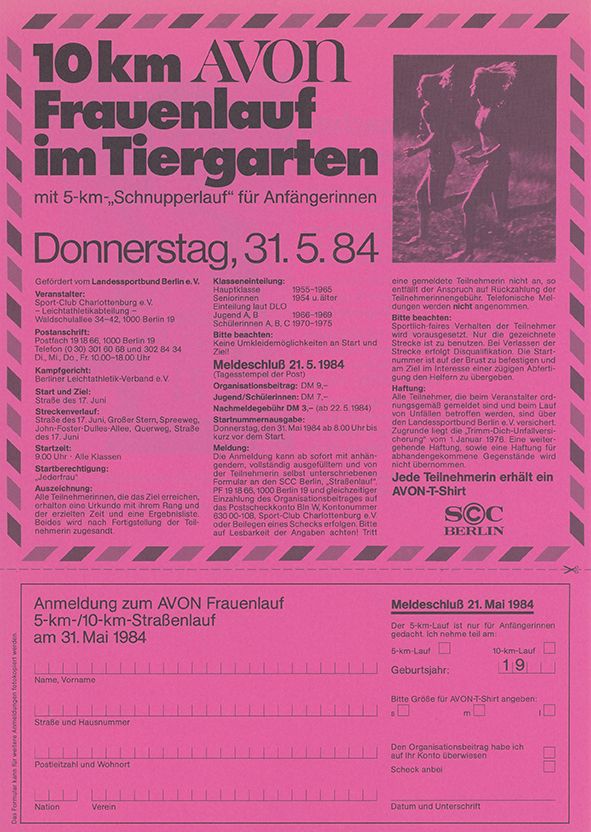
Programme for the 1st AVON Women's Run in Berlin on 31 May 1984 - Photo: Gerd Steins
40 years of the AVON Berlin Women’s Run – founder Horst Milde looks back …
There are several Berlin race anniversaries this year. These runners have played a prominent role in the history of athletics and running in Berlin to this day.
These are the „round“ anniversaries this year:
60 years of the Berlin Cross-Country Race (since 1964)
50 years of the BERLIN MARATHON (since 1974)
40 years of the 10 km race in the Tiergarten (since 1984)
40 years of the AVON Women’s Run (since 1984)
40 years of the Berlin Half Marathon (since 1984)
Committed students from the Free University of Berlin (FU Berlin) launched the Berlin cross-country race at Teufelsberg on 8 November 1964 and are considered the race pioneers for the further development of running in Berlin. The BERLIN MARATHON was founded on 13 October 1974 and celebrates its 50th anniversary on 29 September 2024.
After the Berlin Half Marathon (since 1984), the AVON Berlin Women’s Race (since 1984) is another Berlin race celebrating its 50th anniversary.
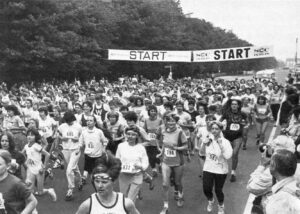
The start of the 1st AVON Berlin Women’s Race 1984 on the Strasse des Juni – Photo: AIMS Marathon Museum of Running.
Germany’s largest women’s race, the 40th KoRo Women’s Run Berlin, will take place on Saturday, 4 May 2024 in Berlin’s Tiergarten and on „Strasse des 17. Juni“
The five jubilarians and „figureheads“ of running in Berlin are just part of the „medal“ that has been needed to develop running in Berlin over the past 60 years. They form the top of the „iceberg“ in the Berlin Athletics Association (BLV), which comprises 75 athletics clubs and organises a total of 220 running events every year. They all contribute to upholding Berlin’s long tradition as a running centre (since the 1890s!).
Other stages in Berlin’s development as a running centre include
the „Berliner Volksmarsch“ over 15 km (1966),
the „Berlin People’s Run“ over 10 km in the Grunewald forest (1967),
the „Berliner Volkswandern“ over 25 km with the BZ (1971),
the „Berlin 25 km race“ (1976),
the „Berlin New Year’s Eve Run“ (from 1977),
the „Berlin New Year’s Run“ (from 1990),
the „City Night on Kurfürstendamm“ (15 August 1992),
the „Berlin 5 x 5 km Team Relay“ (24 June 2000), to name just the most important „gems“ in the SCC organiser’s range of running events.
The AVON RUNNING Berlin Women’s Run celebrates its 40th anniversary
On 31 May 1984 – the Ascension Day and ironically on „Father’s Day“ – the Berlin Women’s Run celebrated its premiere in Berlin – on the Straße des 17. Juni – with the Brandenburg Gate in the background – still blocked by the Berlin Wall.
645 female runners lined up at the starting line – including some male „jokers“ in costumes – a 5 km distance for beginners and a 10 kilometre race were offered.
Women had previously been underrepresented in public races and marathons, and a women-only race was intended to motivate and encourage girls and women to take up running.
It was not unknown to the public that women’s races were developing worldwide, especially in the USA. The cosmetics company AVON promoted this trend, with Katherine Switzer being present as the figurehead who drove the development forward.
On 19 April 1967, she began by running the legendary Boston Marathon unrecognised – as a woman – which was forbidden. Race director Jock Semple recognised her on the way and wanted to fire her, but was prevented from doing so by her companion, who was a boxer. The sequence of pictures of this exchange of blows is legendary. Katherine Switzer ran through – and became an icon of the sport of running. She went on to win the New York City Marathon and joined AVON as a director to promote female running.
I met her at the New York City Marathon in 1983 and asked her if she could persuade AVON to sponsor a similar women’s race in Berlin.
As we know, she succeeded. Katherine Switzer came to Berlin and found the Tiergarten – and the Strasse des 17. Juni – to be an ideal running area. From the very beginning, well-known female runners also took part in the AVON Women’s Run. In 1984, Charlotte Teske won the 10 kilometre race ahead of Christa Vahlensieck, both of whom were world-class runners at that time
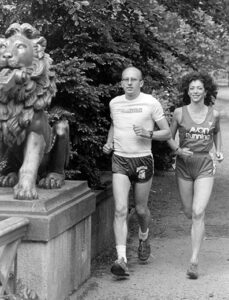
Katherine Switzer and Horst Milde training in the Tiergarten at the Löwen Brücke – Photo: Bildarchiv Forum für Sportgeschichte
The AVON Women’s Race also included the social environment, there were several dinners at the Hotel Interconti for the women, the runners‘ forum at the Free University of Berlin (FU Berlin) and the free running training programme with trainers in all Berlin boroughs, weeks before the running date.
The number of participants increased – also due to the participation of schoolgirls from Berlin schools – who took part in the race in classes, modelled on the mini-marathon at the BERLIN MARATHON.
AVON was a generous sponsor, as all participants received – in addition to a medal and certificate – a difficult bag of the company’s cosmetic products. I remember that an AVON Germany employee spent a few days in our garage filling the large AVON bag with the coveted cosmetic products and an AVON T-shirt.
The three best runners received prizes from the Königliche Porzellan-Manufaktur (KPM) and the winner of the 1984 premiere in Berlin won the right to take part in the International AVON Marathon on 23 September 1984 in Paris.
In the early years, there were also „nasty letters“ from men complaining that the women now had their own race. But there was also a time without sponsor AVON.
Following the example of Oslo and their Grethe-Waitz-Run with over 40,000 participants, we wanted to introduce only a 5 km race (instead of the 10 km), but it remained with this one attempt, the runners wanted „their“ 10 km race again.
The start and finish also changed, with the John-Foster-Dulles-Allee at the Congress Centre serving as the start and finish for a few years. However, the increasing number of participants forced a return to the original start location on Strasse des 17.
The course variants also changed, John Kunkeler, as course scout, found ever more appealing routes through the Tiergarten, and wider paths were created on which it was then also possible to run.
The Sportmuseum Berlin Marathoneum in the Sportmuseum Berlin has now amassed a rich collection of exhibits from the history of AVON running. Dr David Martin, an intimate connoisseur of US running development, AVON’s involvement and also of Katherine Switzer herself, has donated outstanding memorabilia from the early days of women’s running to the museum.
The 25th anniversary of the ‚Avon Running Berlin Women’s Run‘ in 2009 saw a record turnout of around 13,000 women and girls.
There have long been many large women’s runs internationally – for example in Oslo and Dublin or in Morocco and of course in the USA, where the Freihofer’s Run for Women in Albany (New York) took place for the 40th time.
The history of AVON women’s runs in the USA began on 19 March 1978 in Atlanta/USA, Georgia. In Atlanta because the US cosmetics company AVON has its headquarters there, it was a stronghold of the race and there were many helpers for the organisation.
AVON’s initiatives and activities in the area of establishing women’s races worldwide led to the inclusion of the women’s marathon at the Olympic Games.
„The development shows that our commitment in Berlin has paid off. More and more women are realising that running gives you a different, better attitude to life,“ say the Berlin organisers led by Horst Milde.
The first champion in Berlin in 1984 was Germany’s best marathon runner Charlotte Teske from ASC Darmstadt, she ran 33:27 for the 10 km and won ahead of Christa Vahlensieck (Barmer TV) in 33.37 and Birgit Lennartz (ASV St. Augustin) in 35:37.
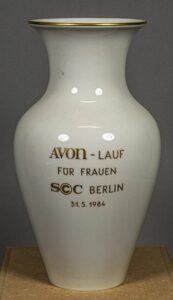
Birgit Lennartz won this precious KPM vase in 1984 – in third place – Photo: Gerd Steins, Berlin.
In cooperation with sponsors, the Berlin organisers from the SCC have been promoting the women’s run for years. „This race has developed phenomenally and is also a source of motivation. I know women who never actually take part in a competition – but they are present at the Women’s Race in Berlin,“ said former world-class runner Kathrin Weßel. The Berlin native has won the 10-km race twice.
The first Berlin AVON Women’s Race started in 1984 with 645 runners. However, the race stagnated for many years with fewer than 1,500 women taking part. In 1995, Berlin tried something new with Grete Waitz from Norway, cancelling the athletic 10 km race and focusing exclusively on a non-competitive 5 km run. The WOW effect was to help „Wellness of Women“
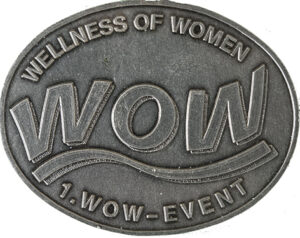
The WOW medal of the 1st event – Photo: Gerd Steins, Berlin
The experiment, copied from the world’s most difficult women’s race in Oslo, where over 40,000 runners competed every year, failed, the Berliners also wanted to prove themselves and „run times“ according to Horst Milde.
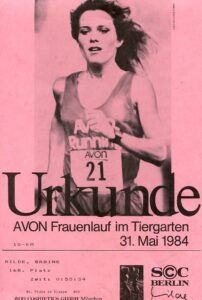
The certificate of the 1st AVON Women’s Race in Berlin – Photo: Horst Milde
Just one year later, the 10 km race in Berlin was back on the programme and the runners returned. But it wasn’t until the 14th edition in 1997 that the number of 2,000 women and girls was reached for the first time. Another two years later, there was a real upward trend when the number of participants almost doubled to 4,362. And it continued to rise significantly in the following years.
Germany’s most difficult charity women’s race
The coronavirus pandemic made it impossible to hold the running event in 2020 and 21. After this difficult period, the „for women only“ event was relaunched in May 2022 with fresh impetus and a new title sponsor.
The KoRo Women’s Race Berlin is Germany’s most successful charity women’s run against breast cancer. Commitment to the fight against cancer takes centre stage – as does the shared joy of running.
For SCC Events as the organiser of the KoRo Women’s Run, the history of the development of the women’s race since 1984 does not end with the edition on 4 May 2024. It needs to be developed further in order to motivate even more women and girls to get involved in running and thus gain a sense of joie de vivre.
Horst Milde
Founder of BERLIN-MARATHON, Berlin Half Marathon, AVON Women’s Run (and many more)
