 EN
EN
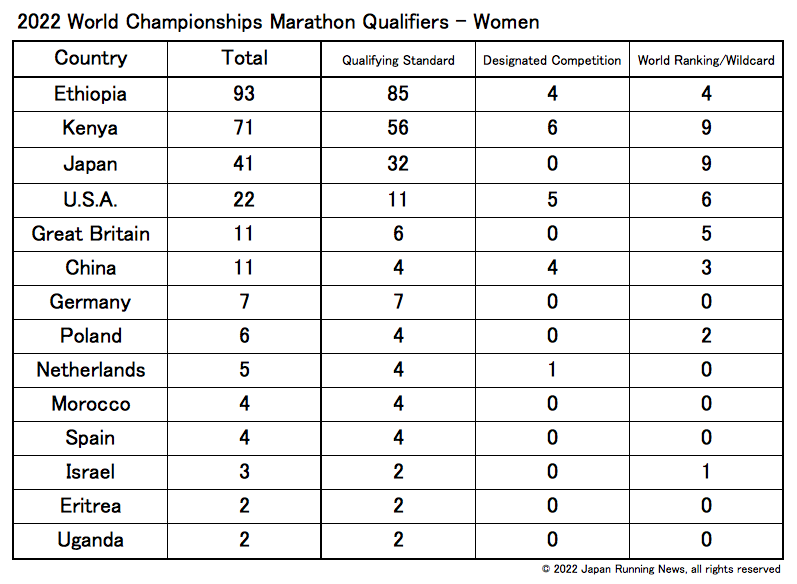

Kenya unsurprisingly topped the men’s list with 124, but Japan surpassed Ethiopia 102 to 83 for 2nd. To put it another way, Ethiopia had 81% as many men qualify as Japan, while Japan had 82% the number that Kenya did. The U.S.A. narrowly beat Eritrea 18-17 for 4th, but again relative to population it was farther down the list, Great Britain having proportionately a bit more than twice as many qualifiers as the U.S., just like among its women. Relative to population, Japan had about 14 times as many men qualify as the United States did.

Like I said earlier, Kenya had the largest total number of qualifiers at 195, Ethiopia next with 176, and Japan 3rd with 143. The U.S.A. had 40 and China 23, with the other 9 countries all between 10 and 19 total qualifiers apiece. Again, both the U.S.A. and China are a lot farther down the list relative to population.

This chart ranks the 14 countries with at least 10 total World Championships marathon qualifiers by Gender Equality Index. Both countries with disproportionately high female representation ranked in the top 25 by GEI, and every country on the list in the top 31 by GEI had at least parity. Every country with disproportionately high male representation is ranked 60th or lower by GEI except Eritrea, for which the U.N. reports not enough data being available to give it a GEI ranking. There were a few exceptions, with Poland, Ethiopia and China all having parity in representation despite low rankings on gender equality, i.e. parity in their elite marathoning if not in other aspects of their societies. But broadly speaking a higher rating of gender equality correlated with greater parity in representation in elite marathoning. Japan was near the bottom of the list again, its GEI ranking of 119th globally putting it ahead of only Morocco and the unranked Eritrea.

Socioeconomic factors no doubt play a big role here. Ranking the 14 countries by GDP, every country in the top 21 worldwide had parity or better except Japan, while every country 33rd or lower by GDP had disproportionately high male representation except Ethiopia. That looks like a pretty strong correlation and it’s not hard to imagine how there might be causality here, but what the actual causes are would be better answered in a more serious academic study. In any case, Ethiopia is clearly unique in the position of its women, and there’s another interesting study to be done there.
© 2022 Brett Larner, all rights reserved
Brett Larner – Japan Runnung News
