 EN

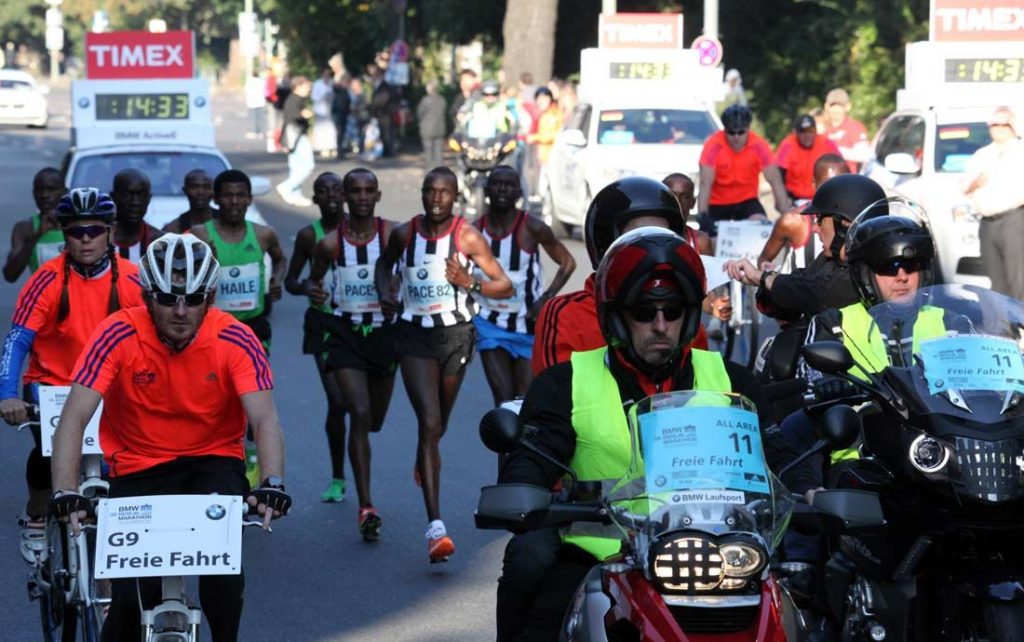
Berlin-Marathon - the rabbits in front ©Helmut Winter
Berlin Marathon – Patrick Makau kept his promises – 38. Berlin Marathon from September 25, 2011 revisited – By Helmut Winter
Patrick Makau was the brilliant winner of the Berlin marathon last Sunday finishing with a new world record of 2:03:38. He improved Haile Gebrselassies mark from September 2008 by 21 seconds or 0.5 seconds/km. Over the full distance he was almost 3 minutes faster than a 3 minutes/km pace which is equivalent to splits of 2:55.8 per km. Indeed astounding numbers.
Despite the fact that Makau had the potential to break the world record, his recent achievements were less promising: a disappointed 1:03 in February in the Ras Al Khaimah half marathon and a solid, but not outstanding performance in April in the London marathon finishing third in 2:05:45. However, after his impressing win in the pouring Berlin rain in the previous year, he showed an even better performance this time and opened up a new page in the history books of long distance running.
In continuing the dominance of Kenyan athletes in the road running races of the WC in Daegu a month ago, the achievement of Makau brought home the prestigious marathon world record for men to Kenya. The reaction in his home country was indeed overwhelming and prompt: Word champion Abel Kirui and new world record holder Patrick Makau were offered wild cards for the Kenyan Olympic team for London 2012.
And aside from the world record of Makau, thousands of spectators along the course could witness a changeover of power concerning the top level in the international marathon scene. After Berlin 2011 it appears obvious that the careers of the former superstars of men and women, i.e. Haile Gebrselassie and Paula Radcliffe, respectively, have reached the descending branch. A medal at the London Olympics might be feasible, however, fairly unlikely.
In this respect, the demonstration of power by the new generation was too impressive. In Berlin it was Makau und Kiplagat, but there are more names one has to take into account as the two Mutais, Kipsang, Mary Keitany and many more. The world of the international marathon elite has changed, Berlin provided a clear cut lesson. It is likely that we see more examples in the following weeks.
Patrick Makau must love this city. In all of his appearances in the German capital he was never beaten, and his career started in the streets of Berlin. In 2006 he competed as a “nobody” in the traditional “25 km of Berlin” as Patrick Musyoki and achieved an impressive win in 1:14:08. A year later it was again in Berlin where he smashed the course record in the prestigious half marathon with a time of 58:56, in those days the third fastest time ever and an astounding 27:27 split for the 10 km.
This course record is still unbeaten so that he holds both records of the most prestigious races in Berlin. He intended to add a further event on his list, however, his attempt to break the world record over 25 km failed because of excessive heat in early May 2007. But he won also this race and in the meantime he has changed – in playing with the names of mother and father – to Patrick (Musyoki) Makau. And as a “compensation” for his failure on that day he promised to come back to Berlin some years later in order to break the marathon world record. In fact, he did!
After a solid marathon debut in the marathon in Rotterdam in 2009, he won that race in the following year in superb 2:04:48 – the fastest time of the year – . And in the pouring rain of Berlin in September 2010 he won again in astounding 2:05:08 in view of the poor conditions. After the race he speculated that the rainy weather might have cost him a minute and a half. He was correct in this respect too. Exactly, on the second!
In a brief analysis of his run from last Sunday, we have plotted his splits in reference to Hailes world record of 2:04:26 from 2007 (dashed horizontal line). The plots show Hailes splits in Berlin from 2008 and 2009 as well as Makaus in 2011 in terms of the time difference to the 2007 splits as function of the distance. In the pre-race press conference a halfway split of 62 minutes was mentioned, in view of the boundary conditions an ambitious target, but the actual race was even faster.

Guided by six pacemakers Haile and Makau started out with a fast pace which was closely oriented on Hailes runs in previous years: 5 km in 14:37, 10 km in 29:17, 15 km in 43:52. Then the pace concerning the world record was increased and the leading group followed in narrow margins the splits from 2009 (red dots) where Hailes ambitions for a further improvement of his record were blowing away in the heat in the final 7 km. In the early stage Makaus countrymen Samal and Kimaiyo were in the leading group, but were unable to profit from the brisk pace in the end: Samal left the race after 35 km, Kimaiyo lost about 6 minutes, but made the podium with 2:09:50 in third.
At halfway in 61:44 – slightly faster than intended and 20 seconds faster than for the WR in 2008– the chase for the record was on, and after some “slower” splits in 2:58 to 3:00 to 25 km in 1:13:18 the pace was enhanced substantially. After two 2:54 splits from 25 km to 27 km Haile suddenly stopped with problems related to effort-induced asthma and the race was decided. Haile tried to continue the race in 3:30, 3:13 and 3:18 splits, but stepped out at 35 km (still under 1:45!), presumably with the intention to save resources and seek for a better day to qualify for the London Olympics early next year in the Dubai or Tokyo marathon.
In those moments where an outstanding career in long distance running seemed to have approached its end, the next generation was ready to go (better: run). Supported by pacemaker Peter Kirui Makau was able to enhance the speed further and with astounding splits of 2:50 and 2:48 the two leaders passed 30 km in 1:27:38 which improved Hailes (official) mark from 2009 by 11 seconds. Kirui passed that mark about 10 meters ahead of Makau, but owing to his DNF he could not be rewarded with the record. Somebody should have told him to jog to the finish line after he quit his job after 32 km… In any respect, Moses Mosop ran this distance on track this spring in Eugene almost a minute faster.
Makau was now alone, but could even enhance the pace. As a consequence he now built up a further lead to Hailes WR by 50 seconds in passing the 35 km mark in 1:42:16. This was the result of 14:20 and 14:38 for the preceding 5 km sections. However, in close similarity to Haile in 2009 the pace dropped substantially compared to the WRs in 2007 and 2008, manifested also by splits of 3:02, 3:01, 2:58, 3:02, 2:58, 3:00 from 34 km to 40 km.
This resembled somewhat Haile “breakdown” in 2009 and a new WR was in danger, but Makau has such a substantial lead built up and was able to respond. After passing 40 km in 1:57:15 (his lead to the WR was molten down to only 18 seconds – last 5 km: Makau 14:59, Haile 2008 14:28) he achieved 2:55 splits for the last two km and the world record was eventually broken. Inspection of the plots nicely illustrates these features and reveals also that with a stronger finish sub-2:03 times should be in reach in some future. In passing we also note that the tactics in breaking the world records in 2008 and 2011 were fairly different: Haile had built up a gradual lead over his former record from 2007, whereas Makau followed Hailes strategy from 2009 (where Haile failed), suffered also after 35 km, but was strong enough to keep the decay in the final stretch in limits. Indeed, a brilliant performance in view of the raising temperatures and running in the bright sun!
Makau manifests a development of the world record in mens marathon which took place in recent years primarily in the streets of Berlin. Starting from Ronaldo da Costas surprising performance in 1998 by running in 2:06:05 as first human being the marathon under a total 3 minute per km split, five from the last seven world records for the men were achieved in the German capital.
How rapid the world record has developed in the last decade or so might indicate that the historical run of Paul Tergat in 2003 by breaking the 2:05 barrier in 2:04:55 is now the average of the ten best times on the Berlin course. A truly sensational figure! Thanks to Makaus splendid performance, Berlin has regained the crown as fastest marathon course on the globe. With the average of the ten best times on this course of 2:04:55 Berlin surpassed Rotterdam (2:05:07) and London with 2:05:21 in third. A decade ago nobody would have even dreamt on such developments.
The reason for this apparent dominance of the Berlin course might be diverse. It is certainly a flat course with still tolerable gradients in elevations and, in particular, thousands of spectators gathering along the course and supporting the elite runner and the mass. Also the weather conditions last Sunday were good concerning almost no wind and dry air, the temperatures in the first part of the race (around 15°C) were of advantage, but during Makaus finish in the sun already at a tolerable limit.
A further decisive factor was the pacing of the top runners by an excessive number of “rabbits”, not less than six for the leading group. As also the graphics shows, this pacing played a pivotal role and brought the mission towards a new world record on its way. This “Berlin model” of pacing – developed by Race Director Mark Milde – is certainly a key issue of success in view of the extremely high standard of the record. Without guiding the athletes in a controlled manner as again successfully demonstrated by the selection of fine pacers in Berlin, a world record would have been out of reach. It would be interesting to learn about future reactions of the IAAF on these developments, in particular in view of the questionable decisions made concerning pacing of women.
However, pacing does not necessarily guarantee outstanding performances, one also needs the appropriate athletes to profit from it. And Makau and also Haile (until his breathing problems) were able to survive from such a “suicidal pace”, all other companions in the early stage suffered substantially in the end. As a consequence only the winner Makau and third place finisher Kimaiyo in 2:09:50 came from the first group.
A pacer from a second group which was fully on schedule to reach halfway in 63:30 finished in second position: Stephen Chemlany, winner of the Tiberias marathon in January 2011 improved with 2:07:55 his personal best by more than two minutes. In the end only 3 men dipped under 2:10 and only 5 under 2:13, for an event of high international standards an almost disappointed depth of results.
Felix Limo belongs to the class of „old guys“, but showed a solid performance. The winner of the Berlin marathon from 2004 (2:06:44) finished fourth in 2:10:38. And Great Britain seems to have a male marathon runner of international class again, Scott Overall achieved a personal best in 2:10:55 on fifth place, whereas veteran Hendrick Ramalaa finished on tenth position in disappointing 2:16:00.
Even more disappointing the achievements of the German runners who have hoped to qualify for the London Olympics 2012. Both candidates, Falk Cierpinski and Martin Beckmann were within schedule at halfway in 1:06, however, left the race after 25 km and 30 km, respectively.
In the Marathon Majors competition, i.e. collecting points in international championchips and in the marathons of London, Boston, Berlin, Chicago, and New York City, Makau moved with 60 points into the lead. But it is likely that the two Mutais will pass him in the ranking after the New York City marathon and will collect the price money of half a million US$. So that Makau will be “left” with the world record which will be already under threat in the next major events this autumn: Chicago, Frankfurt, and Amsterdam.
Also in the womens race a change in generation took place. 24 year old Florence Kiplagat, reigning half marathon champion and cross world champion from 2009, finished her first marathon in superb 2:19:44, well in front of the “old ladies” Irina Mikitenko in 2:22:18 and Paula Radcliffe in 2:23:46. Throughout fine performances, but Berlin showed that it will be fairly hard for the stars in womens marathon over last decade to reach the podium in London 2012.
The support by Prof. Sean Hartnett (Eau Claire) in preparing this article is gratefully acknowledged.
Helmut Winter
Patrick Makau on his last meters to the finish line | 38. Berlin Marathon
