 EN
EN
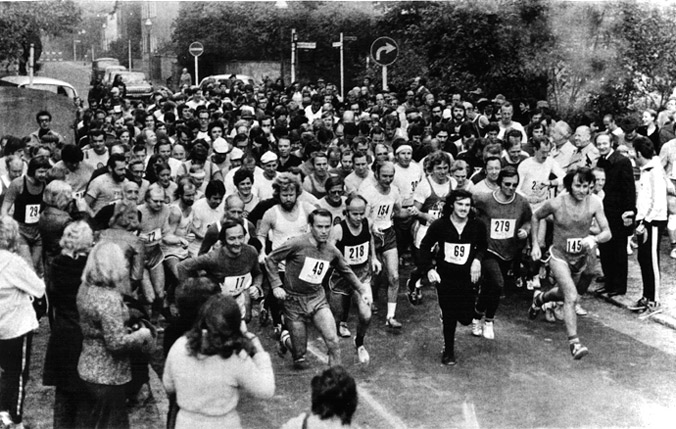
The start of the first Berlin people's marathon "Berliner Volksmarathon" in 1974 ©Sportmuseum Berlin – AIMS Marathon-Museum of Running
RUNNING GERMANY – BERLIN – Countdown: Day 42 – The story of the BERLIN-MARATHON began 13,825 days ago
6 weeks long, we would like to put you in the mood for one of the largest marathons in the world – the BERLIN-MARATHON. It will be a look behind the scenes, a glimpse of this mega event which is organized every year for the past 39 years.
The launch of the first "Berlin People's Marathon," fell on 13 October 1974. Back then, 286 runners, including a few female runners, started their 42km long way along the AVUS. The organiser of this race till 2004 was Horst Milde. The race was started at the Mommsenstadion, still training center and office of the Sport-Club Charlottenburg. Winner was the German Günter Hallas in 2:44:53 hrs, Jutta von Haase (also German) was the fastest woman in 3:22:01 hrs. A year later, the first and only couple in history ran for victory: Ralf Bochröder won after 2:47:08 hrs, his wife Kristin (both German) ran 3:59:15.
For the first time in 1981, the course was going through the city center of Berlin, which was well received by the 3486 participants. Already in 1985 the chief of the London Marathon Chris Brasher, said "the BERLIN MARATHON ascended to number five in the world."
Since 2003 the home stretch is passing through the Brandenburg Gate on the Straße des 17. Juni. This is a very special experience for every marathon finisher.
In 2006, the five largest marathons in the world formed together to the World Marathon Majors (WMM).
Among London, Boston, Chicago and New York is also Berlin.
History of the BERLIN MARATHON
The story of the BERLIN-MARATHON is a story of the development of road running in Germany. When the first BERLIN-MARATHON was started on 13th October 1974 on a minor road next to the stadium of the organisers‘ club SC Charlottenburg Berlin 286 athletes had entered. Horst Milde was the organizer of this race.
The first winners were runners from Berlin: Günter Hallas (2:44:53), who still runs the BERLIN-MARATHON today, and Jutta von Haase (3:22:01).
 1st start 13th October 1974 – 1. "Berliner Volksmarathon" – Waldschulallee 8o in Berlin-Charlottenburg
It all began October 13th, 1974
It was until 1980 that the marathon route led the runners along the Grunewald, a forest in West Berlin. The maximum participation in those days was 397 in 1976. But already during the early stages there was a world record. In 1977 the national marathon championships were held at the event for the first time. Women’s winner Christa Vahlensieck set a new world best clocking 2:34:47.5 hrs. It was also in 1977 when there was a reasonable good men’s winning time: British runner Norman Wilson won in 2:16:20.7 hrs.
27th September 1981 was a big day for the organizers. For the first time the BERLIN MARATHON was run through the city streets of West Berlin. The race was started in front of the Reichstag and finished on the fampus boulevard "Kurfürstendamm". But it had been hard for Horst Milde to persuade the local government and the police to move the race into the city. Ian Ray (Great Britain/2:15:41.8 hrs) was the first winner.
Angelika Stephan from Kassel (Germany) won the women’s race in 2:47:23.5 hrs. 3,486 runners from 30 nations participated in the race – the largest field ever in a marathon in Germany. Quality of the BERLIN MARATHON then improved from year to year. And numbers of participants strongly increased from 1981 onwards. In 1985 more than 10,000 entries were registered for the first time (11,814).
On 30th September 1990 a dream came true
Three days before the German unification 25,000 runners ran through Brandenburg Gate – a lot of them with tears in their eyes. It was also the day when BERLIN MARATHON established itself among the fastest marathons in the world. Steve Moneghetti (Australia) ran the fastest time of the year: 2:08:16 hrs. It was Uta Pippig, who managed a home win.
In 1995 Sammy Lelei (Kenya) achieved a remarkable breakthrough. His 2:07:02 hrs was the second fastest time of all times and the fastest for more than seven years. He missed the world record by just twelve seconds.
20th September 1998
The 25th edition of the BERLIN MARATHON in 1998 had a record number of 27,621 athletes who had entered the race. And the jubilee edition was unexpectedly crowned by a world record. Ronaldo da Costa from Brazil ran the race of his life. He clocked 2:06:05 hours and became the first athlete to have run the marathon in an average speed of more than 20 k per hour.
A year later another world record was broken. This time Tegla Loroupe became the hero of the BERLIN-MARATHON. The Kenyan ran 2:20:43 hrs. Men’s winner Josephat Kiprono (Kenya) ran a world class time of 2:06:44 hrs as well. Mark Milde was responsible for the invitation for the top athletes.
In 2001 a Japanese superstar had decided to run the BERLIN MARATHON: Naoko Takahashi. The aim of the Olympic champion was obvious. She wanted to be the first woman to run sub 2:20 hrs. And finally she was the one to do so. Takahashi won in 2:19:46 hrs. After the 11th September the race had a political dimension as well.
The runners held up a banner before the start. It read “United we Run” and showed the symbols of both the BERLIN MARATHON and the New York City Marathon. A year later Naoko Takahashi was back in Berlin. After injury problems it was her first marathon since her triumph a year ago and she won again in 2:21:49 hrs. Raymond Kipkoech (Kenya) was the fastest with 2:06:47 hrs.
Paul Tergat
In 2003 Paul Tergat crowned the jubilee edition of the 30th real,- BERLIN MARATHON with a sensational new world record. The 34 year-old Kenyan became the first runner to achieve a sub 2:05 hrs time in the classical race. Paul Tergat ran 2:04:55 hrs . Surprisingly Sammy Korir came very close to beating Paul Tergat. He finished just one second behind. Titus Munji, another Kenyan who belongs to Tergat’s group, was third in 2:06:15 jrs.
Regarding these three results the real,- BERLIN MARATHON was the best ever marathon. But there was another world record in the men’s race: Andres Espinosa (Mexico), the winner of the New York Marathon in 1993, became the first master runner to run sub 2:10 (2:08:48 hrs). Berlin’s women’s winner was Japan’s Yasuko Hashimoto with 2:26:32 hrs. It was the first time the finish of the race was at Brandenburg Gate.
In the next two years Japanese women set the highlights once again. In 2004 Yoko Shibui improved the course record to 2:19:41 hrs. And in 2005 Olympic Champion Mizuki Noguchi bettered that mark to 2:19:12 hrs which was a new Asian record as well. The BERLIN MARATHON had developed into one of the world’s best quality road races.
Gete Wami & Haile Gebrselassie
The mass race has developed accordingly: 39,636 runners had entered the 2006 race. Haile Gebrselassie set the highlight of the 33rd edition when he clocked a superb 2:05:56 hrs in warm weather conditions. This remained the fastest time of the year worldwide and lifted him up into seventh place in the list of the fastest times ever. Little more than 15 minutes later Gete Wami made in an Ethiopian double: She clocked 2:21:34 hrs to win the 33rd BERLIN MARATHON.
The fabulous world record of Ethiopian superstar Haile Gebrselassie was the highlight above others at the 2007 edition. Gebrselassie´s second attempt on the world record on the flat and fast Berlin course went much better than a year ago. He shattered the old mark by Paul Tergat by almost half a minute (29 seconds) clocking a remarkable time of 2:04:26 hrs. Race director Mark Milde could be very proud with his athlete and this unbelievable world record time.
The women’s victory went to Gete Wami (Ethiopia) clocking 2:23:17 hrs and securing this way her chance to win the crown of the first World Marathon Majors women’s crown. She finally cashed in 500.000 Dollars to become the first female winner of the WMM series 2006/2007 after placing second behind Paula Radcliffe at the ING New York City Marathon. 32638 finishers marked also a record number at the 34th edition of the BERLIN MARATHON.
In 2008 Haile Gebrselassie was aiming to better his world mark again in order to push it as far below the standing mark as possible to make it as much out of reach for contenders as possible. Favourable weather conditions (sunny, no wind, 14-18 degrees Celsius), timely pacing (62:04 minutes at the halfway mark) and an unexpected contender to run with the champion far longer than expected (Kenyan James Kwambai) made for a perfect race. Haile Gebrselassie finally ended up with breaking 2:04 hours by one second ( 2:03:59 hrs).
In the women´s race German runner Irina Mikitenko who ended up in second place in her first attempt at the marathon in 2007 in Berlin clocked 2:19: 19 hrs to win her second marathon (after London in the spring) and set a national record. A few weeks later she was honoured as the winner of the World Marathon Majors women´s competition earning 500.000 US dollars. 35.783 finishers made the BERLIN-MARATHON 2008 the second largest marathon in the world.
Haile Gebrselassie came back to Berlin in 2009 to make a fourth attempt on the world record on the superfast course in the German capital. On this day though the weather was not as favourable for such an attempt as in the two previous years. Being on course to break his mark set a year ago (2:03:59 hrs) until the 37th kilometer he struggled on the last part of the race and fell off the record pace quite clearly to finish still in world class style with 2:06:08 hours.
Temperatures up to 27 degrees Celsius did not contribute to a better performance. Still he clocked a world record for 30 km passing through this mark in 1:27:49 hrs. This was his fourth win in a row at the BERLIN-MARATHON, an achievement no runner has reached before as well as his average time in these four races of 2:05:08 hrs. First woman at the finish was Atsede Habtamu Besuye from Ethiopia clocking a personal best time of 2:24:47 hrs. 40.923 participants were registered, 35.035 finished the race.
In 2010 the rain set it´s marks on the 37th edition of the classical race through the capital. Nevertheless the results of the top runners were remarkably well in those wet conditions. Three runners were still together at the 35 km mark when shortly thereafter the two remaining Kenyans made a move. Patrick Makau finally was the stronger runner over Geoffrey Mutai winning in 2:05:08 hrs two seconds ahead of Mutai.
The women´s race was won by Ethiopian Aberu Kebede in 2:23:58 hrs.
Source: Berlin-Marathon
