 EN
EN
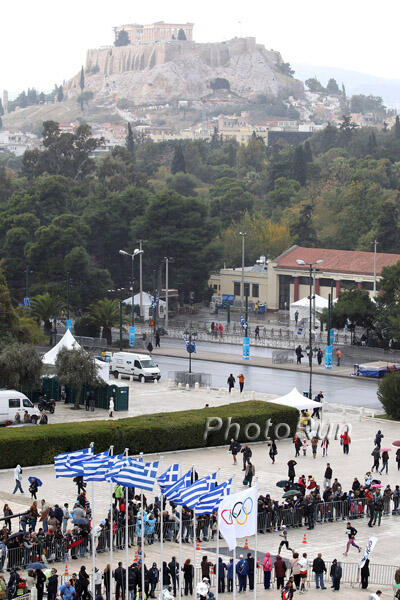
2011 Athens Classic Marathon Athens, Greece November 13, 2011 Photo: Jean-Pierre Durand@PhotoRun Victah1111@aol.com 631-741-1865 www.photorun.NET
30. Athens Classic Marathon – History of Athens
MYTHS & PREHISTORIC ERA
According to mythology, the Olympian goddess Athena and the Olympian god Poseidon competed over who would be the protector and patron god of the city we now know as Athens. This was to be decided based on which god gave the city the finest gift. Poseidon, the sea god, hit the Acropolis rock and created a sea water spring. Athena, who was the goddess of wisdom and knowledge, presented an olive tree. Thereinafter, the city was called Athens and the olive tree branch has become the symbol of good will and noble rivalry.
MYCENAEAN ERA & EARLY CITY FORMATION
It is believed that Athens has been inhabited since the Neolithic Period. It originally was a provincial town during the Mycenaean Era. As it gradually began to develop economically and artistically, it expanded and more tribes moved to the area. Poets and scholars began to emerge, the Acropolis became a place of worship and rhetors started to gather at the Agora, debating and arguing. Athens was slowly growing into a major city of importance.
THE GOLDEN AGE
In the 5th century BC, Athens fought the Persians, who invaded the area twice. The Athenians, who had become a great military power, won both times, once in Marathon and once in the naval battle of Salamina. The Persian War was the reason for the Greek states to unite against a common enemy, and this was a decisive point in world history. If the Greeks had been defeated, Persian culture would have been prevailed. Athens' position was greatly strengthened due to its victory over the Persians and it ultimately became the leader of the Greek world. During the 5th century, or the period otherwise known as the Golden Age of Athens, the great statesman Pericles led the city. Athens was the first democracy and the greatest of all states, giving birth to ideas and principles that had never been thought of before and which all owe their existence to this city.
MACEDONIAN ERA
In 431 BC Sparta declared war on Athens and after many years of fighting, Athens was finally defeated. The Peloponnesian War, as it was called, had weakened most of Greece, enabling Philip II of Macedonia to subdue the majority of the Greek states, including Attica. Later, Philip's son, Alexander the Great consolidated all of Greece and established his empire, conquering areas in Africa and the East, spreading the Greek language and culture. During Alexander's reign, Athens remained an intellectual center.
ROMAN ERA & BYZANTIUM
In 146 BC Greece was conquered by the Roman Army, which greatly contributed to the decline of Athens and to the loss of the city's power and glory. Later, Christianity began to spread throughout the country. In 330, the Roman Emperor Constantine moved the capital of the Roman Empire to the former Greek colony Byzantium, and renamed it Constantinople. Thus, the Empire was split into western and eastern halves and Athens became part of the eastern Byzantine Empire, which flourished for over 1000 years. During this era, most ancient temples were converted into churches, and this is the reason that modern Athens is full of wonderful Byzantine ecclesiastical art.
MIDDLE AGES & THE OTTOMAN OCCUPATION
Unfortunately, the history of Athens in Byzantine times is one of repeated invasions, which resulted in the Empire's eventual collapse. Throughout the Middle Ages, Athens came under the rule of other Mediterranean powers such as the Franks, the Catalans, the Florentines and the Venetians. Ultimately, the Ottoman Turks took control of the city in 1456. For the next 400 years Athens, and indeed all of Greece, was occupied by the Ottoman Turks. In this era, many of the antiquities were damaged terribly, the most important being the Parthenon. The Ottoman forces had stored their gunpowder in the Parthenon, which had been converted into a mosque. Venetian mercenaries fired explosives through the roof of the temple and reduced it to ruins.
GREEK REVOLUTION & INDEPENDENCE
The Greek people finally rose up against the Ottoman Turks in 1821 and so began the Greek War of Independence. The war lasted 8 years, and in 1830 the three great powers – Britain, France and Russia – declared Greece to be a legally independent nation. In 1834, King Otto I named Athens as the capital of Greece.
WORLD WARS & THE 20TH CENTURY
After WWI and the Asia Minor catastrophe, Athens changed immensely due to the exchange of populations between Greece and Turkey. Most people settled in Athens and the greater Attica region. Although the new population crowded the city and new districts needed to be developed, Athens bloomed in the cultural aspects of life.
