 EN
EN
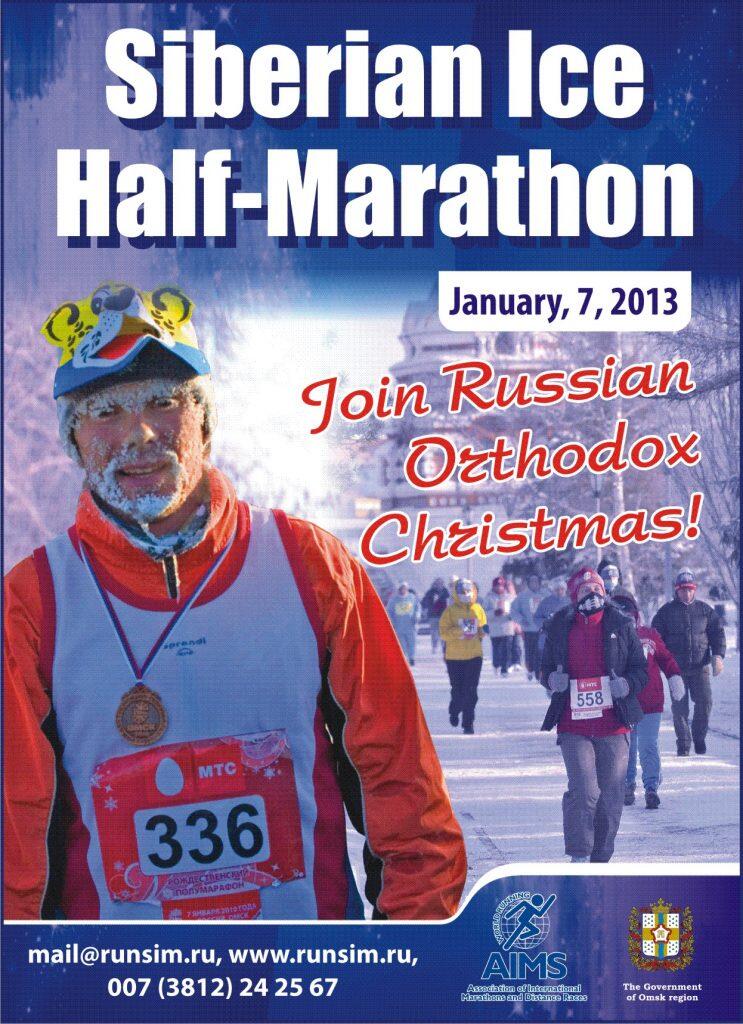
Siberian Ice Marathon receives international stat ©Siberian Ice Half-MARATHON
Siberian Ice Marathon receives international status – 7 January 2013 – 76 participants
The world’s coldest running competition has been given international status – the marathon has become a full member of the Association of International Marathons and Distance Races (AIMS).
In a wire addressed to Andrey Sandalkin, Marathon non-profit partnership Race Director, AIMS President Paco Borao noted: “I am pleased to advise that the Siberian Ice Marathon’s application for the AIMS membership has been approved. I wish you and your team good luck in organizing the event and hope that our Association will contribute to its success.”
Thus, there are already two running competitions officially holding international status in the Omsk Oblast!
According to Konstantin Podbelsky, Omsk Oblast Deputy Minister of Youth Affairs, Physical Education and Sports, AIMS membership will result in more foreign sportsmen and visitors at the SIM and promote the marathon abroad.
About
Siberian Ice Marathon is an official competition that is included in the calendar of the Ministry of Youth, Physical culture and Sport of Omsk region.
Siberian Ice Marathon is the only major long-distance race arranged in Russia in winter. The event is held in extreme weather conditions of Siberian winter and has unofficial status of the coldest race in the world.
Sporting program
Start: 7 January 2013 at 13:00
Official competitions
Non-competitive distance
For all participants
Age of participants is determined in the race day on 7, January, 2013. Every amateur of running is allowed to compete only in one event of the sporting program.
Pay your attention to the following
The MYLAPS sports timing electronic system is used to register results of participants taking part in official competitions. To use personal electronic chip is obligatory. No chip – no result!
21,1 km
Participants
Men and women at the age of 18 years and elder. The age of participants is defined for date of carrying out of competitions.
Compensation
To each participant — starting number, souvenir attributes, a firm calendar; to everyone finishing — the diploma. To winners – monetary prizes.
Start/finish
Cathedral Square
Line of distances
Ring, it is laid by the central historical part of a city of Omsk; length of one ring — 3,5 km. Participants of a semimarathon overcome six circles, running on 7 km — two circles.
Registration
Application fees
| From 01.10.12 till 15.12 | Expo | |
|---|---|---|
| 21 km 100 m | 20 Euro | 40 Euro |
| 7 km | 15 Euro | 20 Euro |
Registration and participant's packet
"Participant's packet" consists of:
- a Bib-number that corresponds the race you compete in;
- a souvenir set with hat;
- a coupon for a tea after finish;
- a personal electronic chip for participants of official race (21-km race).
To get the participant's packet you should come to the registration in person (q.v. the activities program) and show your personal identification document.
Distinctive peculiarities of the Ice Marathon:
- It is unique: in Russia there are no analogues of such a major and mass winter long-distance race
- It is popular: more than 1000 fans of running from 15 regions of Russia and foreign countries take part in the half marathon
- It is extreme: the race is held in conditions of low temperatures (-39 oС in 2001)
- It is holiday: a carnival of Christmas costumes, a show of winter swimmers and traditional extreme fun decorate the program
Christmas half marathon records
The course record among women belongs to Evgenia Danilova (Omsk), who had a time of 1:17:36 in 2008.
The course record among men belongs to Vadim Ulizhov (Murmansk), who had a time of 1:08:10 in 2011.
Interesting facts from Christmas half marathon history
In 2001 at the tenth anniversary Siberian Ice Marathon the temperature fell to -39 oС. For the whole half marathon history there has never been such a low temperature. Since the runners could get frost-bitten the organizers advised them to run only 6 km in spite of distances they had applied for. Eventually only 13 participants ran 21,1 km. One more interesting fact was that for the first time of Christmas half marathons a woman showed a better time than a man.
In 2003 weather surprised participants of half marathon: the temperature was -9.7 oС. It is worth noting that this high temperature did not satisfy participants from Australia, Austria, Belgium, Great Britain and USA who came to feel the extreme Siberian winter.
In 2004 half marathon participants wanted to be original: they wore doctor costumes and carried a stretcher with a “bandaged patient” along the whole course.
Sibirian Ice Marathon
Omsk guide

Omsk, one of the oldest Siberian cities
Omsk was founded in 1716 as a fortress at the junction point of channels of the Irtysh and the Om Rivers by Colonel Ivan Bookhgoltz, this historic fact initiated developing of Omsk – one of the oldest cities in Siberia.
At the second part of the 18th century the fortress became the largest fortification at the East of the country. Construction of Trans – Siberian railway boosted the development of the city. Railway connected Omsk with European part of Russia and its East regions. Omsk turned out to be in a very favorable position being at the crossing of trade ways.
Metal work and food processing industry began to develop in the city. Foreign companies opened their representative offices. Branch banks were opened as swell. In 20s and 30s of the 20th century Omsk was agricultural center of Siberia. Higher Institutes of Education were established and leaped forward.
In 1941-1945 over 100 enterprises of different brunches were evacuated from zone of action of the front into Omsk itself and Omsk region. Since the middle of 50s Omsk became the center of large petroleum refining and petrochemical complex. In 70s and 80s house building and industrial engineering boom stimulated manufacturing of construction materials.
At the beginning of 90s private sector appeared in the economy of the city. In 90s market infrastructure was shaped and private enterprises, banks, financial-investment companies, funds appeared. Production of Omsk enterprises entered national and world market and is in great demand now.
Our dimensions
- In 2016 Omsk City will celebrate 300 years of history
- 572.9 sq. km – the territory of the city
- 45 km – city coast line of the Irtish river
- 40 hectares occupied by trees and plants restituting Omsk status of “garden-city”
- 1 152 000 people – the population of Omsk
- 16 000 – Siberian International Marathon participants, 50 000 – spectators audience
- 2 555 km – the distance from Moscow to Omsk
- Over 3 500 annual flights connect Omsk with districts of Russia and 500 ones with foreign countries
- New international airport “Omsk-Fedorovka” will be in operation in 2016
- 25 % of Omsk metro is already built
- 20 academic institutes, 83 public libraries
- 9 museums containing over 220 000 collection items, 8 professional theatres
- 150 restaurants and night clubs
- 6 stadiums, 370 sport halls, 10 schools of Olympic reserves
- 17 participants and champions of Olympics and World Champions
- More than 60 fairs and exhibitions held in Omsk annually
- 5 000 firms from 48 countries of the world are involved
- International Exhibition of Arms and Material “BTTB-Omsk” – one of the most significant
- Omsk petroleum chemical plants manufacture over 400 types of products
How to get there

Aeroflot
Well known around the world Russian national airline “Aeroflot” will get you to Moscow from any country in the world and then to Omsk.
Duration of the flight “Moscow-Omsk” – 3 hours, there are several regular flights every day.
Airline “Aeroflot” is based around air hub Moscow-Sheremetievo.
Aircrafts fleet: Airbus A320, Boeing B767.
Internet ticket sales: https://www.aeroflot.ru
Our suggestion: If it’s your first time you are traveling to Russia, choose this way, and combine your running experience with visit of Russian capital.

“S7” Airlines
“S7” is one of the world’s 50 biggest domestic airlines. They operate regular flight to Europe and countries in the Asia-Pacific region, as well as charter flights to 20 countries around the world.
“S7” is based around air hub Moscow-Domodedovo and Novosibirsk-Tolmachevo.
Aircraft fleet: Airbus A310, A319, Boeing 737, TU-154M, IL-86.
With “S7” you will get Moscow or Novosibirsk firstly and then Omsk (7-hour railway trip from Novosibirsk)
Internet ticket sales: https://www.s7.ru
Our suggestion: Novosibirsk – one of the biggest Siberian cities. “S7” – is a good way to combine Omsk and Novosibirsk visits.

Transaero
“Transaero” is the first private airline in the history of Russia. This airline recognized in 1995 as the most quickly developing airline of the world, delivers you from any point of Europe to Moscow or St.-Petersburg, and then to Omsk.
“Transaero” is based around air hub Moscow-Domodedovo and Sant-Petersburg-Pulkovo.
Aircraft fleet: Boeing 747, 777, 767, 737, TU-214.
Internet ticket sales: https://transaero.ru
Our suggestion: With Transaero you have a good possibility to visit Moscow and northern capital of Russia St.-Petersburg.

Trans-Siberian Railway
If time is not an issue and you would like to see some Russian countryside, catch a train. A 43-hour trip from Moscow, the train ride takes you through the central part of Russia, the Ural Mountains, and Western Siberia along the famous Trans-Siberian Railway.
Trans-Siberian railway is the world's longest and the most famous train route that goes through Russia. It crosses the whole continent, starts in Moscow, passes through the European Russia, crosses Urals mountains (which separate Europe and Asia), continues into Siberia's taiga and steppes, and finishes in Vladivostok — the Russian Far East coast on the Pacific Ocean.
The Trans-Siberian is an immense route – more than 10000 kilometers. It is possible to reach almost all the cities, situated either to the east or to the west of Omsk: Moscow, St. Petersburg, Ekaterinburg, Novosibirsk, Irkutsk, Ulan-Ude, Ulan-Bator, Beijing, Vladivistok and the others.
All trains are comfortable, include sleeping accommodation, and there are several regular trains every day.
Source: Siberian Ice Marathon

