 EN
EN
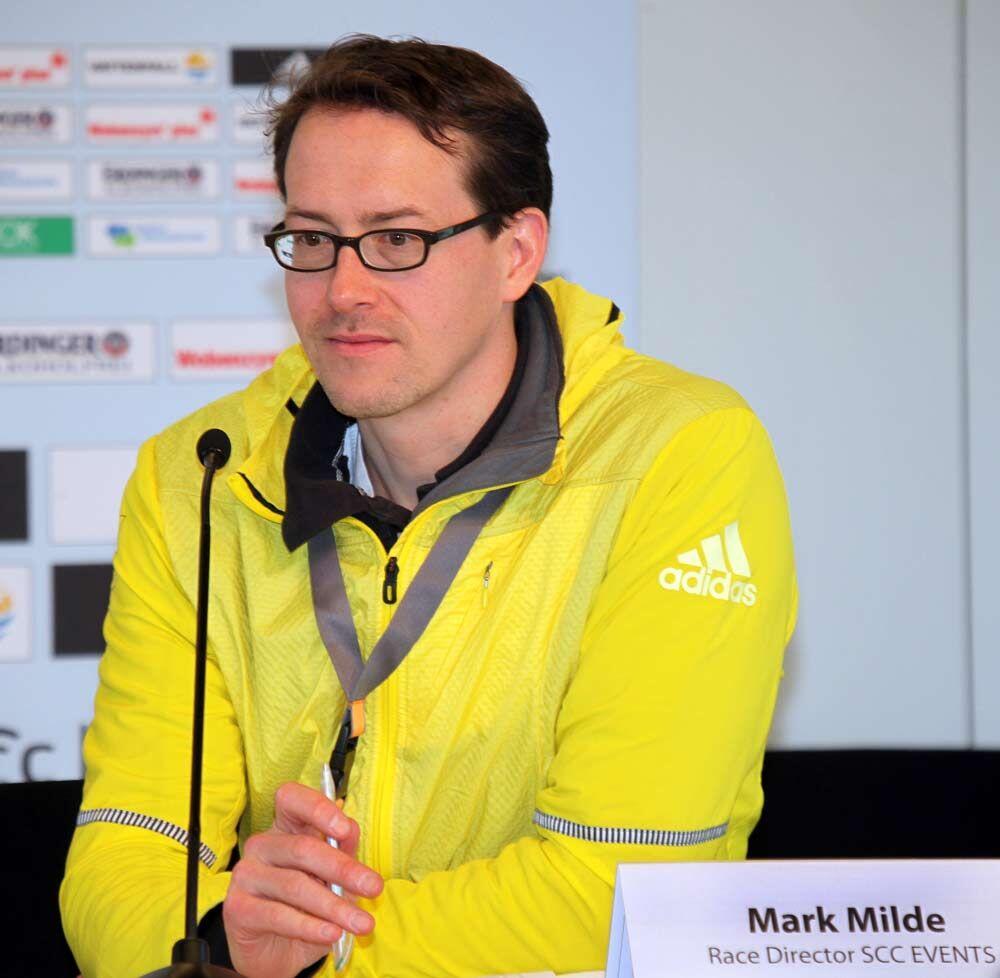
Race Director of the Berlin Marathon, Mark Milde. ©Helmut Winter
RUNNING GERMANY: 40th Berlin Marathon: Race Director Mark Milde – The man behind the records – By Helmut Winter
With one glance at the list of elite athletes competing in the 40th BMW Berlin Marathon this coming Sunday, one can expect results that will be among the top international times. For over a decade, the men's race through the streets of the German capital has been the non-plus-ultra marathon event in the international running scene.
This is impressively backed by times such as 2:03:38 and 2:04:3. Berlin holds the current marathon world record, and shines in the even more impressive statistics for the fastest times ever achieved on a course, a statistic that Berlin dominates internationally. And the fact that the organizers of the Berlin Marathon are able to recruit the best athletes in the world year after year to come and compete for the newest records really says it all.
A significant factor in Berlin's dominance in the marathon scene is due to the work of one man, who for over 10 years has been responsible for the elite athletes at the Berlin Marathon: Race Director Mark Milde.
His work and his abilities contribute in a major way to the reputation that Berlin enjoys around the world when it comes to the marathon. While there is not much attention paid to the developments in running or the marathon specifically by the general public or the media, when it comes to discussing the marathon world record, many will recall, "Wasn't that in Berlin?"
For those on the outside, it is difficult to understand what it means to reach such a status in today's fast-paced global world. The marathon as a competitive discipline for the world's elite athletes has reached such a high level of performance that new records are only possible with the help of detailed planning and organization. The availability of top athletes, the best course profile and optimal exterior conditions are the prerequisites without which "nothing runs".
New records no longer happen on their own, as the most recent results in London show, where the gathering of elite athletes came together to chase the Berlin records to see if they could beat the 2:03 barrier. What happened after the perfect 1:03:34 for the first half is a perfect example of how records of this kind are so difficult to achieve.
The successful work that the large team at the Berlin Marathon puts in each year cannot be praised highly enough. It is a near miracle that the race along the Spree River can be pulled off year after year in such a grand manner with – in comparison to the other big marathons – very limited resources.
When searching for the reasons for this success, one inevitably comes up with one significant protagonist, Race Director Mark Milde. At the actual Berlin Marathon event, one only finds him at the edge of the limelight, for example, on his bike accompanying the top runners, as an interview partner for the competitive aspects of the race, or congratulating the winners in the finish area.
Yet, he earned his excellent positioning in the international running scene through his hard work, which takes place mostly outside the venue of the running celebration through the streets of Berlin. No one compares with his ability to procure athletes for absolute top performances, to establish race tactics together with the runners and their managers, and to support their realization with creative ideas.
The facts speak for themselves: Since Milde took on responsibility for the elite athletes, Berlin has held the world record for the men's marathon race like a monopoly since 2003, improving it along the way three times to the current time of 2:03:38. During this period, Berlin has had the fastest time in the worldwide rankings six times; only the Rotterdam Marathon comes close with three times (where Eric Brommert also functions as a very competent race director). Berlin is also among the top women's races internationally, although not quite as dominant.
He assisted Christoph Kopp in procuring the first record-setting runner in Berlin, Ronaldo da Costa of Brazil (2:06:05), in 1998, and one year later he began his own career as the manager for the elite athletes by procuring Tegla Loroupe (KEN) with her world record time of 2:20:43.
In 2001, when Naoko Takahashi of Japan became the first woman to break the sound barrier of 2:20 on the fast Berlin course, with a time of 2:19:46, Mark Milde was not only responsible for the move to procure her, but he also ensured the financing. This was made possible by securing additional funds through a television contract with Japan. The world record and the unbelievable viewing ratings in the Far East were the payoff for the fabulous management team.
At that time, the race was still under the direction of his father, Horst Milde, who launched the Berlin Marathon in the Grunewald Forest in 1974. His son Mark was only one year old then, and a marathon was certainly the farthest thing from his mind. But he would not be able to avoid the event in the run-happy Milde household. At age eight, together with his brother Karsten, he helped distribute the race bibs, then later assisted at refreshment points along the course and increasingly became involved in the organizational team.
From early on he brought in his innovative ideas, which played an important role in his later success as director of the elite athletes. In 1995, he optimized the provision of drinks to the top athletes by appointing one assistant to each athlete to hand over the drinks at each refreshment point on bike; this ended the chaos of the elite athletes struggling to find their own drinks. If the hand-off was not successful by bike, someone would run after the athlete to make sure he or she got the right drink.
Mark Milde's older brother Karsten played an important role in this procedure, personally handing off the drinks to Costa (1998), Loroupe (1999), Takahashi (2001), Tergat (2003) and Haile (2007, 2008), after which each one continued on to win a world record (which he had predicted). The other innovation that Mark Milde successfully implemented was the almost excessive use of pacemakers for the top athletes.
Early on, it was clear to him that due to the high performance level over the previous decade, it would only be able to achieve times under 2:05 with the use of efficient pacemaking. After the historical procurement of superstar Haile Gebrselassie, together with Dutch manager Valentijn Trouw, Milde put to work an armada of top-notch pacemakers, which one could call the "Berlin Model" that is now successfully implemented in other major races with similar success.
The main idea behind this concept is to have a formation of "rabbits" who create a protective wedge in front of the top runners and provide a fast and controlled pace. For today's top world athletes, this means an average half marathon time under 62 minutes. And to ensure that it succeeds, there are agreements as to which pacemakers are to be active at what point in the lead, and who should take over when one weakens. The pacemakers set up in formation before the race and then carry out the procedure. The success of this model is quite sensational, as demonstrated by Haile's world records. The current men's world record of 2:03:38 set by Patrick Makau was also achieved in a similar manner.
Milde is right in the midst of it all – usually on his bike. When Haile had problems with Makau in 2011, Milde was right there encouraging the star and appointing a pacemaker to assist him from the 5 km to 35 km mark. Milde's talents are recognized by both athletes and managers around the world, yet despite his great success he has kept both feet solidly on the ground.
He also has the ability to recognize potential young athletes and provide early support. In the past years, he entered new territory by recruiting young athletes who demonstrated good times over shorter distances as pacemakers for the marathon, in order to help develop their appetites for the marathon and their affinity to Berlin. One prime example of this concept is 20-year-old Geoffrey Kipsang (who, by the way, is introduced in the current film "The Unknown Runner").
And what an example he is! In April 2011, he won the Berlin Half Marathon at age 18 in 60:38; he then functioned as a pacemaker for Haile and Makau in the fall, and last year he came in a strong third at the Berlin Marathon with an excellent time of 2:06:12. Following his half marathon in February in Ras Al Khaimah (58:54), he is now among the wider circle of favorites on Sunday.
It undoubtedly has helped Mark Milde that he was athletically active as well, and has thus developed a good sense regarding competition. With his best marathon time of 2:50:36, he is one of the fastest race directors, only behind Carey Pinkowski of Chicago (under 2:20). He has even completed an Ironman Triathlon (in Roth), and his love of inline skating inclined him to integrate this sport into the Berlin event.
That has been a huge success, with the Berlin Skating Marathon now the largest of its kind in the world.
In 2004, Mark Milde took over the function of Race Director from his father, Horst, and was able to fill all of the high expectations of him. Berlin is a core marathon in the world. This was demonstrated when the Berlin Marathon was invited to join the "World Marathon Majors" (the elite league of international marathon races), where Mark Milde is often sought out for advice and deliberation.
Berlin's leading position from an athletic standpoint in this elite group is due in a large part to Mark Milde's efforts. They have even profited from his expertise in Vienna, where for the past few years he has been successfully responsible for the elite athletes there, as well.
It is no question that he and the Berlin team will continue to do everything in their power to maintain this leadership position. The field of elite athletes (and the rabbits!) along with the good weather forecast promise for a fast men's race in the vicinity of the world record on Sunday.
And as in the years before, Mark Milde will do his best to see that all their efforts are crowned with success, according to the motto passed on to him from his father Horst when he passed on the torch:
"Lead by example and stay cool."
Helmut Winter
The world records (world best times) in Berlin in the marathon since 1990
|
Location |
Name |
Time |
Date |
Race Director |
|
Berlin |
Ronaldo da Costa (BRA) |
2:06:05 |
20.09.1998 |
H. Milde |
|
|
Tegla Loroupe (KEN) |
2:20:43 |
26.09.1999 |
H. & .M. Milde |
|
|
Naoko Takahashi (JPN) |
2:19:46 |
30.09.2001 |
H. & .M. Milde |
|
|
Paul Tergat (KEN) |
2:04:55 |
28.09.2003 |
H. & .M. Milde |
|
|
Haile Gebrselassie (ETH) |
2:04:26 |
30.09.2007 |
M. Milde |
|
|
Haile Gebrselassie (ETH) |
2:03:59 |
28.09.2008 |
M. Milde |
|
|
Patrick Makau (KEN) |
2:03:38 |
25.09:2011 |
M. Milde |
|
Rotterdam |
Tegla Loroupe (KEN) |
2:20:47 |
19.04.1998 |
M. Kadics |
|
London |
Khalid Khannouchi (MAR) |
2:05:38 |
14.04.2002 |
C. Brasher |
|
|
Paula Radcliffe (GBR) |
2:15:25 |
13.04.2003 |
C. Brasher |
|
Chicago |
Khalid Khannouchi (MAR) |
2:05:42 |
24.10.1999 |
C. Pinkowski |
|
|
Catherine Ndereba (KEN) |
2:18:47 |
7.10.2001 |
C. Pinkowski |
|
|
Paula Radcliffe (GBR) |
2:17:18 |
13.10.2002 |
C. Pinkowski |
