 EN
EN
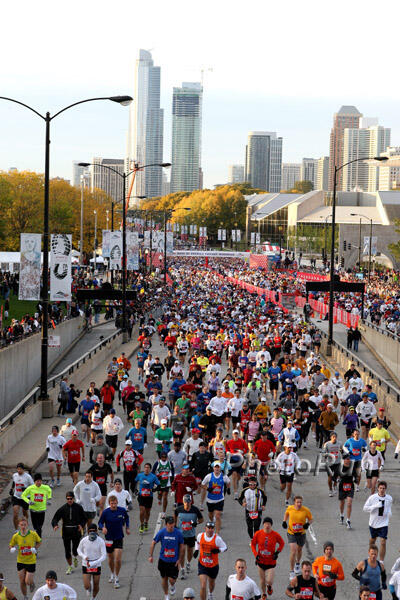
2009 Bank of America / Chicago Marathon Chicago, IL October 11, 2009 Photo: Victah Sailer@Photo Run Victah1111@aol.com 631-741-1865 www.photorun.NET
Bank of America Chicago Marathon – Sunday, October 13, 2013 – Race History 2002 – 2011 – Part III
October 13, 2002: Khalid Khannouchi, 2:05:56; Paula Radcliffe, 2:17:18
The 25th Anniversary of the Chicago Marathon was simply unforgettable – a beautiful day with a record number of finishers, nearly a million spectators, a new women’s World Record and the crowning of Chicago’s first four-time male winner.
Paula Radcliffe capped off her phenomenal year by shattering the World Record with a stunning 2:17:18 performance. Against a superior field, including defending champion and former World Record holder Catherine Ndereba, Radcliffe took control of the race for good after the half-way mark when she clocked mile splits of 5:08, 5:11 and 5:06 from miles 17 thorough 19. She ran alone and stayed strong during the final stretch up Lake Shore Dr. to knock off an amazing 89 seconds from the World Record which Ndereba set a year earlier.
After a one-year absence, Khalid Khannouchi returned to Chicago to win his fourth Chicago Marathon. Competing in the most impressive elite field in the Marathon’s 25-year history, Khannouchi went head-to-head with Paul Tergat, defending champion Ben Kimondiu, and two-time London Marathon champion Abdelkhader El Mouaziz. But it was Toshinari Takaoka who would provide Khannouchi with his biggest challenge as the Japanese 10,000m champion broke out from the pack at mile 19 to take a 21 second lead at mile 23. Khannouchi then launched a tremendous kick and in dramatic fashion, caught Takaoka by mile 25 and passed him at McCormick Place. After taking the lead Khannouchi kept his furious pace over the last two-and-a-half miles to win in 2:05:56, becoming the first marathoner with three sub-2:06 performances to his credit.
October 12, 2003: Evans Rutto, 2:05:50; Svetlana Zakharova, 2:23:07
The 2003 Chicago Marathon was up for grabs with four-time champion Khalid Khannouchi out of the field due to injury. Kenyan Evans Rutto heard the call and took on his first 26.2-miler in Chicago. In a seemingly effortless performance, Rutto not only took home the victory but the debut marathon record in 2:05:50. Rutto’s time marked the sixth fastest marathon ever run, only eight seconds behind Khalid Khannouchi’s course record. The women’s victory went to veteran runner Svetlana Zakharova of Russia. Zakharova trailed behind Constantina Tomescu-Dita until mile 25, where she surged ahead to win in 2:23:07.
October 10, 2004: Evans Rutto, 2:06:16; Constantina Tomescu-Dita, 2:23:45
On the sunny Sunday morning of October 10, Evans Rutto of Kenya and Constantina Tomescu-Dita of Romania charged to victory in the 27th running of the event. Their world-class runs made the city proud on a day when 33,125 participants from 121 countries made it to the finish line on Columbus Dr.
The slender Rutto, who had not come just to defend his 2003 title but to break the World Record, got the victory in an excellent time of 2:06:16 seconds, but was left to wonder what could have happened if the wind had not kicked up. As he fought the gusts over the final miles, it as a lesson in “take what you can get.” While he had hoped to erase the World Record of 2:04:55, set by Kenyan Paul Tergat at Berlin in 2003, the wind was the wild card on a day he had been dealt an otherwise perfect hand. Still, Rutto notched the fourth fastest winning time in Chicago history, and the second fastest marathon in 2004. And the victory kept the 26-year-old perfect at 26.2 miles. He ended the day three-for-three, having also won the London Marathon in April.
For Tomescu-Dita, it was a case of “catch me if you can.” It was a strategy that had not worked for her in the past, but on this morning, the Romanian ruled the road, start to finish. Looking back five times from the corner of Michigan Ave. and Roosevelt Rd. to the finish on Columbus Dr., she was overcome with emotion as she realized she would win her first major marathon title in a time of 2:23:45, just 10 seconds off her personal best.
October 9, 2005: Felix Limo, 2:07:02; Deena Kastor, 2:21:25
The 2005 Chicago Marathon was a world-class racing event as young champion Felix Limo defeated a deep men’s field, and U.S. record holder Deena Kastor claimed victory in a neck-and-neck race against returning 2004 champion Constantina Tomescu-Dita.
It was a tactical battle from the start as the men’s field settled in for a cautious 15:35 split in the first 5K. The lead pack found itself spread 11 athletes-wide across Ashland Ave. about 7.5 miles from the finish. Defending champion Evans Rutto kicked ahead of the elite group at mile 20, but painful blisters inhibited his ability to maintain the lead and earn a third consecutive victory on the familiar course. Limo gauged the final players and accelerated at 40K to take the lead in a sprint that went uncontested. Limo stopped the clock at 2:07:02 in an impressive victory over a championship field. Ben Maiyo finished seven seconds behind Limo in 2:07:09, followed by Daniel Njenga, Evans Rutto, and Patrick Ivuti, all finishing within 44 seconds of Limo to set an all-time top-five finishers course record.
In the women’s race, Kastor snatched the lead from Tomescu-Dita shortly after the first 5K and led the defending champion at sub-2:20 pace through the remaining 23 miles. Tomescu-Dita kept a short leash on Kastor through 25K before the aggressive American shifted gears and pushed to a 40-second lead with seven miles remaining. Kastor’s body painfully retaliated to the pressures of the fast pace, however, and Tomescu-Dita steadily edged her way back into the race. But Tomescu-Dita’s kick was not strong enough to catch Kastor as she crossed the finish line just five seconds ahead of the Romanian record-holder. The win was Kastor’s first in a big-city marathon, and the third fastest time ever run by an American woman. Tomescu-Dita improved her personal best by one minute and 20 seconds, and reset her national record by the same margin.
October 22, 2006: Robert Kipkoech Cheruiyot, 2:07:35; Berhane Adere, 2:20:42
Robert Kipkoech Cheruiyot (KEN) outsprinted Daniel Njenga (KEN) to win an exciting race which presented weather challenges of low temperatures, gusty winds and chilling rain. The race saw Cheruiyot, Njenga, fellow Kenyans Jimmy Muindi and Robert Cheboror, and American Abdi Abdirahman separate themselves from a pack of 12 near the 19-mile mark. By mile 25, it was just Cheruiyot and Njenga racing for the title. After setting his eyes on the prize following a 2004 runner-up finish and 2005 third-place finish, Njenga challenged Cheruiyot in the final sprint on Columbus Dr. to finish in second place once again. On his approach to the finish line, Cheruiyot slipped and fell just before crossing the tape. On official review, the Kenyan’s torso had crossed the plane securing his second consecutive win in a World Marathon Major race.
After leading the women’s race at a blazing world record pace in the first half, returning runner-up Constantina Tomescu-Dita (ROU) found herself faltering in the second half as the competition remained steady. Berhane Adere (ETH) and Galina Bogomolova (RUS) took advantage of the leader’s drop-off, closing the gap and overtaking her in the 22nd mile. Adere’s long strides against Bogomolova’s quicker steps proved stronger as she edged ahead and took the win. Both Adere and Bogomolova set new national records for Ethiopia and Russia, respectively, as did third and fourth place finishers Benita Johnson (AUS) and Madia Perez (MEX).
October 7, 2007: Patrick Ivuti, 2:11:11; Berhane Adere, 2:33:49
The 30th anniversary race was historic in many regards. Both the men’s victory by Patrick Ivuti (KEN) and women’s repeat championship by Berhane Adere (ETH) undoubtedly rank among the most exciting finishes in marathon history. After a neck-and-neck sprint down Columbus Dr. between Ivuti and Moroccan Jaouad Gharib, Ivuti made a final surge, pushing his chest forward to break the tape only hundredths of a second before his opponent. Moments later, Adere surprised Romanian Adriana Pirtea in the final stretch by strategically positioning herself out of Pirtea’s peripheral vision and sprinting up the outside to steal the victory from Pirtea’s grasp. Thinking she was in the final stretch of certain victory, Pirtea was in the midst of pumping her arms to the crowd when she spotted Adere much too late to match her stride. In the wheelchair race, Australia’s Kurt Fearnley set a new course record with his speedy 1:28:06, just one second ahead of 2005 champion Krige Schabort, and Amanda McGrory defeated her University of Illinois teammate for the women’s title.
The elite athletes as well as the mass of 36,000-plus runners were challenged by historic heat on the streets of Chicago. Temperatures soaring into the high 80s combined with high humidity forced organizers to halt the race for the first time in history. Approximately three and a half hours after the official start, runners were rerouted to Grant Park and instructed to stop running as the heat was too intense to ensure runner safety. As a result, while the race welcomed its largest field to the start line (36,867), only 25,534 were able to officially finish the race.
On October 1, only six days before the race, Bank of America completed its acquisition of LaSalle Bank and thereby its future involvement with the historic Marathon. The 30th anniversary closed a storied chapter in the race’s history, ending its 14-year run as The LaSalle Bank Chicago Marathon, a time during which it experienced tremendous growth in many areas including popularity among runners, civic and community support and international recognition.
October 12, 2008: Evans Cheruiyot, 2:06:25; Lidiya Grigoryeva, 2:27:17
With Bank of America at the helm as the new title sponsor, and Nike as the new footwear and merchandise sponsor, the 2008 race attracted 45,000 participants and closed registration in less than three months. With another year of hot temperatures predicted on race day almost 33,000 runners started the race and 31,344 recorded official finish times. 2008 witnessed several new changes, including a separate start for the men’s and women’s elite field (starting five minutes before the Open field), an increase in Aid Stations from 15 to 20 and the first-ever hand cycle division as the Bank of America Chicago Marathon welcomed the Achilles Freedom Team of Wounded Veterans into the field.
With star-studded fields on both the men’s and women’s sides, the men’s race went out in a blistering pace, at one point threatening to take down Khalid Khannouchi’s course record. The early pace shattered most of the field by 25K, leaving Kenyans Evans Cheruiyot and David Mandago to battle it out in a two-man race. After another six miles spent running shoulder to shoulder, Cheruiyot, running in just his second marathon, pulled away and finished in the eighth fastest time ever run in Chicago (2:06:25), an amazing feat considering the warm temperatures.
The women’s race went out much more conservatively, with the lead pack moving at a pedestrian pace nearly 15 minutes off course record pace. Shortly after the halfway point, Russians Lidiya Grigoryeva and Alevtina Biktimirova took command of the race and broke from a large pack of women led by American Paige Higgins. Grigoryeva and Biktimiorva matched each other’s strides until mile 21, when Grigoryeva emerged as the clear victor (2:27:17). The wheelchair races witnessed Australian Kurt Fearnley and American Amanda McGrory repeat as champions.
October 11, 2009: Sammy Wanjiru, 2:05:41; Liliya Shobukhova, 2:25:56
The 2009 race set a number of new benchmarks, among them a record number of finishers (33,703), a record number of charity runners (8,500) and dollars raised ($10-plus million), a record number of spectators (1.7 million), and a new course record (2:05:41).
In a welcome departure from the past two years, race day temperatures were in the low 30’s, and the stage was set for a World Record attempt by Olympic Marathon gold medalist and defending London Marathon champion Sammy Wanjiru of Kenya. With the help of pacemakers, 22-year-old Wanjiru challenged Haile Gebrselassie’s 2:03:59 with a blistering first half run in 1:02:01. Fellow Kenyans Vincent Kipruto and Charles Munyeki were both along for the ride, but the pace slowed during the second half and the World Record was no longer in sight. However, Wanjiru still managed to slice one second off Khalid Khannouchi’s course record and take home an additional $100,000 for his efforts. Morocco’s Abderrahim Goumri ran a tactical race for second in 2:06:04, while Kipruto held on for third in 2:06:08, making the 2009 race the fastest 1-2-3 finish in event history.
In the women’s race, a new star was discovered as Liliya Shobukhova won her first major marathon in only her second attempt at the distance. After a tactical first half, Ethiopia’s Teyba Erkesso burst to the lead, trimming down the lead back to the final contenders. Shobukhova displayed unparalleled speed over the final two miles (run at sub five-minute pace), finishing in 2:25:56, with Germany’s Irina Mikitenko second in 2:26:31 and 2008 Chicago Marathon champion Lidiya Grigoryeva (RUS) third in 2:26:47. Erkesso hung on for fourth while American record holder, Deena Kastor, finished sixth in 2:28:50.
The men’s wheelchair race saw Australia’s Kurt Fearnley win for the third straight year (1:29:09), and the women’s race produced one of the most thrilling finishes in race history, with the top five women all finishing within three seconds of one another. First-time marathoner Tatyana McFadden got the win in 1:50:47.
In the debut Nike Northside/Southside Challenge, a high school invitational held on the final 2.6 miles of the marathon race course, Lincoln Way Central runner Kyle Counter beat a field of 71 competitors to finish 52 seconds ahead of second place in 13:35. The girl’s champion from Luther North, Stephanie Simpson, won in 16:01, 19 seconds ahead of second place. Fifty-seven high school girls competed in the race.
October 10, 2010: Sammy Wanjiru, 2:06:24; Liliya Shobukhova, 2:20:25A record number of race finishers (36,088) contributed to a major Bank of America Chicago Marathon milestone—more than a half million finishers since the event’s founding in 1977.
Leading the way for the record field of participants were a pair of repeat champions as both Sammy Wanjiru of Kenya and Liliya Shobukhova of Russia successfully defended their titles. In doing so, the pair laid claim to the 2009-2010 World Marathon Majors series titles and an equal share of the $1 million WMM prize purse. In a dazzling rematch of the 2008 Olympic gold and bronze medalists, Wanjiru and Ethiopia’s Tsegaye Kebede pushed each other to the limit, with Wanjiru weathering a series of attacks in the final miles before finally prevailing on the incline up Roosevelt Road. Several of the running industry’s top commentators remarked that the battle between the two great champions was the best they had ever witnessed. Shobukhova’s victory, on the other hand, was a runaway by more than three minutes over Ethiopia’s Astede Baysa, who held a half minute lead at 30K. But the patient and measured Russian proved too much in the race’s final 12K, as she posted a Russian national record of 2:20:25 for the win. Desiree Davila become the fourth fastest American with her fourth place finish in 2:26:20, ranking behind only Deena Kastor, Joan Benoit Samuelson and Kara Goucher on the all-time list.
In the men’s wheelchair division, a new course record was set by 52-year-old Heinz Frei of Switzerland who blitzed the course in 1:26:56. In the women’s wheelchair division, Amanda McGrory of downstate Savoy, IL returned to the winner’s circle with a two-second victory over Japan’s Wakako Tsuchida.
The Bank of America Chicago Marathon continued to grow in charitable and economic impact with a record 10,000 charity runners and $12 million raised for local, national and global causes. With all the fanfare surrounding “Marathon Weekend” in Chicago, the city benefitted from $170 million in economic impact.
October 9, 2011: Moses Mosop, 2:05:37; Liliya Shobukhova, 2:18:20
The Bank of America Chicago Marathon reached its registration capacity of 45,000 in record time (31 days), which led to the second-largest field in event history (35,755). Runners battled another unseasonably warm October day with temperatures peaking at 80 degrees, albeit with low humidity and light winds.
The elite athletes proved to be undaunted by the conditions, as Kenya’s Moses Mosop surged to a new men’s course record of 2:05:37, breaking Sammy Wanjiru’s two-year-old mark. Running just his second marathon (his first being a 2:03:06 runner-up finish at Boston), Mosop showed great poise as he withstood a dramatic surge by countryman Wesley Korir between 25 and 30K, before answering with a surge of his own that sprung him to victory. Korir hung on for second in 2:06:15, and Bernard Kipyego made it a Kenyan sweep with a third place finish in 2:06:29. America’s Ryan Hall placed fifth in 2:08:04, becoming the second fastest American in Chicago history.
Female champion Liliya Shobukhova of Russia became the first runner to win three straight Chicago titles, and did so with the second fastest time in event history (2:18:20). Shobukhova had company in Ethiopia’s Ejegayehu Dibaba (running her debut marathon) and Japan’s Kayoko Fukushi for the first half, before she powered away to a nearly four-minute margin of victory. Dibaba’s runner-up time of 2:22:09 was the world’s second-fastest debut, while Fukushi took third in 2:24:38.
Australia’s Kurt Fearnley won a tight wheelchair race with just six seconds separating the top four finishers. His time of 1:29:18 was five seconds faster than the ageless Heinz Frei of Switzerland, who edged Joshua George of the U.S. for second by the slimmest of margins. In the women’s race, Tatyana McFadden boldly pulled away after 10 miles and the gamble paid off, as she was dominant in a nearly two-minute victory over Christine Dawes of Australia. McFadden’s time of 1:45:03 was the second-fastest in event history.
With 10,000 charity runners representing more than 160 nonprofit organizations, the Bank of America Chicago Marathon Charity Program netted an event record $13.4 million in fundraising, while the Marathon’s overall impact on the city also grew to $219 million.
Source: Bank of America Chicago Marathon
