 EN
EN
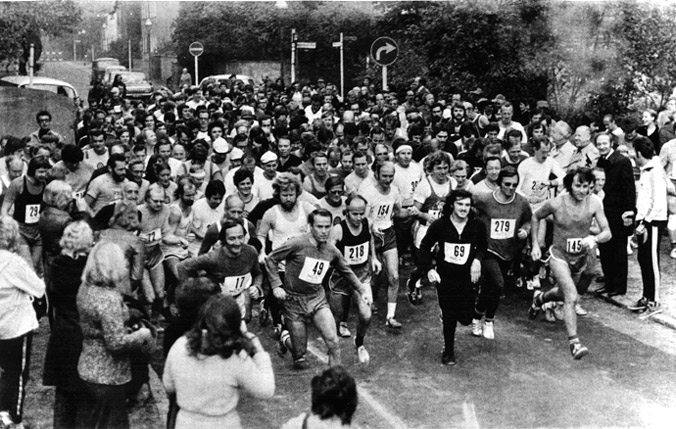
Start des1. Berlin-Marathon 13.10.1974 - Waldschulallee 80 © -Foto: privat
Horst Milde is turning seventy-five – The „inventor of the Berlin Marathon“ remains active with many ideas and activities during his „un-retirement“ as chairman of German Road Races (GRR) – by Wilfried Raatz
Horst Milde is turning seventy-five on October 24th 2013. He is considered to be the "inventor" of the Berlin Marathon, as well as a trendsetter for important events such as the cross-country race at Teufelsberg Mountain, the Women's Run in Tiergarten Park, the Half Marathon, and…and…and…
This interview with the chairman of the interest group German Road Races (GRR) developed more and more into a review of 50 years of the sport of running in Germany, which recently demonstrated how far it has come with the 10km German Road Race Championships put on by the German Athletic Association (DLV) on September 21 in Bobingen.
"For me, Horst is the father of the sport of running," commented the well-known manager who is responsible for signing top athletes, Christoph Kopp, about the very active and valued "doer" from Berlin. "What I find especially important is how he supported and promoted so many key developments…and he is still at it today!"
Christoph Kopp, who worked together with him in various positions since the 1980s, attributes one special characteristic to Horst: the ability to "not only have an eye on his own events, but to always be looking beyond them as well." Trained as a pastry chef and holding a business degree, the passionate runner from Berlin played a significant role in shaping the sport of running not only in Berlin and in Germany, but worldwide as well-through his untiring diligence, his great tenacity, and courage for innovation. "Horst Milde is on a first-name basis with the world of international running."
His own athletic career as a mid-distance runner includes a personal best of 1:49.8 in the 800m (1965), as well as two German Championship victories in the 3 x 1000m relay for SCC Berlin with Bodo Tümmler and Gerhard Kopp in 1964 and 1965. Horst was not able to develop into a world-class runner, however, as there was simply not enough time for effective training after spending an eight-hour day baking.
Even as a young man, however, Horst Milde was a master of multi-tasking. During his active running career, together with the sports department at the Free University of Berlin (FU Berlin) he organised the first Berlin Cross-Country Race. Influence by the clearly lasting experiences he had had as a participant at cross-country races in Le Mans/FRA (1964) and in Olympia/GRE (1965), Horst Milde was set on hosting a cross-country race in his hometown.
He wanted to put on an event in which "all Berliners could participate," but he faced opposition from the Berlin Athletics Association, which only wanted to allow athletes who belonged to clubs. But he planned and executed the event – and at its premiere in 1964, 700 (!) runners participated: students, running club members, and those just out running for fun. The race had prominent champions, with cross-country star Bodo Tümmler, who went on to become European Champion (1966) in the 1500m, winning the running club event, and world champion motor-paced cyclist Rainer Podlesch winning the "people's" race.
He also had the press on his side, and with his contacts with the Berlin daily newspapers, running found its place on the sports pages.
As a precursor to running groups, public training was offered near Teufelsberg Mountain, which caused as much of a stir as did the first "people's races," which Horst Milde admits were "really forest runs." In the end, it took ten more years after the first cross-country race for Horst Milde, who had since taken on the responsibilities for the "public race" sector of the Berlin Athletics Association and the "popular sport" area for LSB Berlin, to organise the first marathon race with the help of a few others.
Milde announced "his" first marathon with ads in running magazines ("which was also a first!") and 286 participants signed up. There were 244 finishers, which was way above the standard at the time. "The prior year the Association had organised a marathon race in front of their offices, which had 90 participants. I thought to myself: I can do better!"
The premiere of the Berlin Marathon was set for October 13, 1974, with a two-loop course laid out far away from the action of the city, leading from Mommsen Stadium into the forest along the AVUS highway, with the turning point at the Wannsee beach. "Of course we were lacking experience, but our volunteers were euphoric. There were two water stations with salt tablets, and at the finish we served hot broth!" Horst Milde recalled, thinking about the sumptuous treats that are currently offered along the courses and at the finishes of today's marathon races.
In the same breath he stated: "And we wrote in our announcement: ‘No marathon without training!'" Then and now, that has always been an important creed for the once mid-distance runner and later organiser. Seven German Championships were carried out under his leadership (including three marathon and two German cross-country championships.)
The Berlin Marathon really took off in 1981, when it was relocated into the city centre and ultimately to the Brandenburg Gate in 2003. Despite or maybe due to the permanent battles with the regulatory agencies, the marathon came out the winner. The city marathon made its breakthrough with 3,200 runners and 100,000 spectators, a victory for Milde and Co. He ran the marathon himself eight times, with his premiere in New York, followed by London and Boston. "I simply did not have time for more-with a bakery with 20 employees, three children and a garden…" Horst Milde said with his typical Berlin humour.
The Berlin Marathon quickly became one of the giants in the running scene, with great numbers of participants and many world records. "Never in my dreams could I have imagined this development. Unlike today, everything we did was as volunteers, always looking with big eyes at how Fred Lebow was doing things in New York City!"
That is, until politics entered the game…and in 1990, three days before Reunification of Germany, 25,000 people ran through East and West Berlin. Steve Moneghetti of Australia celebrated an amazing victory with the first time ever under 2:10 (2:08:16), while Uta Pippig, who was from the east side of the city that had been divided up until then, prevailed in the women's race with (2:28:37).
These were emotional moments, also for Race Director Horst Milde, who had travelled the world on marathon business. He had worked as the head of the event organisation and later director of SCC EVENTS for forty years, until – as Horst Milde described it – he "decided to stop at age 65 and resigned."
Horst Milde's diverse activities were not limited during the era of the divided city to the head of the SCC athletics department (1969 -1982) or to the position as head of the "people's races" department for the Berlin Athletics Association. In 1994, together with other great personalities from the event scene such as Wolfgang Kucklick (Hamburg), he helped found German Road Races (GRR), the interest group of the major German events, and in 1998 he was elected to the board of AIMS.
Horst Milde certainly belongs to a species of functionaries that is very rare in its intensity today, with volunteerism being of utmost importance. "I was a pure amateur organiser. I even paid my telephone charges myself! Of course, that would hardly be possible in today's world with all of the diverse demands!"
With his family supporting him at his side – his athletic wife Sabine and their three children, Karsten, Mark and Gesine – the "idea factory" never ran low materials.
Only after he sold his pastry shop in 1998 was Horst hired as the director of SCC Events. Now, as a "retiree", Horst Milde is as busy as ever. As the chairman of GRR, he leads the interest group of currently over 60 event organisers, manages the unique bilingual (German/English) German Road Races (GRR) website (www.germanroadraces.de) and continues to push for advancements in the sport of running. And his great wealth of experience continues to be treasured by the committee for running at the German Athletics Association (DLV).
Horst Milde, amidst all the recognition, also has space for critique. "I still do not understand why we did not allow women to compete in the cross-country events in 1964-65." There is room for some critique of his successors as well: "Unfortunately, the work that our generation did does not always get the appreciation it deserves. What we created as pioneers and visionaries is exemplary!"
What would head organiser Horst Milde do differently today? Indisputably, he did many things, if not almost everything, right. "All in all, our events pretty much sold themselves. In addition to the cross-country race and the Berlin Marathon, we established the half marathon, the AVON women's run and the team relay (5 x 5km), the City race on boulevard Kurfürstendamm (10k) as high-quality events, and under my leadership we put on well over 300 events with 1.3 million participants.
We were actually able to provoke the population to think about their own health with this idea of running. We succeeded in integrating handicapped athletes with competitions for wheelchairs athletes and hand cyclists. We got the youth involved with the creation of the Mini Marathon (4.2km) with 10,000 Berlin kids, which has become an event of its own within the framework of the Berlin Marathon."
With Horst Milde's input, the Berlin Marathon has been a trendsetter in many areas: The ChampionChip was put into action for the first time in the world on September 25, 1994 on the course that ran between the Reichstag and Kurfürstendamm; non-denominational services were held as part of the supporting programme; the marathon expo was started; and he helped introduce the Breakfast Run, the Bambini Race, the kids drawing competition, the Berlin Marathon Jubilee Club, film/theatre premiers, the literature marathon, the inline skating race (since 1997) – the biggest in the world – , the elaborate emergency system that was developed together with the Berlin Fire Department, as well as the medical symposia and forums with legendary race doctor Dr. Willy Heepe.
Horst Milde's advice is still sought after both nationally and internationally. Through his initiative, the IAAF was convinced to move the Olympic and World Championship marathon races into the public eye of the host city centres, rather than through bleak countrysides with the starts and finishes occurring in empty stadiums (initiated in Berlin (2009), followed by London (2012) and Moscow (2013).
He brought the Berlin Marathon into the elite group of the World Marathon Majors (WMM), and the Berlin Marathon was crowned "Marathon of the Decade" by AIMS, due to the great number of world records set there. The Berlin Marathon is also one of the founding members (in 1982) of the Association of International Marathons and Distance Races (AIMS).
For the past six years he has been chairman of the AIMS Symposium that meets annually in November in Athens and Marathon, Greece – in conjunction with the Athens Classic Marathon. The AIMS Marathon Museum of Running at the Berlin Sports Museum in the Olympic Park was founded under his initiative in 1994, which has since become a jewel in the landscape of museums for running and athletics.
You could fill volumes with anecdotes from his intensive era as an event organiser, as Horst Milde is also a charming storyteller. "There are 1000 things that are all unique in their own ways. Like the New Year's Race in 1990, a non-competitive run with 20,000 participants leading through East and West Berlin. Or the …"
Happy 75th Birthday!
Your fellow GRR event organisers around the world!
Wilfried Raatz
Related Content:
